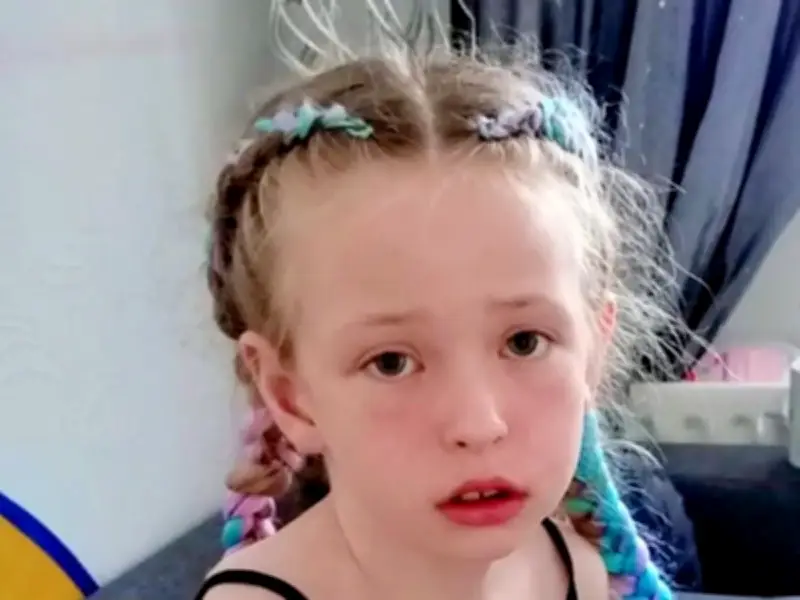
A schoolgirl who collapsed on the way to school was later diagnosed with a rare and serious heart condition. Gracie Doyle, 9, from Belfast, was diagnosed with pulmonary hypertension in May 2024, after years of her parents believing she suffered from asthma.
By spring 2024 her condition had worsened – she became breathless and fatigued and complained of pain in her legs and head, before she fainted on the way to school with her father. The following week she collapsed again, this time at school, and had a seizure.
Diagnosis and transfer to GOSH
After rushing Gracie to hospital, her parents were told she had pulmonary hypertension, a condition defined by the NHS as high blood pressure in the blood vessels that supply the lungs which can damage the right side of the heart, and that she might need a heart transplant, a lung transplant, or both.
Her care was transferred to Great Ormond Street Hospital (GOSH) in London. While Gracie was initially “afraid of everything”, her parents said working with play specialists at the hospital – who use toys like Playmobil and Lego to explain complex details about her condition – made her feel brave, to the point where she was able to have a heart procedure without general anaesthetic, which reduced the risk of complications.
Gracie’s mother Emily Doyle, 34, and father Gary McGann, 36, said Gracie “always had a very bad chest”. “She was always catching colds and chest infections, and the doctor had said that it was asthma,” Emily told PA Real Life. “But going on years after that, she was just kind of getting worse and losing a lot of weight. Always caught anything going about. Very breathless.”
The collapse and diagnosis
The family moved house around three months before Gracie got her diagnosis, to a new home at the top of a steep hill. “We’d noticed she was doing more walking and complaining a lot – her legs were sore and her head was sore – and we thought there’s no way. You’re a seven-year-old wee girl, really hyper and full of energy,” Emily continued. “But she was just declining and declining. More antibiotics, more inhalers, and then she fainted on the way to school one day with her dad.”
“We were walking to school one day, and she just collapsed,” Gary remembered. “I carried her to the side and started trying to do CPR, and trying to just wake her up and bring her around. So then we went to the hospital, they checked her, and they said that they couldn’t really see anything, so they sent us on our way. But a week later, the school rang to say that she had collapsed again, but this time she had a seizure.”
Gary and Emily took Gracie back to hospital, where doctors performed an ECG which uncovered an abnormal heart rhythm. She was diagnosed with pulmonary hypertension, and the doctors advised Gary and Emily that she may need a heart transplant, a lung transplant, or both, and that they were transferring her care to GOSH in London.
Treatment and recovery
According to the NHS, symptoms of pulmonary hypertension include shortness of breath, tiredness, feeling faint or dizzy, chest pain and a racing heartbeat. The condition is caused by high blood pressure in the pulmonary arteries, which cause the walls of the arteries to become thick and stiff, reducing their capacity to allow blood through. This makes it harder for the right side of the heart to pump blood through the arteries, causing it to become weaker, and can lead to heart failure.
After Gracie’s diagnosis in May 2024, she spent seven weeks at Great Ormond Street Hospital, and her parents said that the unit was “brilliant” with their daughter – particularly the specialists who are part of GOSH’s play team. “When Gracie was diagnosed, she was afraid of everything, and GOSH was great,” Emily said. “They always had someone there to come round and entertain her, and help her through everything. She went from being really scared to feeling really relaxed over there. She was there for seven weeks, and she didn’t want to come home, honestly! She really loved it. It’s such an amazing hospital.”
Gracie said that when she had a peripherally inserted central catheter fitted, the play specialist helped her feel safe and calm during the procedure. “I couldn’t do it without her,” said the nine-year-old. “If she wasn’t there, then I wouldn’t be able to do it. I wouldn’t be able to do anything if the play team wasn’t there.”
In June this year, Gracie had a procedure called a cardiac catheterisation, where a thin, flexible tube is inserted through a blood vessel – usually in the wrist or groin – to reach the heart. It can be used for diagnosis and treatment, and in Gracie’s case the procedure was to try a new kind of treatment. While it is usually done under general anaesthetic in children under 12, those with pulmonary hypertension can face additional risks when undergoing general anaesthetic.
Gracie was asked if she might be open to having the procedure while awake, with the play team at GOSH explaining how the procedure worked using Lego and Playmobil toys. “It helped me in every single way,” Gracie said. “I felt really happy about it, less worried – it was brilliant.”
During the procedure, doctors found that Gracie’s heart was doing better than they had feared – some of her cells were regenerating, her parents said, which showed her treatment is working. While Gracie needs ongoing treatment, her parents say she is mostly back to having the life a nine-year-old girl should. “She’s running about the streets, she’s able to play on her bike – things that we thought that she was never going to be able to do again,” said Gary.
Emily added that Gracie’s health battle has inspired her to become a nurse or a doctor when she grows up. “She’s really keen to learn, and to help others,” she said. “I'm super proud of Gracie.”