
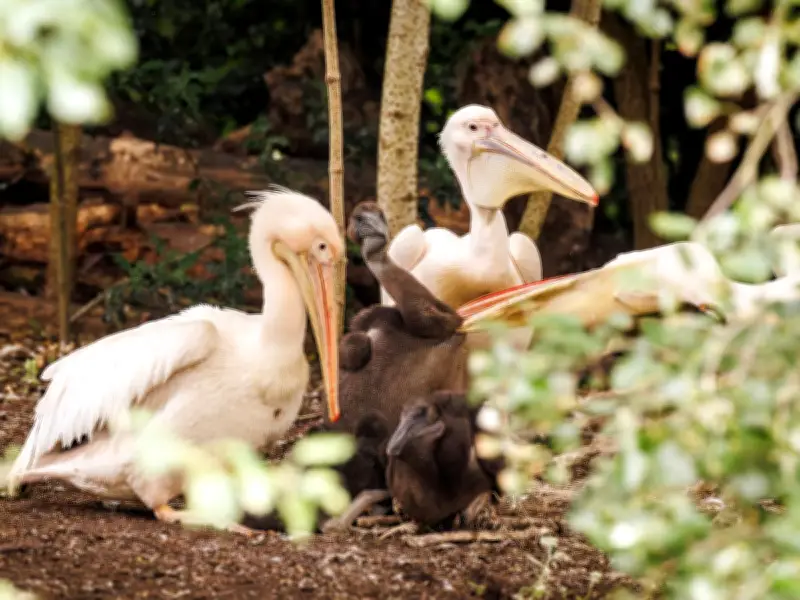
For the first time in its 360-year history, St James's Park in London has welcomed four pelican chicks, marking a milestone for the park's beloved bird population. The chicks, which hatched in spring 2026 after the adult pelicans were confined together on Duck Island due to avian flu precautions, are the first to be born in the park. Park manager Mark Wasilewski described the event as the fulfillment of his "wildest dreams."
Mischievous Flock Grows
Wasilewski, who has managed the park since 2002, noted that the current group of adult pelicans is "by far the most mischievous" and that the addition of the four youngsters will require the staff to adapt. "We're going to have to learn how to cope," he said. The park receives semi-regular phone calls from members of the public asking staff to collect pelicans that have wandered off.
The pelicans have been a fixture of St James's Park since 1664, when a pair was presented to King Charles II by the Russian Ambassador. They initially lived in an aviary on what is now Birdcage Walk. Over the centuries, more than 40 pelicans have called the park home, cared for originally by the keeper of the King's birds.
A History of Escapades and Diplomacy
Wasilewski maintains a detailed list of every pelican since 1897, which he describes as "basically a pelican list of births, marriages and deaths." The early history is sketchy, but the 20th century is well-documented. Pelicans arrived from Kew Gardens in 1903 and survived the First World War, during which the lake was partially drained for temporary wartime buildings.
In 1953, four American white pelicans were gifted by the governor of Louisiana. One died of heart failure on arrival, despite a "timely dram of whiskey" administered on the advice of the zoo curator. The other three took flight, unimpressed by their new home. Two were named Wilfred and Daphne; Daphne later became famous as the sole surviving pelican of the 1970s, known to parkgoers as the Lady of the Lake.
The American pelicans became a politically charged topic. In 1951, the Daily Express objected to the arrival of American brown pelicans with the headline: "Next thing we'll be having G.I.s on guard at Buckingham Palace." Those birds were a saltwater species unsuited to the freshwater lake and were replaced. The episode also had a Cold War dimension: the US ambassador, learning of the Russian origin of the park's pelicans, felt America could not be outdone. After the wrong species was sent, white pelicans were substituted and the two flocks lived together in peace.
Failed Breeding Attempts and Public Interest
Efforts to encourage breeding have a long history. In 1969, park bird-keeper Arthur May built a nest himself in an attempt to encourage mating, but it did not work. By 1995, the question of whether the pelicans would ever breed reached the House of Lords, where Lord Inglewood compared the pelicans' community to that of "monasteries and nunneries."
Formal naming of the birds began in 1977, when names for two pelicans gifted by the Russian ambassador were put to a public vote. Unusual suggestions like "Vodka and Lime" were submitted, but the chosen names were Astra and Khan. Astra was later transferred to London Zoo for "unsociable habits," specifically a tendency to eat pigeons. The pigeon problem resurfaced with other birds, causing public outrage; two pelicans were sent to the zoo in 1981 after complaints, and in 2006 one famously swallowed a live pigeon whole.
Escapology and Mischief
The flock is also known for escapology. In 1996, a man named Mr Soloman found a large white pelican in his driveway in Southend. After two to three weeks of the pelican showing no intention of leaving and running up a considerable bill in sprats, Mr Soloman asked the Royal Parks if they would take her. The bird, Gargi, was brought to St James's Park, where she has lived ever since. Gargi, around 30 years old, remains fully flight-capable and has been known to fly to London Zoo to steal fish before returning for her regular meals. During lockdown, she disappeared for several days and was later spotted in Staines upon Thames, but returned the following day.
The pelicans are free to roam the park, with no area considered out of bounds. Wasilewski notes that they often occupy park benches, pushing people off if necessary. They have been photographed outside Buckingham Palace and have wandered into Green Park and even as far as Northumberland Avenue, on the other side of Trafalgar Square, before being retrieved by a police officer from Scotland Yard stables.
Avian Flu Leads to Unprecedented Breeding
Avian flu precautions at the beginning of 2026 kept the pelicans isolated on Duck Island. When they were released in April, staff noticed they had started building nests. Wasilewski said: "When you're cooped up on Duck Island with nothing to do for several weeks, we know now what they do." The confinement achieved what 360 years of management had failed to do.
The four chicks are now a month old. Wasilewski and his staff are eagerly awaiting the day the youngsters are old enough to take to the water. "But if the adults we have now are a handful, just wait until these youngsters emerge. Life is going to be very interesting with these four," he said.
Pelicans in Numbers
- There are 6 adult pelicans in St James's Park: Isla, Tiffany, Gargi, Sun, Moon, and Star, plus the four new arrivals.
- They are great white pelicans living freely but managed within the park around Duck Island.
- Their wingspan can reach 3.5 metres.
- Their diet is mainly fresh fish (roach, herring, mackerel, whiting), and they eat between 1 and 2 kg per day.
- Most are wing-clipped (non-flying), except Gargi, who is fully flight-capable.
- They typically live 15–25 years in the wild but can exceed this in managed care.




