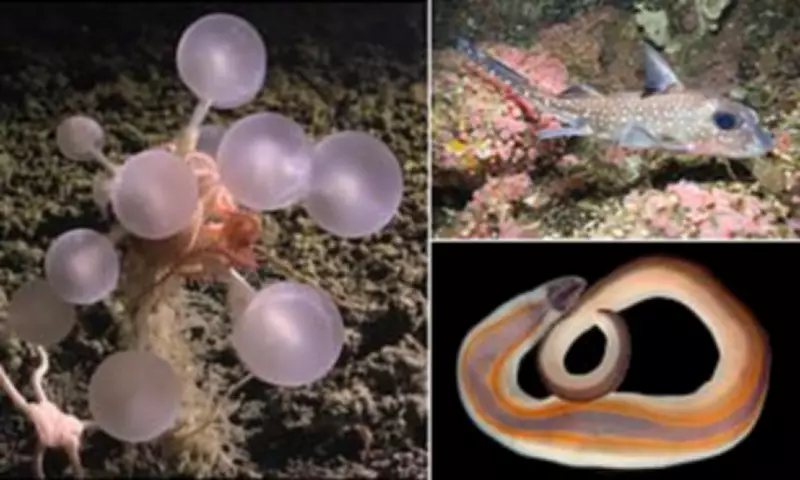
Scientists have identified more than 1,100 new marine species over the past year, including a carnivorous sponge with Velcro-like hooks, a translucent ghost shark with glowing eyes, and a worm that lives inside a glass sponge. These discoveries were made as part of the Ocean Census, an international initiative to catalogue marine life.
Ghost Shark Discovered in Australian Waters
One of the notable finds is a type of chimaera, or ghost shark, found more than 800 metres below the surface in the Australian Coral Sea marine park. Chimaeras are named after the mythical Greek beast, as they often appear to be assembled from parts of different fish.
Carnivorous Death Ball Sponge
Researchers also discovered a death ball sponge in the South Sandwich Islands, a remote chain of volcanic islands in the sub-Antarctic South Atlantic. Found at a depth of 3,601 metres, this carnivorous creature uses Velcro-like hooks to capture tiny crustaceans, which it then slowly digests.

Glass Castle Worm and Other Finds
Among the more unusual discoveries is a glass castle worm that lives in a symbiotic relationship with a glass sponge. Found 791 metres below the surface, the worm nestles within the sponge's translucent skeleton. Other new species include a sea anemone that burrows deep into the ocean floor and bright orange-banded shrimp living in a sea cave off the coast of France.
Ocean Census Initiative
The discoveries were made by researchers backed by the Nippon Foundation, Japan's largest philanthropic organisation, and Oxford-based charity Nekton. Scientists estimate that up to two million species may inhabit the world's oceans, which cover 70 per cent of Earth, but only 240,000 have been formally recognised so far.
Programme director Oliver Steeds emphasised the importance of exploring Earth's oceans: 'We spend billions searching for life on Mars or going to the dark side of the moon. Discovering the majority of life on our own planet, in our own ocean, costs a fraction of that. The question is not whether we can afford to do this. It is whether we can afford not to.'