
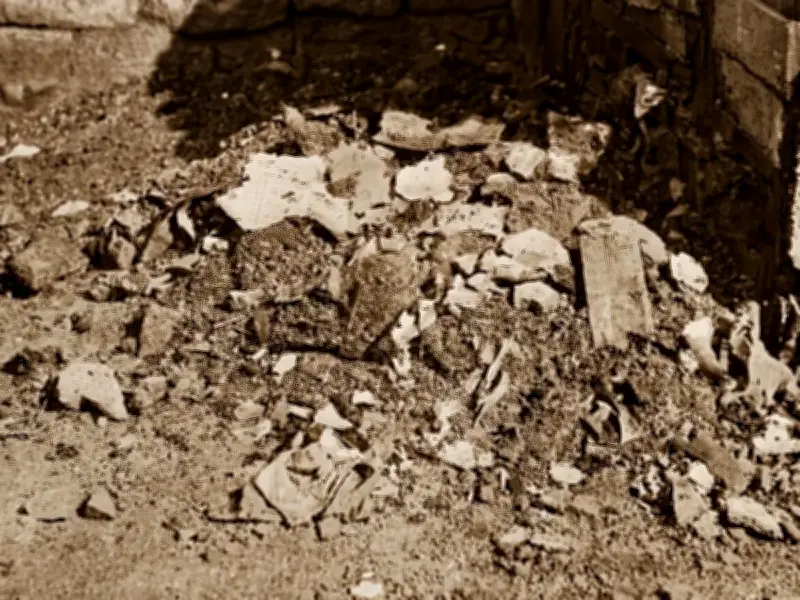
Historian Stephen Miller has uncovered photographs hidden in a 1905 magazine that capture the damage caused during a notorious haunting that turned a Lancashire village into a national sensation. The images, published in Wide World Magazine, show a damaged, blocked-up bedroom window and a pile of rubble scattered across the floor, offering a rare visual record of one of Lancashire's most intriguing paranormal mysteries.
In the summer of 1904, a house in Up Holland, Lancashire, became a national sensation, attracting thousands of sightseers. Night after night for weeks, a first-floor bedroom was the centre of unexplained chaos as heavy pieces of plaster, mortar, and stone were hurled across the room. The mystery was widely attributed to a poltergeist.
Disturbances in a family home
The disturbances began with knocks, bangs and strange tapping noises inside the home of widow Alice Winstanley, who had seven children, three girls and four boys. Her eldest daughter had moved out of the family home on Church Street, leaving Alice living with her remaining siblings. The house sat right next door to the White Lion pub and opposite St Thomas the Martyr Parish Church.
The situation became increasingly alarming when sections of an old, blocked-up window in her son's bedroom began to break apart, with pieces of masonry apparently flying across the room and into other parts of the house. One night, Alice's sons reportedly witnessed the material flying around their bedroom and were left terrified.
Alice turned to the police for help before approaching local councillors including Cllr Baxter and Cllr Bibby, who became involved in investigating the strange occurrences. Despite attempts to keep the matter quiet, news spread rapidly through the small village.
Crowds and competing explanations
For much of August 1904, hundreds and reportedly thousands of people gathered in the churchyard opposite the house, peering through its windows in the hope of witnessing something extraordinary. Stephen said the crowds became increasingly rowdy, with some treating the spectacle as an evening's entertainment, while psychic investigators sought access to the property.
The household was a far cry from the sensational image of a haunted house that developed around it. Alice was a 49-year-old widow whose husband had died a couple of years earlier. Her sons, who followed in their father's footsteps and worked in the coal mines, shared a small bedroom, while the family's younger daughters and their mother slept in another room.
As the story spread beyond Up Holland, competing explanations emerged. Sceptics suggested the boys might have been responsible, while others pointed to possible structural subsidence or vibrations from passing tractors. Those who believed the house was haunted had their own theory: that the disturbances were being caused by the spirit of George Lyon, a notorious local highwayman who was hanged in Lancaster in 1815.
Discovery of the photographs
Stephen, 42, who grew up near Blackburn and now lives in West Yorkshire, discovered the images while researching the case for his podcast, The Poltergeist Project. He had found references to pictures taken during the investigation but could not locate the images themselves. A report led him to Wide World Magazine, prompting him to track down a copy of the 1905 publication. Inside, he found photographs of two councillors involved in the investigation, alongside the images of the damaged window and rubble.
He compared them with images associated with other famous paranormal cases, including Borley Rectory in the 1930s and the Enfield poltergeist investigation in the 1970s. After searching for earlier examples and asking contacts in the field, Stephen was unable to find any photographs that predated the Up Holland images. He believes their significance has been overlooked partly because the magazine containing them gradually disappeared from view, while previous accounts of the case tended to treat it as an unusual piece of local history.
The house itself was eventually demolished in 1934 to make way for road widening, but Stephen hopes the discovery of the photographs will bring renewed attention to the national mystery.




