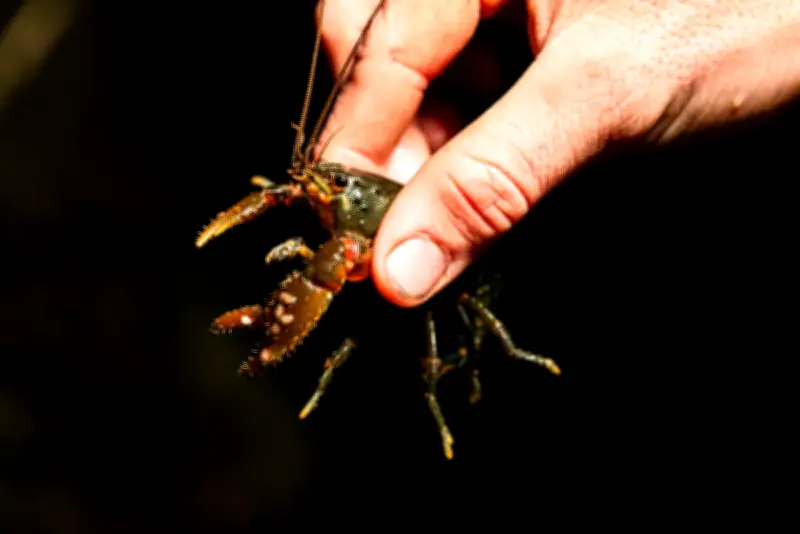
Nightfall comes early under the dense cloak of the rainforest canopy, and ecologist Ollie Scully—boots off and barefoot—wades through cool water with a torch, scouring the rocky bottom of a shallow creek. At an undisclosed spot in the hinterland of Queensland's Sunshine Coast, the search has been on for hours, with leeches and trip hazards aplenty. 'This will not be for the want of trying,' he shouts.
Then, picked out in the torch beam, a spiny crayfish appears. This relic of Australia's ancient past has inhabited the continent's freshwater habitats for tens of millions of years. 'It's a Conondale … one of the giants,' Scully says of the juvenile, about 15cm long. As he places her down, she rears up her claws in a defensive display, looking other-worldly. Her right claw is regrowing after a likely run-in with an eel—a predator that glided past Scully's legs minutes earlier. 'They can drop their claws in self-defence,' he explains.
Threatened Species
The Conondale spiny crayfish is one of 52 known species unique to Australia and is endangered. In 2019, only three appeared on the country's threatened species list; now there are 36, with more heading that way. Dr Nick Whiterod, an ecologist and crayfish expert at the Coorong Lower Lakes and Murray Mouth Research Centre and Adelaide University, notes that most Australians are unaware of them. 'People could be water skiing or whatever and have no idea there might be thousands of crayfish under their feet. But these guys are really threatened, and we've got concerns about their future.'
Rapid Environmental Change
Whiterod has studied spinies for decades and believes a coordinated national effort is needed to save them. 'They split off from marine crayfish and then from northern hemisphere crayfish about 100 million years ago. So they've been here a long time and have withstood everything Australia has thrown at them. But the rate of change is escalating in terms of climate, fire, and human habitat alteration in the last 200 years. A lot of species are not well adapted to cope with rapid change.'
Spinies can live for decades—some maybe 50 years—and are found across a massive range, from far north Queensland to South Australia, from rainforests to alpine bogs. They grow by moulting their hard shell and must survive at least five years before reproducing. Threats include feral pigs, foxes, poachers, and degradation of shady creeks. However, Whiterod says their main threat is climate change, which raises water temperatures, dries out creeks, and makes habitats more susceptible to bushfires. 'This is all conspiring to make them a highly threatened genus. We're assessing all species, and for all of them, there are worrying signs for extinction risk.'
The 2019-2020 bushfires scorched habitat for an estimated 40% of species. Fire can raise water temperatures that kill crayfish and strips shade from the canopy, causing further temperature rises. Scorched undergrowth can't hold sediments, so soils and ash flush into creeks. 'They can't physiologically cope and will just cook,' Whiterod says.
Conservation Efforts
WWF-Australia has funded scientific work leading to eight spinies being listed as critically endangered. Conservation scientist Dr Stuart Blanch says spinies are 'the canaries in the coalmine for many species living in the delicate ecosystems of our mountain streams.' He adds, 'The survival of spinies depends on transitioning away from fossil fuels and stabilising global temperature increases to no more than 1.5C.'
Scully first got interested in spinies while looking for threatened frogs. 'And then this huge rock just moved. It was this enormous crayfish. I'd never seen anything like it. I was instantly obsessed.' Whiterod says most scientists who study them get hooked similarly. 'They're not the obvious thing to get obsessed about—people usually go for the furry things—but they're incredibly captivating. They get under your skin.'
Rob McCormack, a research associate with the Carnegie Museum of Natural History, has been investigating spinies full-time for 20 years. He first got interested in the early 1980s while farming yabbies. 'Most people know the yabby, but the spinies are a different kettle of fish. I was looking at all these weird and wonderful species, mainly the Euastacus. They're incredibly long-lived—I could show my children a crayfish in a pool, and they could bring their children back and show them the same crayfish in the same pool.'
McCormack says spinies are 'the engines that drive the whole river system. They're not a species people should be catching and eating or putting in a fish tank. For one to reach maturity and replace an adult, it's maybe a 1,000 to one chance. So these are food sources for all other animals to live on. Healthy crayfish populations mean healthy streams.'
Both Whiterod and McCormack have witnessed major die-offs where sharp drought and fire killed whole populations—decades-old spinies gone in a flash. 'Given enough time, they should recover,' Whiterod says. 'But if that becomes a regular theme from climate change, then these populations are never going to recover.'