Viral Omaha Sinkhole Exposes Widespread Underground Crisis
A dramatic sinkhole that swallowed two vehicles in Omaha, Nebraska, captivated audiences worldwide through viral video footage. However, this incident represents just the tip of an iceberg, with hundreds of similar cave-ins occurring annually across the city, often escaping public notice.
The Pacific Street Collapse That Captured Global Attention
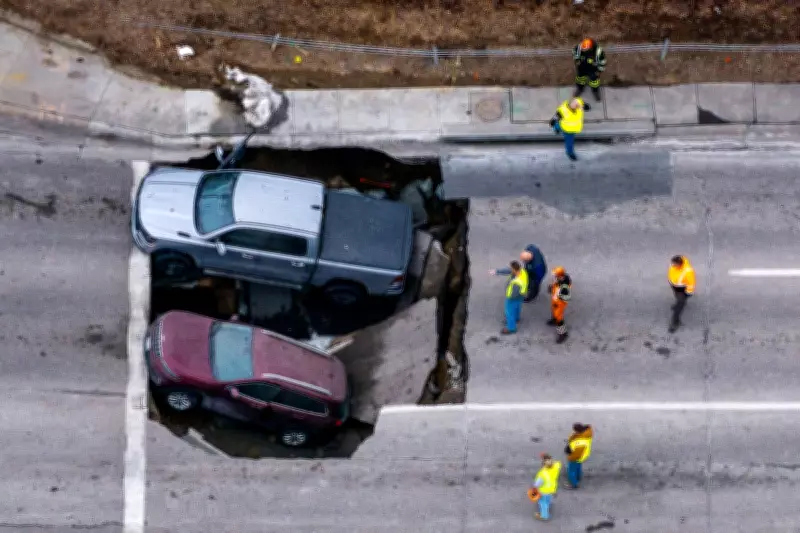
In February, retired geology professor Harmon Maher observed unusual orange sediment in a creek along Omaha's Keystone Trail. Hours later, his son alerted him to a catastrophic collapse on Pacific Street, where a section the size of a sand volleyball court gave way, consuming a silver Ram pickup and maroon Jeep Cherokee. The sediment Maher had noticed had washed out from beneath the roadway, creating a massive void.
"I was sorry I wasn't still teaching," Maher reflected. "I would've probably spent time in class saying, 'Look, here's the relevance. Here's geology in action. Here's a sinkhole.'"

Security camera footage of the moment the road collapsed quickly amassed millions of views internationally. Yet most of Omaha's sinkholes never achieve such virality.
Omaha's Unique Geological Vulnerability
Over the past five years, city work crews have documented more than 2,100 "cave-ins," ranging from minor pavement depressions to gaping chasms like the Pacific Street incident. According to a Flatwater Free Press analysis, Omaha experiences more cave-ins than several other Midwestern cities.
Geologists attribute this susceptibility to Omaha's soil composition. Much of the city rests atop fine-grained sediment called loess (pronounced "luss"), which water can easily erode, creating underground gaps.
"It's great for growing corn, but terrible for building roads," explained City Engineer Austin Rowser.
Unlike regions with karst topography like Florida's "Sinkhole Alley" or the Missouri Ozarks, Nebraska lacks significant dissolvable bedrock. State Geologist Matt Joeckel, a professor at the University of Nebraska-Lincoln, noted that Omaha's sinkholes are generally shallower and often result from human infrastructure interacting with the region's fine sediment.
"We're not going to have a situation in which a giant sinkhole suddenly appears and continues to grow and eat up a neighborhood," Joeckel assured.
Infrastructure and Water: A Dangerous Combination
When pipes break or sewers leak, water can carry away loess or fill dirt underground. Omaha's hilly terrain accelerates this erosion, according to Maher, who taught at the University of Nebraska at Omaha for four decades.
Rowser theorized the Pacific Street sinkhole began months earlier with a small leak in a Metropolitan Utilities District water main that infiltrated the storm sewer, creating an undetected void. Eventually, water pushed enough dirt into the sewer to form a massive cavity that collapsed under vehicle weight on February 24.
MUD has contested this explanation, arguing the city's damaged storm sewer caused the sinkhole and the water main broke afterward. This chicken-and-egg dispute has led both parties to file claims against each other for repair costs.
The Scale of Omaha's Cave-In Problem
Since 2021, Omaha has averaged over 400 cave-ins annually, with many appearing as slight dips in roads or sidewalks. The city ordered barricades for approximately 40% of these incidents, indicating surface hazards.
Warmer months see significantly more sinkholes than colder periods, as frozen soil resists erosion. This distinguishes them from potholes, which typically form during freeze-thaw cycles in late winter and early spring.
UNO geology professor Ashlee Dere expressed little surprise at Omaha's high cave-in rate, given its soil type, altered topography, and aging infrastructure.
"It's surprising in that it doesn't cause more problems," Dere remarked.
Memorable sinkholes dot Omaha's history, including a 2014 St. Mary's Avenue collapse that swallowed a car and injured its driver, and a downtown incident last year that consumed half a garbage truck on 16th Street.

Despite these events, Rowser emphasized that drivers face minimal risk, with the two Pacific Street motorists emerging unharmed. However, Joeckel stressed that local engineers must account for the rapidly eroding soil beneath their projects.
Detection and Prevention Efforts
Public Works crews investigate every cave-in report to prevent sinkhole formation. The process typically begins with injecting colored dye into pavement cracks. If dye appears in sewer water downstream, it indicates water and sediment leakage. Camera inspections then trace the water's path to identify entry points for repair.
When dye doesn't reach the sewer, animal burrows or dead tree roots might be the cause, requiring special concrete filling.
Reported cave-ins have decreased from over 500 in 2021 to about 340 last year, but aging underground infrastructure could increase future risks. The city is exploring new diagnostic methods, including fiber optic cables to detect water line leaks.
Joeckel suggested geological surveys could identify water concentration areas and potential trouble spots.
"It would be great if you could see what was going on below the surface before something happened," he said.
Rowser acknowledged uncertainty about what might have flagged the Pacific Street risk earlier. A dye test conducted late last year while investigating surface settlement showed no sewer breach.
Rapid Repair and Lasting Fame
Construction crews swiftly repaired pipes and filled the missing road section after the collapse, reopening Pacific Street just nine days after closure. By then, the sinkhole had achieved global fame, featuring in The New York Times, USA Today, Fox News, and international outlets from Belgium to Vietnam.
Rowser credited the UNO security camera footage for the incident's internet popularity.
"If a picture's worth a thousand words, I don't know what a video is worth," he mused. "It's got to be a lot more."
Maher suggested the clip's virality taps into fundamental human psychology.
"I suspect it has to do with the psychology of how we are intrigued by the unexpected," he observed. "It's unexpected that the ground that is so solid and firm beneath your feet just gives way."
This story was originally published by Flatwater Free Press and distributed through a partnership with The Associated Press.