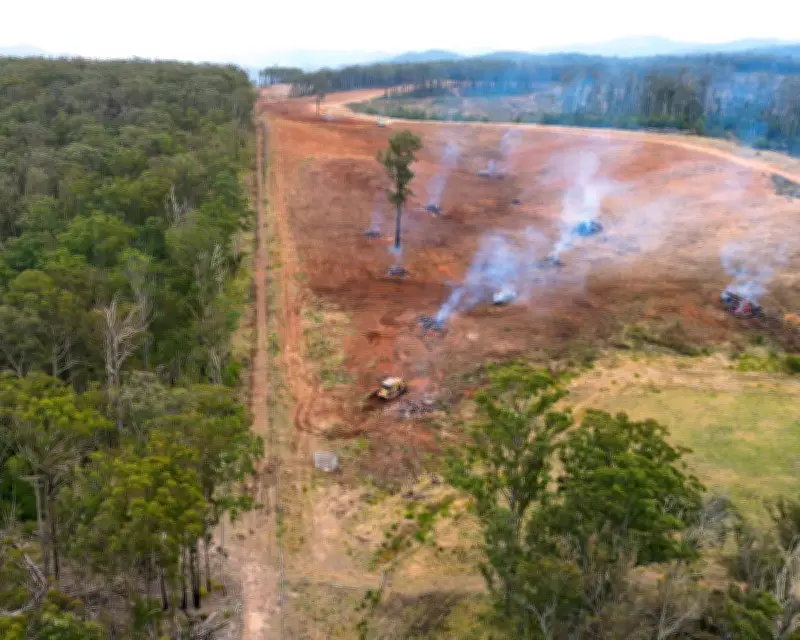
Almost 90 football fields’ worth of woody habitat were bulldozed in New South Wales every day in 2024, according to new government data which shows the state has failed to rein in high rates of clearing.
Clearing of vegetation across the state increased by 16% in 2024, reaching 81,293 hectares (200,879 acres) in total – an area more than 275 times the size of the Sydney CBD. The increase was due to a sharp jump in clearing of non-woody vegetation, up 70% on the previous year.
Environment groups criticise lack of action
Environment groups said the numbers, published in the annual Statewide Landcover and Tree Study (Slats) report on Tuesday, showed the Minns government had failed to deliver its promise to stem the state’s high rates of clearing.
“Given there’s been no policy change since the government were elected in 2023 it’s no surprise to see that land clearing hasn’t been fixed,” said Jacqui Mumford, chief executive of the Nature Conservation Council of NSW.
“It’s incredibly disappointing when they had a commitment to rein in land clearing that we’re still seeing such high rates.”
Woody vegetation clearing declines but still high
Land-clearing has been tracked in NSW for the past 20 years. The data is categorised into woody – meaning trees and shrubs – and non-woody vegetation, which includes ground cover plants, herbs and grasses.
In 2024, 24,103 hectares of woody vegetation was cleared, a decline on the previous year – when clearing skyrocketed to 32,837 hectares – and 19% below the 2018-2024 average of 29,800 hectares.
But WWF-Australia said the rate of woody habitat clearing was still too high and was the equivalent of clearing about 88 rugby league fields every day for a year.
“Every hectare of trees bulldozed means fewer homes for wildlife and more carbon pollution in the atmosphere,” said Dr Stuart Blanch, WWF-Australia’s forest policy manager.
Non-woody vegetation clearing surges
The data reveals a 16% increase in overall clearing due to a sharp jump in clearing of non-woody vegetation. In 2024, the amount of non-woody vegetation cleared reached at least 57,190 hectares, compared with at least 33,651 hectares the previous year. That figure was also 13% above the 2018-2024 average of 50,700 hectares.
Most of the clearing – 60% – was classified as “unallocated” meaning it did not have a permit, either because it did not require one or the clearing was unlawful. More than 80% of the clearing was for agriculture, while the remainder was for infrastructure and native forestry.
Calls for policy change
“The NSW premier, Chris Minns, promised to rein in land-clearing but he has failed to prioritise it and the result is a predictable one,” said the Australian Conservation Foundation’s Nathaniel Pelle.
“All of that vegetation was habitat for native animals and was sequestering carbon so those numbers tell a story of massive damage to nature and the climate in NSW.”
Mumford called on the government to fix the state’s vegetation rules, which were relaxed under the previous Coalition government in 2016. She also called for the government to scrap a specific clearing designation known as “invasive native species”. This classification allows landholders to clear native vegetation that has regrown in ways that are different to its original state. It accounted for 61% of authorised clearing – meaning clearing that had a permit – on rural regulated land in 2024, according to the data.
Mumford said the invasive native species classification was not a scientific classification and “allows landholders to clear native vegetation under the guise of invasive native species”.
“It’s one of the key drivers of land-clearing and habitat loss in NSW and that classification needs to be removed,” she said.
On Tuesday the NSW Greens said they would introduce a private members’ bill to repeal the former Coalition government’s changes to native vegetation laws and address the state’s “runaway” land-clearing when parliament resumes. “Half of the current Labor cabinet lined up to slam these laws when they were introduced, so what is stopping them from fixing them?” the Greens environment spokesperson, Sue Higginson, said.