
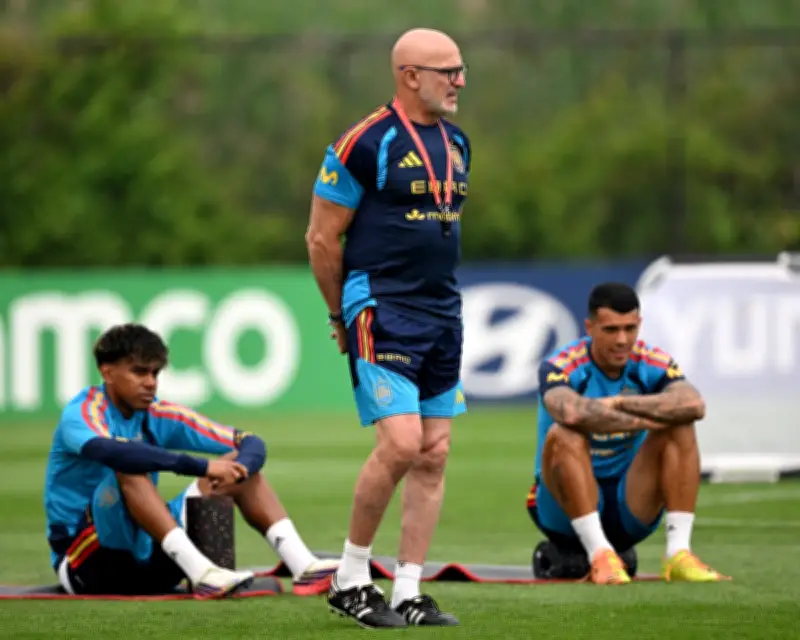
Spain's footballing culture, spearheaded by the visionary Johan Cruyff, has established the nation as a global leader in the sport. Cruyff introduced the 4-3-3 formation and a specific ideology to Barcelona, which was later refined by tactical purists like Pep Guardiola and Unai Emery. This philosophy has defined the playing style of the entire league, all youth squads, and the national team for nearly two decades. Its principles include ball-oriented defending, clearly defined positions and roles, a high level of organisation, and technical, combination-based football. Eleven players operate as a unit, moving like a swarm.
Luis de la Fuente's Embodiment of the Philosophy
Spain's head coach, Luis de la Fuente, has internalised this guiding philosophy. He spent decades working in youth development at club and federation level, and his assistants are longtime associates. On the pitch, this style is embodied by Rodri, widely regarded as the world's best player. Spanish idealism triumphed over French individual brilliance in the semi-final, with Spain's superiority perfectly illustrated by the goal that made it 2–0, when full-back Pedro Porro slotted home unmarked inside the penalty area.
Spain's Dominance and Influence
Spain exerts influence across its continent because of its dominance. The nation has won three of the past five European Championships (2008, 2012, 2024) and is, by a wide margin, the most successful country in European club competitions this century. Spanish coaches are in high demand across top leagues, having exported their ideas throughout Europe for years. The women's team are also world champions. The World Cup has underscored the fact that the global style of football is largely shaped by a Spanish-dominated Europe. At present, almost all of the international elite look to the models established by Barcelona, Paris Saint-Germain, and Arsenal. Wherever a coach follows this guiding principle, sporting progress ensues, confirming an age-old maxim: the quality of the coaches determines the quality of the sport.
Global Alignment with Elite Coaching
It is not true that coaching methods have changed globally; rather, there is an alignment with the elite level. This applies to France, especially since Luis Enrique moulded PSG into the best club in Europe. Didier Deschamps has long embodied this philosophy, and although he didn't quite make it to a third consecutive World Cup final, he is handing over a team with a promising future. England's squad benefits from the Premier League, the world's strongest league, which is highly international. The team are physically imposing and battle-hardened. Leaders Jude Bellingham and Harry Kane stepped up, aiming to achieve immortality after a 60-year wait. In the semi-final, however, their opponents' stronger sense of identity prevailed.
Success Through Philosophy and Individual Quality
Success follows where, beyond a guiding philosophy, there is outstanding individual quality, as seen in Norway with Erling Haaland and Martin Ødegaard. Even when such talent is lacking, teams that adhere to the principles of a clear philosophy remain competitive. Canada (Jesse Marsch), the USA (Mauricio Pochettino), and Ghana (Carlos Queiroz) hired coaches with experience in Europe. This trend is extending to Brazil (Carlo Ancelotti), where the unique abundance of talent from the past has faded. Morocco benefit from having a large portion of their squad trained in European academies or playing in top European leagues. Tactically, the team are no different from Europe's elite sides. Other African teams, too, defend compactly, operate with structure out of possession, and are difficult to beat.
European Dominance in the World Cup
At this tournament, six of the quarter-finalists were from Europe. From the starting lineups, 84 of 88 players were under contract with European clubs last season. The other four played in Europe before moving to a different continent after the age of 30, Lionel Messi among them. With the exception of one penalty, every goalscorer from the winning teams in the quarter-finals and semi-finals plays for a club that has reached a Champions League final in the past decade: Real Madrid, PSG, Arsenal, Liverpool, Atlético Madrid, Inter Milan, Chelsea, and Tottenham. True excellence is forged in Europe.
Argentina's Distinct Identity
However, it is quite possible the world champion will come from South America for the second time in a row. Argentina also set a model: defensive, focused on physical duels, and prioritising security. Football as an existential struggle is deeply rooted in their culture. With the exception of Brazil, all South American teams were managed by Argentinian coaches. The prime example is Lionel Scaloni, who could become the first coach since the Italian Vittorio Pozzo in 1938 to successfully defend a World Cup title. Scaloni spent 10 years as a professional in Spain, where he took his first steps as an assistant coach. He was mentored by De la Fuente, the man he will face in the final. It is a small world in football.




