
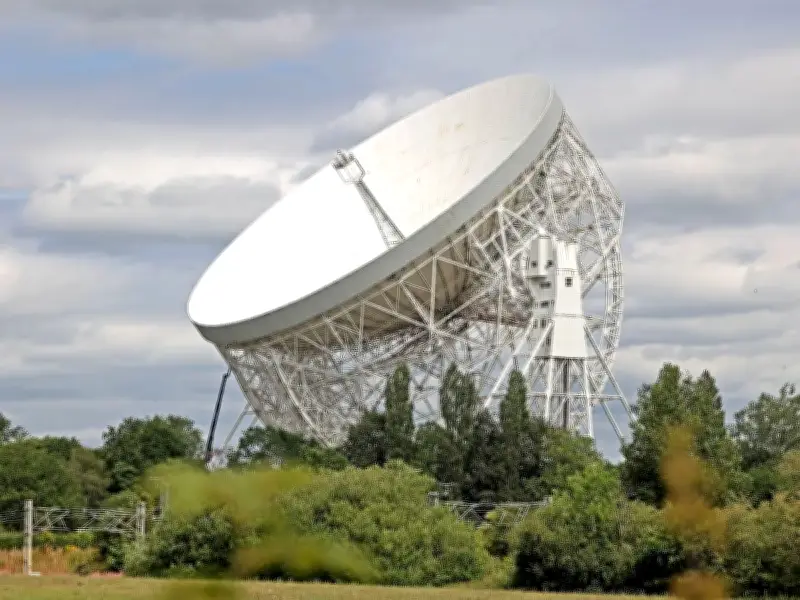
The Government has promised a "secure future" for Jodrell Bank, following a Manchester Evening News campaign to save space science at the iconic observatory and Lovell Telescope.
It comes after the future of the near 70-year-old telescope in Cheshire came under threat after funding cuts were announced in July.
Business Secretary Jonathan Reynolds had today (Thursday, October 15) confirmed the government is "exploring" long-term options for the UK's largest telescope.
He said he recently met representatives from the University of Manchester, which runs the project, in the hope of finding a solution.
The major update comes as the M.E.N campaign to save science at Jodrell Bank has now reached more than 10,500 signatures.
Government commitment to Jodrell Bank
Addressing the Commons on Thursday (October 15), Mr Reynolds said: "The Prime Minister and I have been clear that Jodrell Bank has a secure future."
He was responding to Gorton and Denton MP Hannah Spencer, who said the closure of the e-Merlin telescope - the lead of a network of telescopes up and down the country carrying out scientific research in deep space - will put jobs at risk.
The Green MP said: "Many of us went there on school trips as kids, and the Prime Minister assured us that his Government will find a funding solution."
"So will the Secretary of State explain how the Government intends to honour this heartfelt commitment and secure Jodrell Bank’s long-term future as an active sovereign scientific facility?"
Science-based decision and funding details
Mr Reynolds said there has been a "science-based decision" to move from e-Merlin telescope to the Square Kilometre Array, an intergovernmental project headquartered at Jodrell Bank but largely built in Australia and South Africa.
He added: "It’s important, given that we have a very significant R&D budget in the UK, that scientific decisions are made on the basis of the science."
"But that still doesn’t mean there isn’t a future for Jodrell Bank as an asset. That is consistent with making sure we’re making science-based decisions on the prioritisation of that funding."
"I met with the University of Manchester just a few days ago about this, and the local MPs of the area have been incredibly supportive in finding a solution. I hope to have more to say soon on that."
UK Research and Innovation (UKRI) said in July this year that the observatory will not be prioritised for further funding after its current agreement ends in March 2028. The annual grant to the facility is worth some £2.8m a year.
Bosses at the University of Manchester said the funding cut would mean the end of the Lovell Telescope as an "active scientific instrument for radio astronomy" by March 2028 and the loss of 28 jobs employed by the e-Merlin grant.
Support and legacy
After the M.E.N launched a petition to save the facility, Jodrell Bank's associate director Tim O'Brien said he had been very thankful of the support. The astronomer said he was hopeful of finding "a solution" so that vital scientific work could go on at Jodrell Bank.
He said: "We are delighted that the M.E.N. is campaigning on our behalf. It’s a very difficult time for us here, but what is really helping is all the love and messages of support we are receiving."
"We are blown away and very grateful to everybody. Hopefully some solution can be found that will enable this special place to keep watching the skies."
In September, Prime Minister Andy Burnham pledged he would find a way to save the telescope.
He told the M.E.N: "Every one of my generation went on a school trip to Jodrell Bank. You stood underneath that telescope, you looked up in awe, I want tens of thousands more kids to have that moment."
"Jodrell Bank is a heritage asset for this country as well as a research asset, and its demise will not happen under my Government. I gave that commitment at the despatch box and I am giving it again here."
"And I want to thank the readers of the Manchester Evening News, and all those in the North West, who signed the petition because they feel, passionately, that Jodrell Bank belongs to them. You have been heard in Downing Street. And that is why I am committed to find a way to save Jodrell Bank, working with the University of Manchester, with the Congleton and Macclesfield MPs, and through Number 10 North."
Since 1957, the Lovell Telescope has been the largest telescope in the UK and the world's third largest steerable radio telescope.
In 1966, the first images taken from the surface of the Moon were received at Jodrell Bank. It went on to play a key covert role in the Cold War. For five years at the height of the tensions, Jodrell Bank was relied upon to give a four-minute warning of an impending nuclear attack.
In the decades since, the observatory has studied distant galaxies and helped to discover objects and phenomena including black holes, quasars, pulsars and gravitational lenses.




