
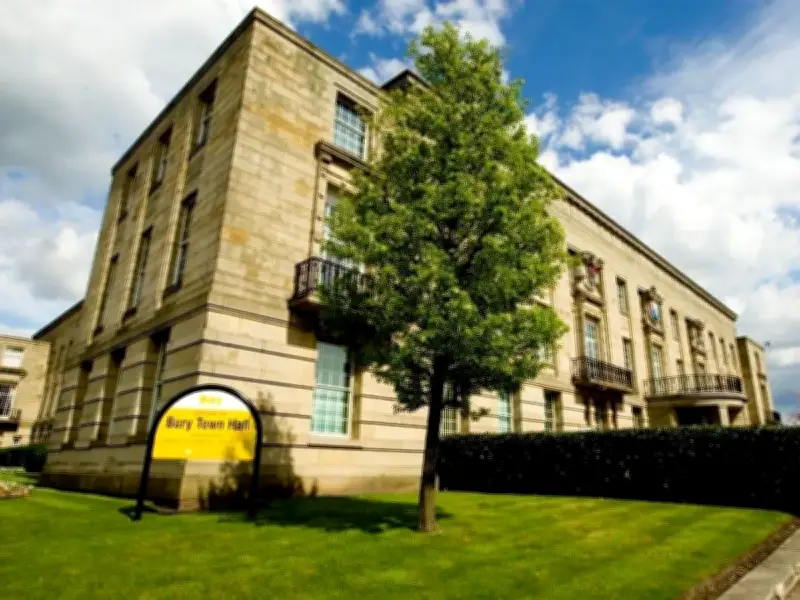
Bury council has confirmed that leaders will enter a conversation with the Government regarding its financial difficulties. Cabinet members signed off on starting the discussion on Wednesday, October 14.
Last week, it was revealed the authority requires Exceptional Financial Support (EFS) to balance its books for the coming years – something councils are legally required to do. EFS allows town halls greater flexibility when it comes to meeting expenses.
What EFS could involve
This can be achieved in a number of ways, including higher council tax increases, permission to borrow and flexibility with capital receipts - money generated through asset sales. The local authority is currently facing a £9.6m budget gap next year, rising to £17.5m in three years.
Finance lead Sean Thorpe told councillors: "This year brings us to a quite a serious situation in terms of our budget setting in the sense that, whereas in the past we've been able to rely on reserves to be able to supplement any gap, we don't think we can any longer do that [...] Over the next couple of years we're going to have to have some flexibility to be able to manage our budget."
Savings proposals under consideration
The council is also looking at ways of increasing income and cutting costs, with several proposals being considered to achieve this. These include additional waste charges, changes to leisure fees, cuts to school crossing patrols, trimming or dimming street lighting and potentially removing the payment cap for people who receive homecare through the council.
Leaders had also been considering cuts to youth service provision, but revealed this week that this option was no longer on the table. Coun Thorpe said the Government's new Families First initiative, which looks to better integrate children's social care, early intervention and child protection services, would allow them to maintain funding in this area.
Council tax and wages questioned
Members of the Overview and Scrutiny Committee grilled finance heads on the EFS proposals on Tuesday, October 13. Questions ranged from potential cuts in staff pay and council tax hikes to the potential safety and funding consequences of the proposed cuts.
Reform councillor Shadman Zaman asked Coun Thorpe about potential council tax increases, branding EFS a 'bailout' and calling on leaders to rule out an above 4.99pc hike in the charge. While Coun Thorpe said he could not fully rule out that eventuality, he stressed it was not something leaders 'were seeking'.
He said: "I can't rule out whether the government will impose [it] on us, but I think it's a really remote possibility. It's the most unlikely of the scenarios and it's certainly not one that we're going to the government and saying this is our silver bullet, increasing council tax. Clearly, it'd have a massive impact on people and the cost of living and it wouldn't really help us."
Capital receipts and living wage
The council believes the best solution for its situation is additional flexibility when it comes to using capital receipts – money generated from sale of assets. This would allow that money, usually ringfenced for capital projects, to support day-to-day service costs instead, with the council believing it is also the option that would have the 'least impact' on residents.
He was also asked whether the council had considered moving away from paying employees the Real Living Wage and reducing to National Living Wage levels. This was put forward as a potential way of saving staff jobs given the authority is currently working through a voluntary redundancy process.
The committee was told this had been a 'major consideration' when leaders were looking at savings proposals, but ultimately was decided against. This was in part due to the 'morality of impacting the lowest paid workers', Coun Thorpe said. However, he added moving to a National Living Wage approach could save in the region of £3.7m, depending on contractual arrangements and would impact around 3,000 social care workers.
He added: "So, we're conscious of the impact, we're conscious of the significance of the decision. And, the decision we've made at the moment, we know we may have to revisit as well."
Concerns over safety and green waste charges
Committee members raised concerns about the safety implications of cuts to school crossing patrols and street lighting. Councillors also questioned whether the proposed savings had been fully costed to account for unintended consequences.
Of particular concern was the proposal to charge for green waste collections. Radcliffe First councillor Carol Birchmore questioned whether this could result in the council losing money through increased fly-tipping and lower recycling. Coun Thorpe said there was a possibility that the costs could be higher than the income, but the proposal had to be looked at as an option. The details would be teased out through the consultation process, he said, with the council then judging whether it would 'wash its face'.
He added: "We've got some misgivings about this, but we've got some misgivings about a lot of it. We have to leave no stone unturned." He later clarified he considered losing money through this proposal to be unlikely.
Council defends its record
Political leads at the council were also keen to stress they consider themselves to be a 'well-run' council, blaming the current difficulties on a mix of low income and increasing demand in health and social care services.
Coun Thorpe said: "This is a council that's well run, that delivers improvement where it needs to deliver improvements, particularly in children's and adult social care, that delivers in terms of the ability to deploy our services where we need to [...] All over the borough we are regenerating our economy, delivering services where we need to. In that context, the difficulties we're having financially are a testament to a broader systemic issue."
This claim has been met with scorn from some in the opposition, however, with Reform UK councillors accusing leaders of 'sugarcoating' the situation while at the same time 'taking action to avoid the risk of bankruptcy'.




