
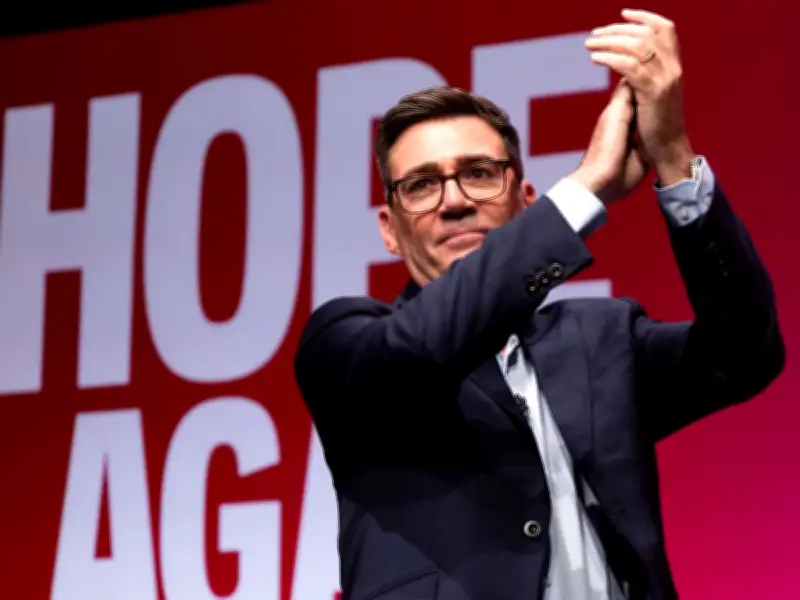
Prime Minister Andy Burnham has announced a major shake-up to how State Pension increases are calculated from 2030. The government will adjust the pensions triple lock to help fund adult social care reforms in England.
Speaking at his first conference as Prime Minister, Mr Burnham said pensions would rise either by CPI (Consumer Prices Index) inflation, or a minimum of 2.5%, removing the link to average earnings. The Labour leader explained this would aim to help save “significant” savings. Under the plans, the state pension could still rise by more than inflation or 2.5% in some years, to keep its value relative to average worker earnings.
Triple lock promise honoured
The Prime Minister will honour the manifesto promise to keep the triple lock unchanged throughout this Parliament. Mr Burnham said: “We promised in the last parliament to keep the triple lock unchanged until the next parliament, I will honour that promise and I will do more.
“That promise will take the State Pension to a record high. In April 2030, we will adjust it. The state pension will continue to rise every year, by the right prices or 2.5%. It will hold its value relative to earnings over time.”
Expert reaction
Jonathan Cribb, deputy director at the Institute for Fiscal Studies (IFS), said: “For pensioners, the reform means that state pensions will still rise in real terms over time but more slowly than under the current system, and in the long run their pensions will keep pace with growth in employees’ average earnings.
“While increasing the state pension in line with inflation in years where inflation is high has a rationale – to protect state pensions against high inflation – the minimum 2.5% increase each year remains an arbitrary and potentially costly part of the system.”
He added: “Although it no longer permanently ratchets up expenditure, it will still lead to some years, potentially many years, of higher state pension expenditure, most likely in years of low inflation, compared to if this part of the system had been removed.”
Union criticism and National Care Service
Before Mr Burnham's speech, the leader of trade union Unite, Sharon Graham, told BBC Radio 4's Today programme: “Instead of going and trying to pick the pocket of pensioners, we need to move over to the other side of the equation and look at things like wealth taxes, way before we try to stop something like the triple lock.”
A landmark policy “as significant” as the creation of the NHS itself has been announced by the Labour leader. The National Care Service will be introduced in the next parliament. It will be fully funded and not through borrowing, according to the Prime Minister.
Setting out his plans for a new National Care Service, Mr Burnham said he wanted to build a “national consensus” around plans being drawn up following a consultation by Baroness Louise Casey.
He said: “I accept I may pay a political price. But someone has to go through the pain barrier and rip the plaster off. This change will generate significant savings which we will use to build up our National Care Service.”




