
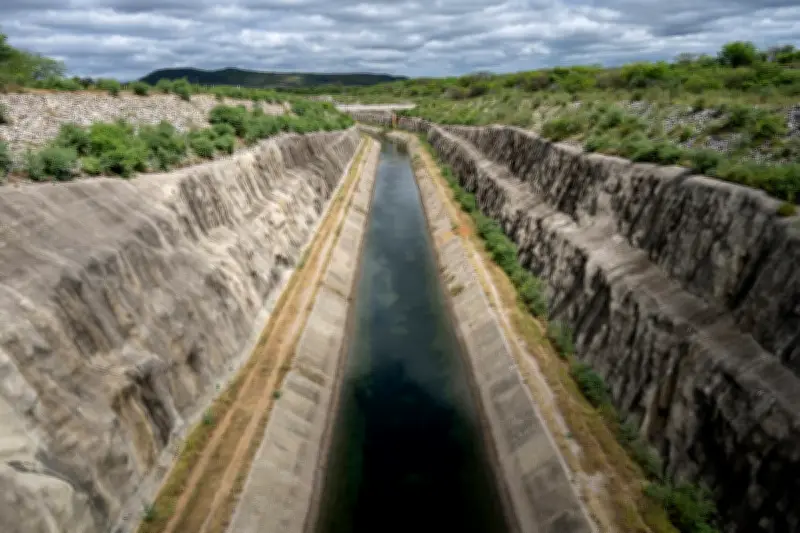
A concrete canal cutting through the Caatinga scrubland feeds a surface reservoir two and a half miles from Maria de Fátima Ferreira da Silva’s home in rural Brazil. The canal passes Sertânia and continues until it reaches Monteiro, where it spills into the Paraíba River. Such proximity to a reliable water source would usually be considered a blessing in the sertão, but not for Ferreira, who was displaced nearly 20 years ago by the construction of the canal and now lives without any water supply.
“There’s no water; what are we supposed to do without water?” says the 54-year-old, who depends on what she can grow on her smallholding. The canal and reservoir are part of a hydrological supply system: the diversion of the 1,700-mile-long São Francisco River, which provides 70% of the north-east’s water supply.
Impact on displaced communities
While the government says the diversion provides water security to 12 million people, some question its success, especially for the most affected communities. “In my view, the diversion has not been beneficial. It caused immense damage to the donor basin while yielding little effectiveness for the sertão,” says Janaína Andrade, a regional prosecutor for citizen rights in Paraíba state.
Construction of the £2.1bn scheme began in 2007, requiring the expropriation of about 2,000 properties. The 848 most vulnerable families were relocated to 18 planned neighbourhoods known as “productive rural villages” (VPRs), like Vila Salão where Ferreira lives. Each family received a three-bedroom house and a few hectares of land, plus financial support.
Yet Vila Salão lacks running water and sewage services, and communal buildings stand abandoned. “People were relocated to the productive village – but without water. They had no water for human consumption, for their livestock or for agricultural production,” Andrade says.
Stories of loss and adaptation
Ferreira cannot afford to dig a well, so she bathes at the reservoir and collects water for her crops and donkey, paying for drinking water monthly. “Things were better before,” she says. In Vila Lafayette, a VPR with better conditions, Maria de Lourdes Souza da Silva, 64, recalls how her mother died shortly after being told to leave her home. “That was where we were raised, where our roots were,” she says.
Agnaldo Freitas da Silva, vice-president of Lafayette’s residents’ association, campaigned for water access. “I said: ‘I’m not going to let it go; the state government has to give us water.’” The association’s persistence led to Lafayette being the first VPR connected to mains water and irrigation. Freitas now grows fruit and vegetables, keeping chickens and fish. “Today we’re all rich; we have what we need,” he says.
In Vila Salão, residents lack unity, says Edileuza dos Santos Leite, 55. “People aren’t united here,” she says, hoping the state governor will fix things. “God willing, we’ll have water soon.”




