Atlantic's Largest Tagged Great White Shark Makes Sudden Coastal Movement
Largest Atlantic Great White Shark Makes Sudden Coastal Movement

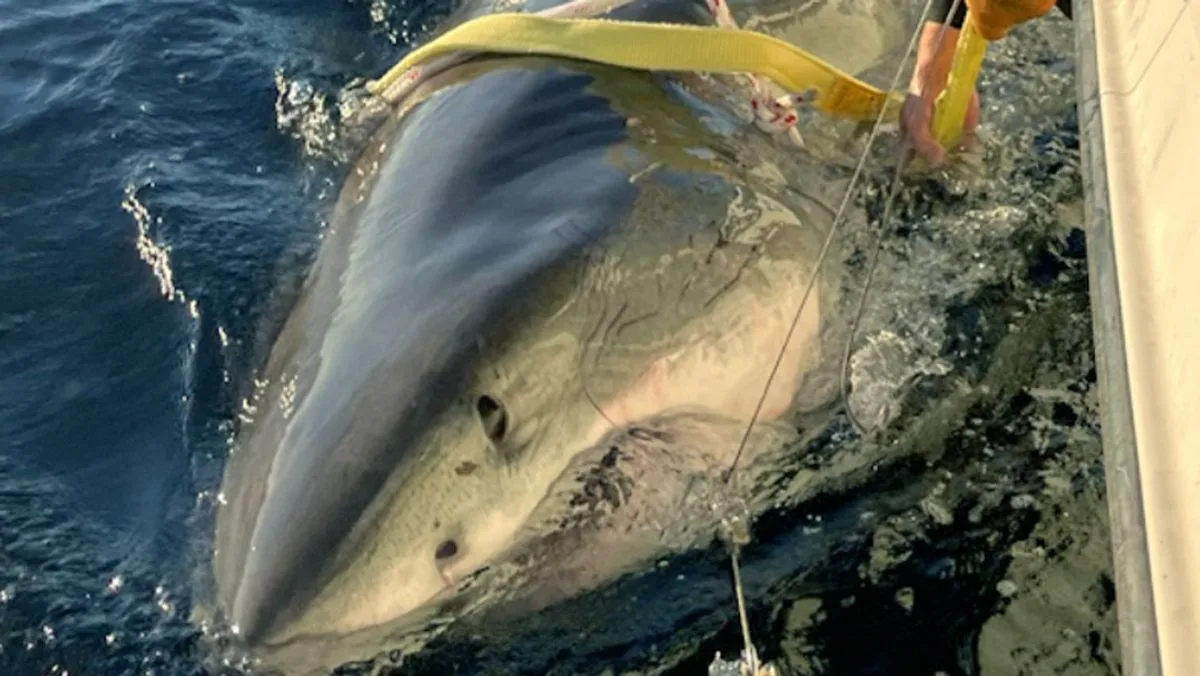
In a significant development for marine science, the largest great white shark ever tagged by Ocearch in the Atlantic Ocean has executed a "sudden movement" near the coastline, offering researchers unprecedented data on the behaviour of these formidable predators.

Contender's Remarkable Journey

Contender, an imposing 14-foot-long male great white shark weighing approximately 750 kilograms, has been actively tracked after being tagged by Ocearch in January 2025. The tagging occurred approximately 45 miles off the coast where Florida and Georgia meet, initiating a comprehensive monitoring effort.

Tracking a Predator's Path

Since his initial tagging, Contender's movements have been meticulously documented along the eastern seaboard of North America. His migratory route has spanned from the southern waters near Orlando, Florida, all the way north to the coastal regions of Quebec in northwestern Canada.

Wide Pickt banner — collaborative shopping lists app for Telegram, phone mockup with grocery list

Recent tracking data reveals Contender has been detected off the coasts of both Georgia and South Carolina. Throughout his journey, he has ventured notably close to shore on several occasions:

  • March 12: Pinged near St. Augustine, Florida, a popular tourist destination
  • January 16: Detected again off the Florida coast, not far from Orlando
  • February 16: Located near Wilmington, North Carolina
  • September 29: Tracked off the coast of Quebec

Sudden Movement Sparks Scientific Interest

On Wednesday, April 1, Contender was recorded passing the Gulf Stream at a considerable distance from the Georgia coast. However, what followed has particularly intrigued researchers: the shark subsequently made a rapid movement into deeper Atlantic waters.

This abrupt behavioural shift has prompted scientists to speculate about potential breeding activities. John Tyminski, Ocearch's senior data scientist, commented: "This sudden movement could be to forage in deeper waters, but we cannot rule out the possibility that it's related to reproduction at this time of year."

Scientific Significance

Ocearch emphasizes that such movement patterns are commonly observed among mature male white sharks like Contender. As the organization's largest male great white ever tagged in the Atlantic, Contender represents a particularly valuable research subject.

The non-profit organization stated: "Each new ping deepens our understanding of these apex predators—their life history, movements, and potential breeding areas—offering critical insights for conservation."

Understanding Great White Sharks

Great white sharks have inhabited Earth's oceans for over 400 million years, yet according to Ocearch, they remain "feared, admired and misunderstood." The organization's mission involves safely studying these marine giants under challenging conditions to replace fear with factual understanding.

Ocearch explains there are nine distinct white shark populations worldwide:

  1. Western north Atlantic (off eastern North America)
  2. Mediterranean (recent sightings near Majorca)
  3. Southern Africa
  4. Western north Pacific (around Japan and China)
  5. Eastern Australia and New Zealand
  6. Southwest Australia
  7. Eastern north Pacific (off western USA)
  8. South American Pacific (off western South America)
  9. South American Atlantic (off eastern South America)

Public engagement with this research is encouraged through Ocearch's Shark Tracker application, which allows users to monitor Contender and other tagged sharks in real-time, fostering greater awareness and appreciation for these remarkable creatures.

Pickt after-article banner — collaborative shopping lists app with family illustration




