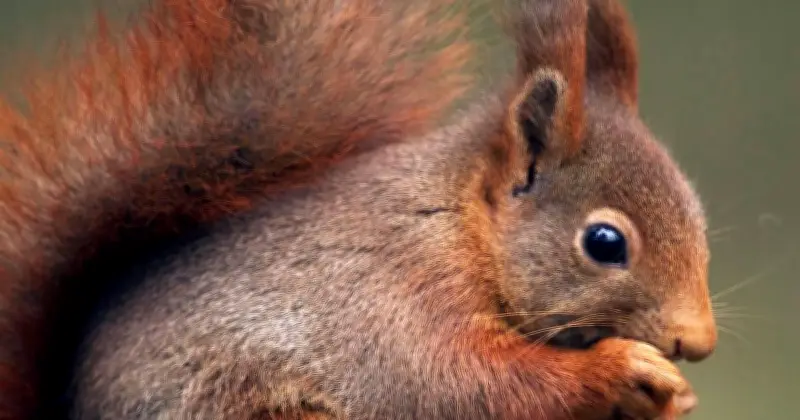
England's red squirrels could be extinct within 25 years unless they are granted the same legal protection as beavers, bats and newts, campaigners have warned.
Animal welfare group Save Our Reds has published a briefing paper for MPs calling on ministers to close a legal loophole that was shut for bats, dormice, otters and newts in 2007.
Under the Wildlife and Countryside Act 1981, a person accused of killing a red squirrel or destroying its drey in England or Wales can rely on a defence if they show it was a side effect of a lawful operation and could not be avoided.
Legal loophole
The equivalent defence under the Habitats Regulations was removed in 2007 for European protected species including bats, dormice, otters and great crested newts, but red squirrels are still not on that list.
The Forestry Commission's own guidance states: "There is no mechanism for licensing forestry operations where they may cause damage or disturbance to red squirrels."
For Red Squirrel Awareness Week (5–11 October), Save Our Reds' Marie Carter-Robb said: "Beavers now have stronger protection for their breeding sites than a native animal that's lived in Britain for ten thousand years. That cannot be right."
Protection call
Conservationist Dr Craig Shuttleworth said: "We are now perilously close to losing red squirrels from large parts of Britain. It feels like we’re not at the eleventh hour, but eleven seconds to midnight."
Save Our Reds is calling for the government to add red squirrels to Schedule 2 of the Conservation of Habitats and Species Regulations 2017, alongside other protected species.
That would bring red squirrel breeding sites and resting places under the stricter Habitats Regulations regime, which makes their damage or destruction an offence without requiring proof of intent. In England, work that would otherwise breach those protections would require a licence from Natural England.
Recovery strategy
The paper sets out a proposed route using existing powers to amend the legislation through statutory instruments, without a new Act of Parliament. Beavers were added to the regulations in England in 2022 and in Wales in March this year.
The paper, developed with Dr Craig Shuttleworth and Dr Peter Lurz, follows Natural England's Red Squirrel Recovery Strategy, published in April, which warned that, under current management, red squirrels face a high probability of extinction across mainland England within about 25 years.
It is estimated there are around 120,000 red squirrels in the UK, and less than 15,000 in England, while there are over two million greys in Britain.
Dr Peter Lurz, Honorary Fellow at the University of Edinburgh, said: "We need better protection and much greater consideration of our endangered red squirrels in decisions affecting their habitat."
Dr Shuttleworth added: "We have the knowledge, the legislation and the conservation expertise. What is needed now is the political will to ensure those protections are properly applied and enforced."
Marie added: "Today it is easier to destroy a red squirrel’s home than a bat’s."
From Cumbria to Anglesey, the same pattern keeps appearing: red squirrels are known to be there, and their habitat still faces development and felling pressures. Ministers already hold powers to strengthen protection through secondary legislation, and the beaver precedent shows that species protection can be extended.
"This is not a silver bullet. Red squirrels face disease, grey squirrels and habitat loss. But stronger legal protection is a practical step the Government could take now, before more strongholds are lost."
The Department for Environment, Food and Rural Affairs (Defra) said the government was protecting endangered red squirrels by tackling the threat of non-native grey squirrels. They added: "Working alongside landowners and conservation partners, we are supporting promising research into fertility control so that we can manage grey squirrel populations and help our iconic red squirrels and native wildlife flourish."