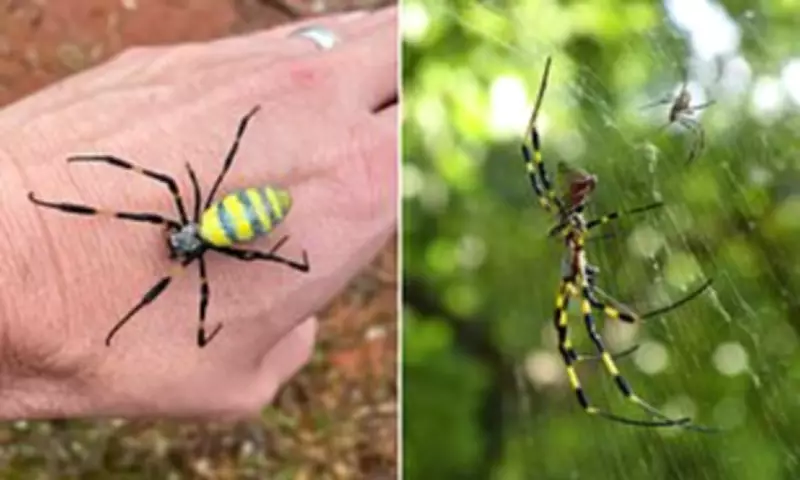
Joro Spider Invasion Spreads Across US, Experts Warn of Growing Infestation
The terrifying Joro spider, a species that once plagued the northeastern United States, is making a dramatic return. This new infestation is spreading deeper into the country than ever before, with experts cautioning that the population spike since 2024 could lead to widespread distribution across the nation.
Origins and Current Spread
The bright yellow Joro Spider originated in Japan, China, Korea, Taiwan, and other parts of Asia. It first appeared in the United States in 2014, likely arriving in shipping containers from East Asia headed for Georgia. Since then, the species has spread to numerous states including Georgia, Tennessee, the Carolinas, California, Virginia, Maryland, Pennsylvania, South Carolina, North Carolina, West Virginia, Oklahoma, and Alabama.
Currently, a new wave of Joros is preparing to hatch this spring. This brood is particularly concerning because they are capable of flying several feet through the air using a process called ballooning, where they form sail-like trails of silk that lift them off the ground. This ability allows them to potentially hitch rides all over the nation, with experts predicting they may soon reach Canada.

Physical Characteristics and Behavior
Female Joro spiders display a distinctive bright yellow body with blue strips and red markings, making them hard to miss. Males can be spotted by their more brownish color and smaller size. The females tend to grow much larger than the males, sometimes reaching the size of a human hand, although they are typically around four inches with their legs spread out.
These spiders build large, golden webs to capture their prey, and these webs are becoming increasingly common as the population swells. The females occasionally exhibit cannibalistic behavior toward their male counterparts. The spiders are most visible in the fall when they reach their full size between August and October.
Urban Tolerance and Environmental Impact
One of the most concerning aspects of the Joro spider invasion is their surprising tolerance for urban environments. If you live in or near a city, you might see more Joro spiders, as they can thrive in conditions including busy roads, vibrations, noise, and crowded structures—environments that would typically affect many native spider varieties.
The University of Georgia's Odum School of Ecology conducted experiments using tuning forks that simulated road vibrations, finding that the spiders were relatively unaffected by noise that would disturb other arachnids. Andy Davis from the University of Georgia noted in a statement: 'These Joro webs are everywhere in the fall, including right next to busy roads, and the spiders seem to be able to make a living there. For some reason, these spiders seem urban tolerant.'
Minimal Threat to Humans but Significant Ecological Concern
Despite their venomous nature and ability to fly, researchers stress that there is no significant danger posed to humans or pets. José R. Ramírez-Garofalo, an ecologist based on Staten Island, previously told the Daily Mail in 2023: 'There have been no documented fatalities, nor any notable medically significant bites. Taken together with their behavior (they are very reluctant to bite) and the evidence from the literature, they really pose no threat to humans or our pets.'
However, the invasiveness of the spider cannot be questioned. According to the academic journal Arthropoda, the Joro's fast population growth is due to its high metabolism, rapid heart rate, and tolerance for cold weather. Researchers have tested this cold tolerance by freezing more than two dozen samples, with more than seventy-five percent remaining unaffected.
Ecological Impact and Management
David Coyle of Clemson University noted that while their spread across the US may end up being more of an annoyance than a full-blown infestation, people who don't want the spiders around can easily move them with a broom or stick. However, the assistant professor in the Department of Forestry and Environmental Conservation cautioned that Joro spiders are still considered an invasive breed that requires more attention from the scientific community.

'These are not just benign spiders coming to catch and kill bad things; these are pushing out native species and catching and killing whatever happens to get in their webs,' Coyle warned. The spider's eggs normally hatch between May and June and take a few months to reach full size and start looking for mates, contributing to their rapid spread.