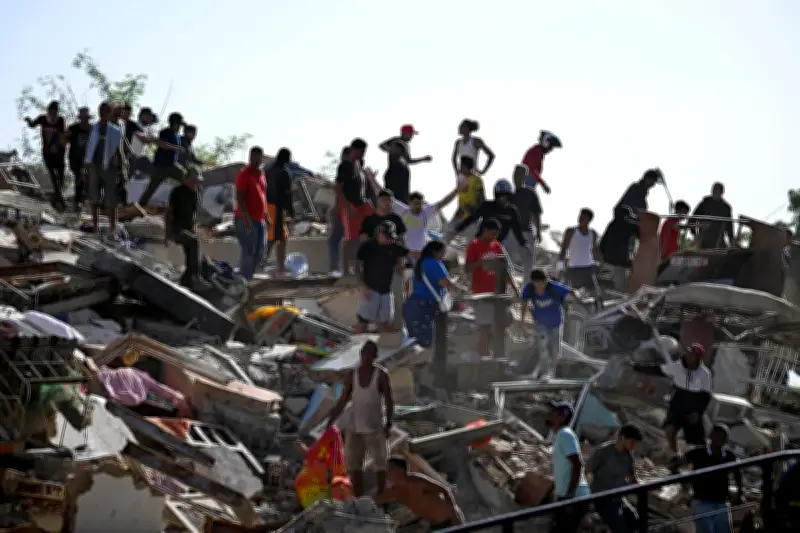
Countries around the world, including Iran, the US, and Cuba, have committed to help with rescue efforts in Venezuela after deadly twin earthquakes hit the country on 24 June. The back-to-back quakes, with magnitudes of 7.2 and 7.5, killed at least 164 people, injured close to 1,000, and caused significant damage to the capital, Caracas, and areas across the north.
Challenges Amplified by Pre-existing Crisis
Tommaso Della Longa, spokesman for the International Federation of Red Cross and Red Crescent Societies, noted that the earthquake struck after a series of challenges Venezuela already faced. “We are talking about a system that in some parts was already, if not weak, then under several constraints and challenges,” he said. “If you look at the number of injuries, just to give an example, that would overwhelm any health system.” The economic crisis, flooding, and health issues had already strained the country's capacity.
International Pledges and Responses
US Secretary of State Marco Rubio announced a “whole-of-government” response, stating, “It’ll be big, it’ll be fast, and it’ll be effective,” adding that the Department of War would play a “big logistical role.” Latin American countries including Mexico, Brazil, El Salvador, Ecuador, the Dominican Republic, and Cuba offered solidarity and help. Cuban health workers were already on site, fully mobilised and providing medical services, according to Foreign Minister Bruno Rodríguez.
The Netherlands allocated about €2 million (£1.72 million) for a rescue team with workers, dogs, and equipment. Spain and France said they would send dozens of rescuers, Germany promised six military transport planes, and Switzerland offered emergency teams and rescue dogs. Iran’s Foreign Ministry spokesman Esmaeil Baqaei announced “Iran’s readiness to provide any assistance required in relief and rescue operations,” expressing solidarity with the Venezuelan government and people. China also said it was ready to send whatever was needed.
UN and Humanitarian Agencies Mobilise
Tom Fletcher, UN humanitarian chief, confirmed specialist rescue teams were en route to help search for survivors. He praised the “solidarity and practical offers from the region and beyond” as superb. “The coming days will require a massive collective effort to support the government-led response and help communities… Sustained international support for humanitarian organisations responding on the ground is essential and urgent,” he added.
The earthquakes—the strongest since 1900—prompted rescuers and locals to clamber over flattened apartment buildings in the dark to hunt for survivors. The disaster struck when 7.9 million people in Venezuela (nearly 28% of the population of 28.5 million) already needed humanitarian assistance, according to the UN. Persistent gaps in basic services—healthcare, water, education, and energy—remain critical for vulnerable people.
Underfunded Humanitarian Response
Jan Egeland, secretary general of the Norwegian Refugee Council, warned: “This earthquake will deepen the suffering for millions already in dire need. More than a quarter of the country’s population needed urgent aid even before the earthquakes.” The humanitarian response plan in Venezuela is drastically underfunded: only $146.9 million (£111 million) of the $632.2 million promised has been delivered. The 2025 plan is just 20% funded, while the 2024 plan was 28% funded. Egeland urged donors to step up, stating, “The deep suffering of the crisis-engulfed people in Venezuela has been neglected for too long… Donors must urgently step up support as this earthquake has become a catastrophe on top of a crisis. There can be no delay in this support.”