
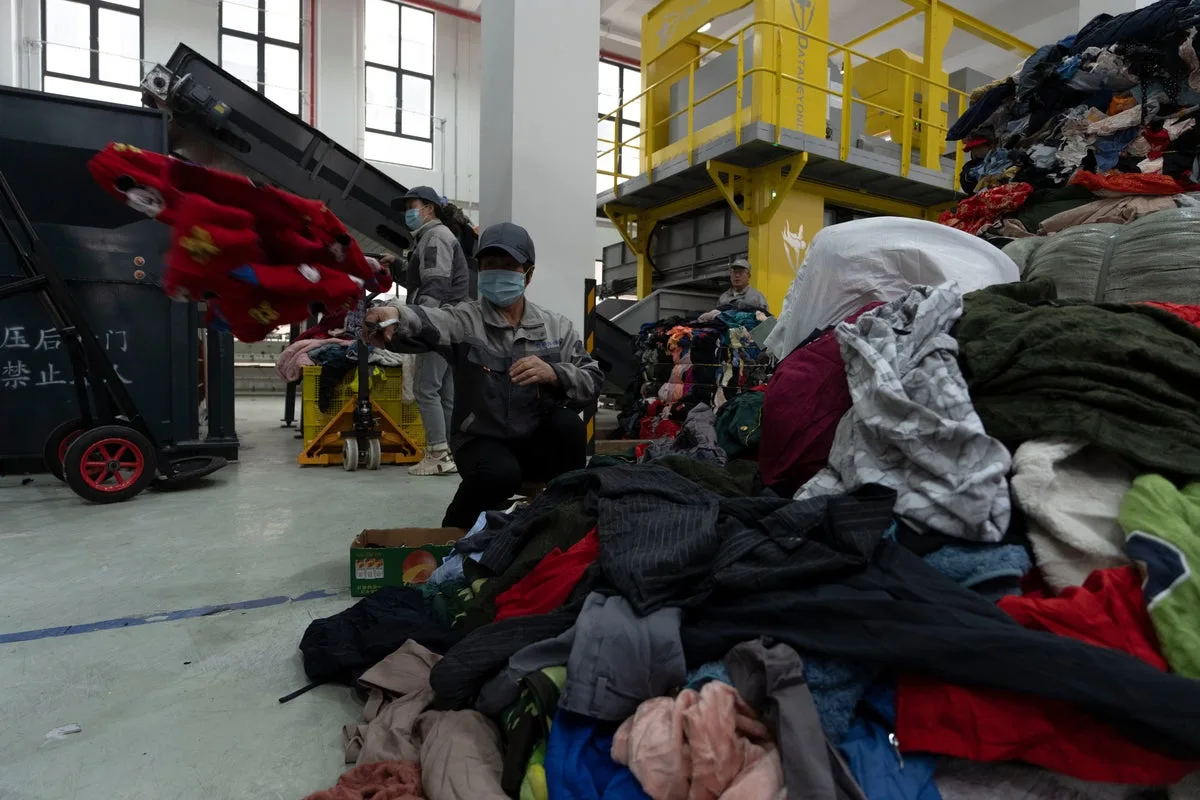
In an industrial park in Zhangjiagang, a small city on China's east coast, a large humming and hissing machine feeds on piles of used clothes and sorts them. The novelty? It uses artificial intelligence to sort them by composition at high speed, offering a glimpse into how AI could play a role in reducing the impact of synthetic textile waste.
The Fastsort-Textile machine, named one of Time magazine's Best Inventions of 2025, was created by DataBeyond, a Chinese AI recycling company founded in 2018. “We can make full use of textile waste and reduce the amount that is incinerated which will be a great help to recycling resources,” DataBeyond CEO Mo Zhuoya said.
Synthetic textiles are derived from fossil fuels and account for around 70% of global textile production, according to a report from Amsterdam-based nonprofit Circle Economy. Textile waste is a major global pollutant, with China as the leading contributor. China led global textile exports at $142 billion, more than double that of the European Union, according to the World Trade Organization’s 2025 Key Insights and Trends report.
Fastsort-Textile is being used only in one location in China: Shanhesheng Environmental Technology Ltd., a textile recycling facility in Zhangjiagang that installed the machine in 2025. The equipment uses an AI scanner to read the composition of such textiles and sorts them by fibers, after which they can be recycled.
The machine sorts through 100 kilograms of clothes in two to three minutes, compared to around four hours for one worker to do the same thing. It can process two tons per hour, while two people would need two days and at reduced accuracy, according to analysis by Shanhesheng. “This sort of thing saves money on labor costs, it saves time. When people sort materials, they can’t tell accurately if it’s 80 or 90% polyester. This machine rarely makes mistakes,” Shanhesheng Sales Manager Cui Peng said.
Previously, up to 50% of the processed textiles were deemed unrecyclable and sent to landfills or incinerated. That number is down to 30% with the Fastsort-Textile machine, Sales Director Li Bin said. “Now, though machines are already capable of sorting, people’s energy is limited. People can’t work for 24 hours straight, so robots may take over the roles in the end. The ultimate goal is a ‘dark factory’ with the robots running 24 hours.”




