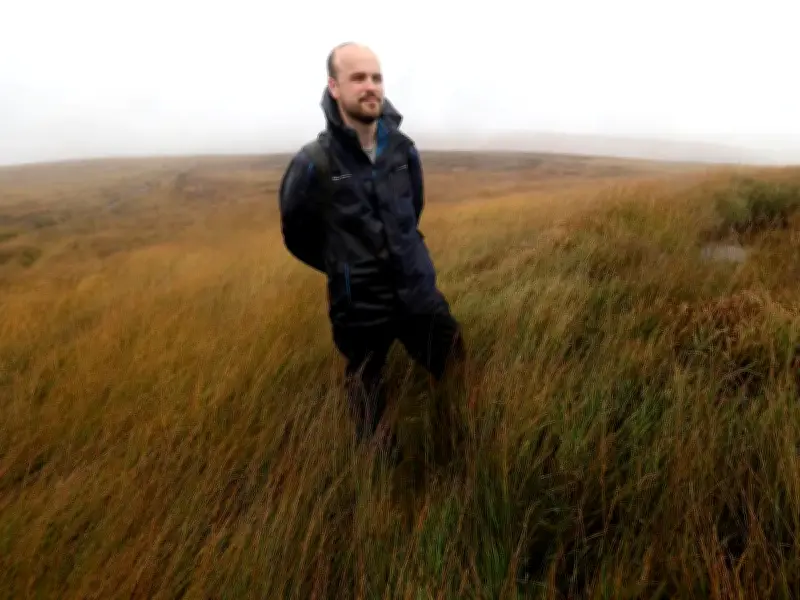
Rain lashes sideways across Winter Hill, and from a few hundred yards away the 1,000ft TV mast is invisible in the mist. The ground wobbles underfoot like blancmange. It is hard to imagine this was the scene of one of the UK's worst wildfires in the summer of 2018.
Then conditions were very different. The UK was in the midst of a prolonged heatwave, leaving grass and peat parched. When a fire was started deliberately near the mast, authorities were on high alert. The following day a second blaze broke out on another part of the moor, and on the third day the wind changed direction and the fires joined up.
41 days of fire and destruction
At the height of the blaze, 150 firefighters battled the flames as helicopters dropped hundreds of thousands of litres of water on the moors. It would be 41 days before the fire was finally brought under control. By then, an area of moorland the size of 1,200 football pitches had been burnt, and countless birds, rodents, reptiles and insects killed.
"The loss was massive," said Andy Ryding, from land-owners United Utilities, who remembers watching kestrels and raptors hovering around the edge of the fire, waiting to pounce on field mice and lizards fleeing the flames. "It was devastating."
Perhaps the biggest damage was to the peat. In some of the worst-affected areas, the fire burnt down around 50cm into the bog.
Rewetting the moor
Today, while much of the wildlife and vegetation has returned to Winter Hill, the worst-hit areas of peat, a vital carbon store, are still recovering. That is why a project to 'rewet' the moor is underway.
Over the last few months, thousands of crescent-shaped dams have been created on the northern slopes of Winter Hill. From the air it looks like a herd of giant horses have trotted across the moor. Those muddy puddles are locking in carbon, reducing flood risk by holding back millions of gallons of water, and creating conditions for sphagnum mosses and wildlife to return.
They also act like a giant natural filter, reducing the costs of making water drinkable when it lands in reservoirs. Crucially, by rewetting the moor, they reduce the risk of future wildfires.
Increasing wildfire risk
Since 2018, which also saw a huge blaze burn on Saddleworth Moor for 21 days, the risk of wildfire has only increased. Winter Hill has seen several other smaller fires in the intervening years. During this summer's record-breaking heatwave, a major wildfire burned for more than three weeks on moors near Dovestones in Saddleworth, with smoke smelt as far away as Sale, Stockport and Levenshulme.
Elsewhere in the UK, several homes in Stourbridge in the West Midlands burned down, and a wildfire came perilously close to Sizewell B nuclear power station in Suffolk, destroying vast areas on a protected nature reserve. In August, the Prime Minister Andy Burnham convened an emergency Cobra meeting and issued a temporary ban on the sale of disposable barbecues, as a wildfire alert was sent to millions of mobile phones.
While climate change is a major factor in moor fires, Alex Hubberstey, manager at the Lancashire Peat Partnership, the organisation behind the Winter Hill project, says human beings are in fact a bigger risk. "There is nothing natural about fire on moorland," he says, explaining virtually all moor fires are caused by humans, either deliberately or accidentally. "The only situation where it might happen is through a lightning strike on a degraded moor."
A slow recovery
Rewetting Winter Hill will be a very slow process. Peat accumulates at a rate of around 1mm per year. It is estimated it will be another two to three years before the badly burnt areas return to their pre-2018 state. Years of erosion, over-grazing and climate change mean it will be at least another five decades before Winter Hill returns to peak boggy condition.
In the meantime, the dams are already taking effect. The vegetation around the edges is visibly greener than the surrounding moor. Birds including curlews and lapwings have returned, alongside a notable increase in insects such as dragonflies and grasshoppers.
"The moor will always come back," says Andy Ryding. "Within a couple of months [of the 2018 fire] we were seeing birds like skylarks and pipits come back. But a moor is a mosiac. It's about getting that mixture right."
As if to prove his point, a hawk comes swooping into view. Remarkably, it is a female hen harrier, one of England's rarest and most endangered birds of prey. A handful are known to nest in the nearby Forest of Bowland, but they are an extremely unusual sight on Winter Hill.
As he turns to watch the harrier hovering over the rain-lashed moor, Alex can barely contain his excitement. "Get in," he says, punching the air. "I'm well-chuffed. That's exactly the reason we are doing this. They are an apex predator. If we are seeing them here, it means we are getting something right."