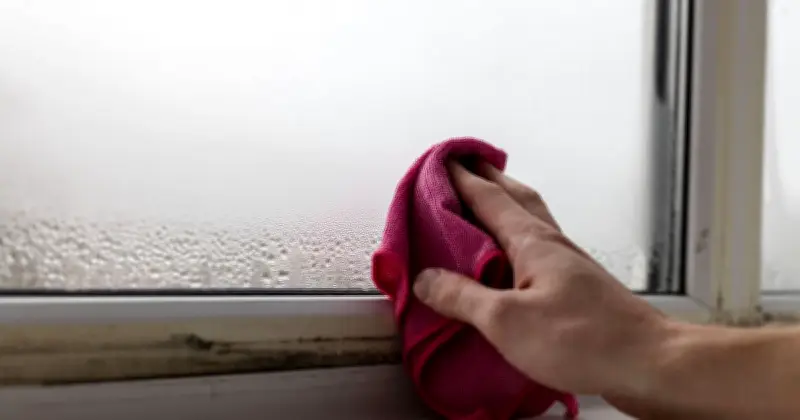
Applying washing-up liquid to windows does not remove condensation - it simply redirects the moisture to other colder surfaces, where it can lead to black mould growth.
Condensation forms when warm, moisture-laden air meets a cold surface such as window glass or an uninsulated exterior wall. As the air cools rapidly, it loses its ability to hold water vapour, which turns back into liquid droplets.
Why the viral hack fails
Social media influencers frequently share the tip of buffing washing-up liquid onto window glass to prevent condensation. Among them is cleaning influencer 'Cleanwithlily', who has nearly 200,000 TikTok followers. In a viral video with more than 2,000 likes, she told viewers: "Then before you go to bed tonight, do this one thing and you'll wake up to no condensation in the morning."
She advised applying a small amount of washing-up liquid to a microfibre cloth and buffing it thoroughly into the window, adding: "Trust me when I tell you, this is an absolute game-changer." One viewer commented: "Need to try this!" while another wrote: "Going to be trying this tonight! My windows are always like this lately and making mould on wall so I will definitely try."
Moisture simply moves elsewhere
However, the trick does not remove moisture from the room. Washing-up liquid acts as a surfactant, forming a soap coating on the glass that breaks the surface tension of water. Instead of forming bead-like droplets, moisture spreads into an invisible, microscopically thin film across the window.
The total amount of water vapour in the air remains unchanged. If the glass can no longer draw vapour into visible droplets, the moisture migrates to the next coldest surfaces - typically external walls, window frames, sills, ceilings and upper wall edges.
How the hack can make problems worse
By suppressing window condensation without tackling the underlying moisture, homeowners lose an early warning sign. Water on glass can be wiped away with a towel or squeegee, removing that moisture from the home altogether. If it instead settles invisibly into plasterboard, paint or wallpaper, it creates ideal conditions for black mould, which is far harder to clean than wet glass.
Persistent dampness can rot wooden frames, cause wallpaper to peel, lift paint and deteriorate plasterwork. Mould spores can trigger respiratory problems, worsen asthma and provoke allergic reactions, while high indoor humidity encourages dust mite populations and makes damp walls into cold spots that are harder and costlier to heat.
Effective alternatives
To prevent condensation transferring onto walls or furniture, the focus should be on extracting or managing moisture at its source. Recommended methods include wiping down window condensation daily with a squeegee or cloth, increasing ventilation by opening windows or using purge vents and extraction fans, and operating a dehumidifier in central locations or where clothes are drying.