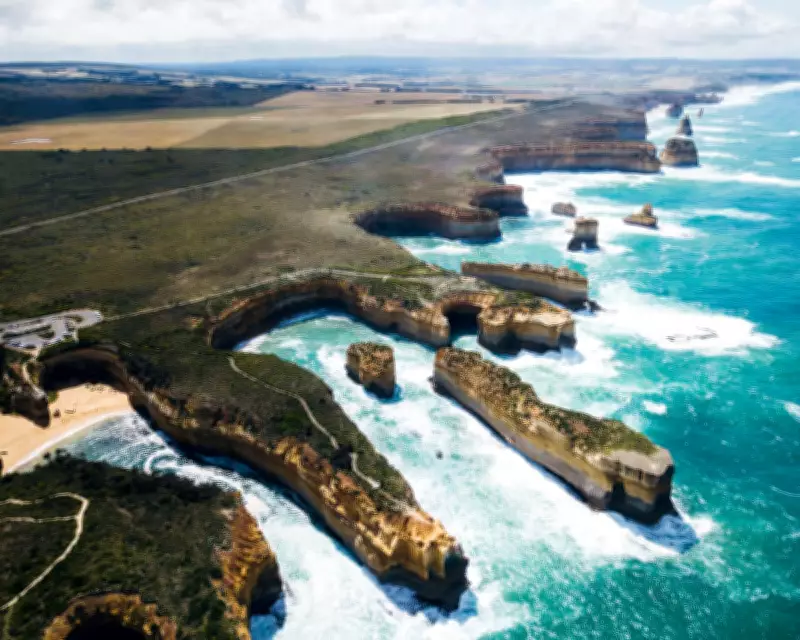
The iconic Twelve Apostles along Victoria's Great Ocean Road have been precisely dated to between 8.6 and 14 million years old, according to new research published in the Australian Journal of Earth Sciences. The findings, based on microscopic fossils embedded in limestone, provide a detailed history of the geological forces that shaped these towering sea stacks.
Uncovering Earth's History
Associate Professor Stephen Gallagher from the University of Melbourne explained that geologists view the Apostles as layers of time. Tectonic plate movements over millions of years lifted and tilted the underlying Gellibrand marl (15 million years old) and the yellow and grey Port Campbell limestone, which formed since the mid Miocene. These layers are topped by a more recent layer of red-brown soil called Hesse clay.
“The tectonic movements didn’t push up the Apostles perfectly straight. Instead, they forced layers to tilt and break along the way,” Gallagher said. “Small fault lines can also be seen, which are records of ancient earthquakes.”

Formation of the Sea Stacks
While the rocks are ancient, the seven or eight sea stacks—originally called the “Sow and Piglets” on nautical maps—formed much more recently as cliffs eroded. “Only 20,000 years ago, you could walk to Tasmania because Bass Strait was a lake,” Gallagher noted. “You could walk about another 70km offshore from the present Twelve Apostles and you would still be on land.”
Dating Techniques
Scientists used photographs, digital mapping, samples, gamma radiation measurements, and analysis of minuscule popcorn-like fossils called foraminifera to establish exact ages for each rock layer. These single-celled organisms evolved, lived, and went extinct at particular times, making them ideal for dating marine ecosystems.
Dr Matthew McCurry, curator of palaeontology at the Australian Museum, said foraminifera are a useful method often combined with radiometric dating. Dr Erich Fitzgerald, senior curator at Museums Victoria Research Institute, noted that the Apostles formed during the Middle Miocene Climatic Transition, a period of global cooling that set the stage for the Ice Ages.
Ancient Marine Life
During the Miocene, seas were higher and teeming with plankton and diverse ocean life. “Sharks were never larger, never had it better,” Fitzgerald said. “That is the peak reign of the gigantic mega-tooth shark, Megalodon.”
Fitzgerald described the study as important for “bookending” the age of the Twelve Apostles in geological time. “Despite more than 100 years of scientific inquiry, this highlights how much we are still learning about even the most famous natural features in Victoria,” he added.