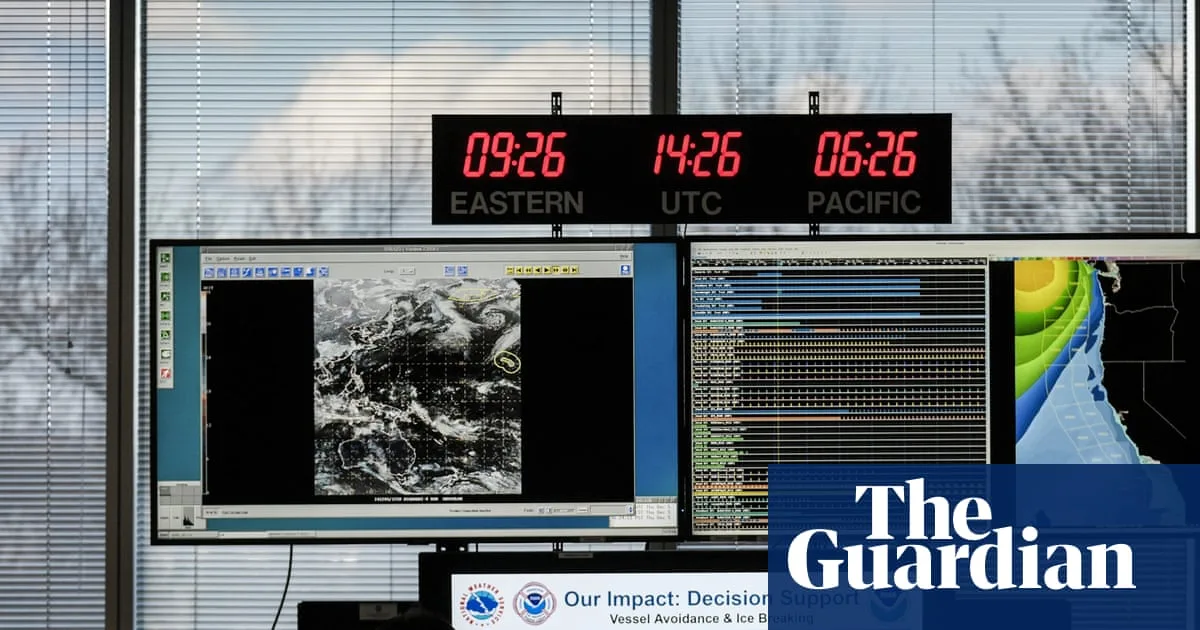
As the United States braces for hurricane season and a summer of record-breaking heat, experts warn that the Trump administration's cuts to climate and weather data programs could undermine the reliability of federal weather forecasts when they are most needed.
NOAA's AI Weather Models Under Scrutiny
The National Oceanic and Atmospheric Administration (NOAA) launched a suite of artificial intelligence-powered global weather forecast models late last year, claiming they would enhance speed, efficiency, and accuracy. In March, an agency official stated that these models are being trained using centuries of weather data. However, Monica Medina, who served as NOAA's principal deputy undersecretary of commerce for oceans and atmosphere from 2009 to 2012, emphasized that AI is a valuable tool only when well-trained with ample data.
Under the Trump administration, climate and weather data collection has declined, Medina noted. This year, the administration proposed a modest budget increase for the National Weather Service but a 40% cut to NOAA overall. "We absolutely need AI to help us crunch the data faster and to make sense of more and more data that we can collect," said Medina, who also served as assistant secretary of state for oceans under Joe Biden. "But right now, what we're doing is cutting back the data collection ... we're going in the wrong direction."
Staffing Cuts and Data Collection Challenges
Erica Grow Cei, a National Weather Service spokesperson, countered in an email: "Despite the misinformation circulating about missing weather and climate data, there is, in fact, a wealth of weather data collected each day, from satellites in space, to a network of weather balloons, to buoys in the ocean, and land-based sensors." Yet widespread reports indicate that staffing cuts have forced NOAA's National Weather Service to scale back satellite operations and balloon launches, crucial components of the nation's data collection system. Experts also point to reduced climate programs threatening ocean buoy networks and other observation systems. Research into the climate crisis's effects on Earth's systems is being slashed, along with funding for researchers who analyze data and identify new sources.
Craig McLean, NOAA's former acting chief scientist and head of NOAA Research, explained: "Weather times time equals climate. Cutting climate research impacts the skill of our weather forecast, and it arrests our advancement of weather forecasts." These impediments come as the US prepares for more extreme weather. A "super El Niño" is expected to spike temperatures, smash heat records nationwide, and potentially boost hurricane activity in some regions. NOAA is set to issue its outlook for the 2026 Atlantic hurricane season on Thursday.
AI vs. Traditional Forecasting Models
For decades, scientists used traditional physics-based models to predict future weather, relying on complex mathematical equations to simulate atmospheric dynamics. New AI-based models instead identify patterns in decades of historical data to forecast outcomes. This new technology uses less computing power and has outperformed traditional models for some aspects of forecasting. However, a study published in April in Science Advances found that AI models still "underperform" in predicting extreme weather events. Because their forecasts are based on past events, they struggle to simulate the record-breaking events increasingly common amid the climate crisis, tending to predict weather more similar to historical events.
Traditional physics-based models do not have this problem, as they assess and predict outcomes based on physical conditions. "They don't really care if there's a different situation than we've seen before, because they can understand based on a rules-based [analysis] what will happen tomorrow," said Sebastian Engelke, a professor at the University of Geneva and co-author of the study.

Chris Gloninger, a forensic meteorologist who received death threats in 2023 after speaking about the climate crisis on television, likened the AI model issues to infrastructure struggling with global warming. "You have infrastructure systems in this country that are built on having a steady or static climate, and we know that that's not the case as extremes are increasing," he said. Like stormwater systems not designed for heavy rainfall or roads not built for extreme heat, "the AI weather models were trained on a climate that no longer exists."
Gloninger noted that conventional models outperformed AI-based ones in forecasting a historic February 2026 blizzard in the northeastern US. If the government scales up reliance on AI models while reducing data inputs, federal forecasts could be compromised. "It's kind of a snowball effect," he said. "You need accurate data for inputs for our forecast models, but we're running on less data currently with this current administration."
Long before Trump re-entered office, the National Weather Service faced decades of understaffing. Recent cuts have exacerbated the problem. NOAA has not fully switched to AI forecasting but is incorporating more AI into its ensemble models, which blend multiple techniques. Cei stated that NOAA's new AI-powered model suite is "an addition to our stable of weather models, not a replacement," built on data from the agency's flagship physics-based Global Forecast System model. However, Gloninger remains concerned that integrating any AI component into federal models could raise issues, particularly amid cuts to data collection and climate research.
Leadership and Political Pressures
John Sokich, a former director of congressional affairs for the National Weather Service, described current NOAA administrator Neil Jacobs as "probably one of the preeminent modeling scientists" and expressed confidence that he would not rush to implement untested technology. Yet McLean noted that while Jacobs is "committed to advancing weather forecasting," he is also "a Trump appointee who must back the Trump budget or leave his job." Jacobs defended Trump's NOAA cuts at a House environment subcommittee hearing in April. "I don't think Dr Jacobs would be in a rush to be replacing capacity with AI that's not ready yet," McLean said. "But at the same time, the man has demonstrated his willingness to be obedient to the president who appointed him [and who is] destroying the National Oceanic and Atmospheric Administration."
Weather forecasts serve indispensable practical functions, powering early disaster warnings, enabling safe aviation and shipping, and helping officials optimize sectors of the economy from energy production to agriculture, said Medina. Less accurate forecasting could pose dangers to Americans. "Weather forecasts are vital to our economy, to our health, and to public safety," she concluded.





