
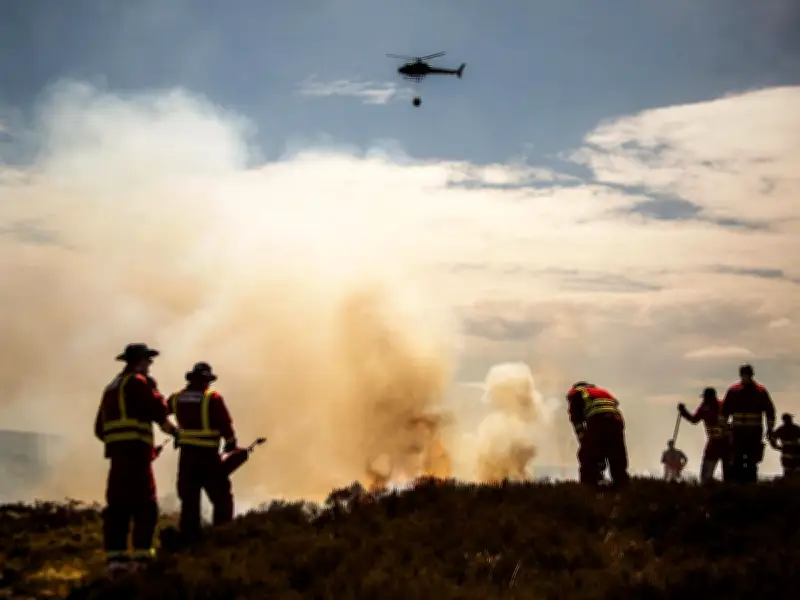
A wildfire that broke out on Tintwistle Moor on June 24 has now been burning for more than five weeks, leaving communities on the Tameside-Derbyshire border dealing with smoke, heartbreak and a major road closure. Firefighters first left the scene on July 2 but returned a week later following reports of smoke, and a major incident was declared on July 12.
Alongside a separate moor fire near Dovestone Reservoir in Greenfield, the blaze has dominated life in the Peak District's north-western corner. Daily routines have been upended in the neighbouring villages of Tintwistle and Hollingworth, where charred moorland looms in the distance.
Residents describe weeks of anxiety
Jean Striven, who owns Pixie Bakes Cakery and Coffee Shop in Tintwistle and lives on a nearby street that backs onto the moor, told the Manchester Evening News: "It's been nerve-wracking as to whether we would be evacuated, but that luckily hasn't happened. But we've been on pins while it's been going on."
Despite being so close to the fire, residents said Tintwistle had not experienced the worst of the smoke, with the wind carrying it elsewhere. Natasha Naz, who runs Tintwistle Village Store, said: "The smoke for us - I don't feel it has been as bad as it has for other people, but you find yourself checking the weather every day when you don't usually, checking what's the wind direction. You feel au fait with everything weather when things like this happen."
But the smoke has been an issue for some residents with breathing difficulties. Natasha described how children with asthma had struggled before a school closed early for the day, while older residents also faced challenges.
One woman living on Old Road, Tintwistle, who asked not to be named, said: "My son lives in Hollingworth and I was going to go there one day for a coffee. He had to tell me not to come. He sent me pictures and it was worse for him than it was for me here. I have lung problems and it was better that I stayed here in the end."
Sam Gregson was away on holiday when the fire first broke out. "When I came back it was still going on," he said. "I've seen pictures from family and friends that live around here. I've never seen anything like it."
A road closure that became a 'silver lining'
Hollingworth and Tintwistle are usually synonymous with heavy traffic. The neighbouring villages sit side-by-side on the A628, on the edge of Woodhead Pass, one of two major routes through the Peak District connecting Manchester and Sheffield. Thousands of drivers use the road every day, including lorries and other large vehicles.
On July 14, the A628 was closed by National Highways to ensure the safety of fire responders. A manned closure was installed at the A57 junction in Hollingworth and the Old Road junction in Tintwistle. The road reopened on Friday morning (July 31), three days after the M.E.N. spoke to residents on Tuesday.
Natasha said it had been a "silver lining" from the woodland fire, even though it had affected deliveries at her shop. And while the closure has caused queues through Mottram, between the M67 and Hollingworth, she said drivers were already used to long delays in that area.
"As a resident, I'm over the moon that Woodhead Pass is shut," she said. "From a business side, having that road shut is not the best for passing trade. I would ban them [lorries] from using the Woodhead Pass. It's a small village, the road is not built for it, the houses are not built for it. The pollution is terrible - if we're talking about the pollution from the fire, talk about the pollution from lorries."
Natasha is far from alone in sharing that view. One Old Road resident described the closure as "heaven", adding: "All of these who live on this road will tell you. It's been fantastic. I probably see more of my family now - they hate coming here because of the traffic, but they've loved it. Something needs to be done about it [after the fire]."
Her neighbour Nigel Cave firmly agrees. "I wish it was like this all the time," he told the M.E.N. He pointed out a damaged kerb on the corner of the A628 Manchester Road and New Road, where he said heavy vehicles had caused the problem, including "fork lifts" cutting the corner. "It's dangerous," he said. "We shouldn't have to live like that."
Lorries ignoring closure signs
While the road closure was in place for weeks, some lorry drivers continued to approach Woodhead Pass before being caught out. When the M.E.N. visited Hollingworth and Tintwistle, clear signs were placed at the edge of the closure in Hollingworth, diverting traffic away from the A628 onto the A57 towards Glossop. Closer to Woodhead Pass, there were more signs in Tintwistle. Yet multiple lorries were seen travelling up New Road and attempting to turn onto the A628 towards Woodhead, only to be turned away.
At one point, two lorries passed each other in close proximity on New Road, as one approached the A628 while the other was pointed away. "There's the sign there saying 'police road closed'," Nigel said. "I don't know if they can't read, or they don't read."
Allan Dyer, vice chair of Tintwistle Parish Council, has witnessed it repeatedly. He recalled: "There were three articulated lorries, virtually one after the other, going up New Road and trying to turn right - in so doing, nearly taking the wall down. The guy said 'where the hell are you going? The road is closed'. He made him reverse back down New Road and then go left. Within 10 to 15 minutes, he tried the same thing again."
National Highways said it had urged drivers to follow official road signs and diversion routes, and to check traffic conditions before travelling rather than relying on sat navs. Signs about the closure were also displayed on motorways in the North West.
Bus lifeline cut
While the major road closure was welcomed for calming traffic, it brought problems. One of the biggest talking points was the loss of the 237 bus, which runs through Hollingworth and Tintwistle on its way between Ashton-under-Lyne and Glossop. It is a lifeline for many residents, but it had not been running through the villages while the A628 was closed. Several residents spoke out about the issue affecting people without a car who need to get to work or medical appointments.
"So many people are reliant on it," Coun Dyer said. "I've personally taken so many people to the GP, to hospital appointments, to collect prescriptions, as they don't have a car, they can't walk very far. It's a major, major issue."
Julie and Bernard Crook are staying with friends while visiting the UK from New Zealand. They said they could "smell smoke" when they first arrived, but the fire had eased more recently. They spoke to the M.E.N. moments after getting off a bus on Mottram Moor, and were preparing to walk through Hollingworth to get to where they were staying. "Why they don't go through New Road [in Tintwistle] is beyond me," said Bernard.
"It's not good because we're relying on public transport," added Julie. "[Our friends] are really struggling to get to where they need to be."
Responding to concerns about the 237, Nick Fairclough, Transport for Greater Manchester's interim deputy director of bus, said: "The 237 service has been operating on diversion since July 16 due to road closures affecting its normal route. An ongoing closure on the A628 was introduced by Greater Manchester Fire and Rescue Service as part of the emergency response to the Tintwistle Moor fire. Between July 22 and 28, separate roadworks at Station Road, in Hadfield, also resulted in Derbyshire County Council introducing additional restrictions affecting the route. We don’t take any service diversion lightly but, while the 237 is part of the Bee Network, these closures and restrictions were put in place by the relevant emergency and highway authorities. We recognise the impact this has had on people who rely on the service and apologise for the inconvenience caused. We will seek to revert to the normal route as soon as is safe and practicable."
TfGM confirmed the bus had resumed on Friday.
Businesses feel the impact
While the "peace" of the road closure was widely welcomed in Tintwistle, it caused more issues for businesses in Hollingworth. Ravi Vyenduri, manager of Hollingworth Village Store, told the M.E.N. his takings were down by "around £200 to £300 each day".
He explained that the problem was even more stark when locals had been restricted from using more of the A628 in previous weeks. "Because of the road being closed, it's been very quiet," Ravi said. "Until last week they didn't even open this bit for locals. It's normal for people that are passing here, to Sheffield or wherever, to stop and buy something - but they are not buying anything. It's a big impact."
Ravi said the road closure had also added to his journey time to and from his Denton home. It was a problem echoed by punters in the New Inn, where one man, who asked not to be named, described the situation at the Mottram Moor lights as a "shambles". "It was two hours, an hour and an half to move from Mottram roundabout to Hollingworth in red hot traffic," he said.
The closure was also affecting passing trade at the pub. "We've got so many people heading through, now there's no one coming," a bar worker said. "You don't realise as a small business just how much it affects you."
National Highways said the road closure was reviewed daily, with access routes adjusted when it was safe to do so, including the addition of signage to support local residents and businesses. The A628 reopened on Friday with the addition of temporary traffic lights to support firefighting activity, which was expected to cause delays.
Firefighting operation continues
Dozens of firefighters from across the country have continued to work on Tintwistle Moor in recent days, alongside mountain rescuers, members of the Peak District Fire Operations Group and United Utilities, among others. Over the last few weeks, helicopters have dropped water on the site, while firefighters have battled soaring temperatures to beat the flames.
The fire was contained into four sectors, but conditions made tackling it extremely difficult. Deep-seated fire has been burning within the peat under the moorland's surface, and in an update issued on Wednesday (July 29), Derbyshire Fire and Rescue Service (DFRS) said there were no visible naked flames.
Alongside the nearby fire at Greenfield, crews have been working on an area roughly equivalent to 1,250 football pitches. Crews often walk for more than an hour from parked vehicles just to reach the working areas at Tintwistle Moor, according to DFRS, while the deep-seated peat fire means smouldering can continue for long periods before reigniting.
A number of controlled burns have also taken place in recent weeks at Crowden, to reduce the amount of potential fuel for the moor fire. DFRS was also not helped when a significant amount of resource had to attend an out-of-control campfire in woodland off Monks Road, Glossop, on July 18. The fire reignited two days later, with crews remaining on the scene until July 22.
In a statement issued last week, DFRS deputy chief fire officer Clive Stanbrook said: "This remains an incredibly demanding and complex incident, requiring a huge collective effort from firefighters and partner agencies over a sustained period. The scale of work undertaken on the moorland is difficult to comprehend. Crews have been operating in challenging conditions, carrying equipment across remote terrain, constructing fire breaks and working methodically to tackle deep-seated fires burning beneath the surface. While we have made significant progress, the nature of peat fires means they can remain active underground and reignite if not fully extinguished. That is why we continue to maintain a major incident response, with specialist resources in place to monitor, contain and extinguish remaining hotspots. I would like to thank all of the firefighters, partner agencies and supporting organisations involved in this response, as well as local communities and road users for their patience and understanding throughout what has been a lengthy and challenging operation."
Community praise and calls for change
Residents have been full of praise for those working to tackle the fire. DFRS was inundated with offers of food and assistance by members of the community, but on July 14 the fire service said it had to stop accepting donations and had enough supplies.
"It has been fascinating watching everything that's going on really," Tintwistle resident Nigel said. "I think the fire brigade have been really good, they've been on it as much as they can."
A cause for the fire is still unknown due to the extensive nature of the area covered, DFRS says. The fire service has issued repeat pleas to the public to stay away from the area and avoid using barbecues, campfires or any naked flames in the countryside, and to avoid discarding cigarettes and glass bottles.
After weeks of an unsettling blaze on their doorstep, thoughts in Tintwistle have turned to the future. Pixie Bakes owner Jean said: "I think we are in a funny period of time with climate change. You see Spain, Italy, France - hundreds of thousands of people evacuated. We just have to think ourselves lucky."
Like others the M.E.N. spoke to, she wants to see portable barbecues banned. She added: "I'm all for having freedom to walk [in the countryside], but having seen the devastation, the wildlife - birds, insects, hares, deer, everything - it's truly heartbreaking."
Natasha said she has not sold disposable barbecues at Tintwistle Village Store for around 15 years, but she occasionally gets visitors telling her they intend to have a barbecue in the picturesque Seven Falls nearby. "It's always a minority, but they ruin it for everyone else," she said. "It's just such a shame for all the wildlife that's sadly perished in this fire, and the fact that there is absolutely nothing that we can do about how it's been started. For one, we might never find out, and no one will be held to account for it. It's really sad. But how do you police the countryside?"




