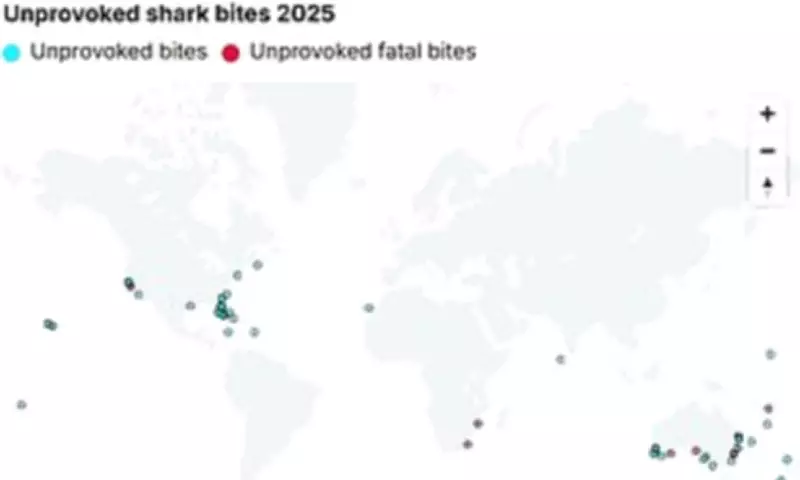
Global Shark Attack Hotspots Mapped for 2025
The world's shark attack hotspots have been identified in a new report, with a detailed map illustrating the locations with the highest number of encounters in 2025. According to the International Shark Attack Files' annual analysis, unprovoked bites returned to near-average levels after a significant decline in 2024. Overall, there were 65 shark attacks recorded last year, which is slightly below the ten-year average of 72 incidents.
Deadly Trends and Regional Dominance
However, 2025 proved to be an unusually lethal year for shark attacks, with nine fatalities reported compared to an average of just six. The United States emerged as the worst country for shark attacks, accounting for 25 bites or 38 percent of the global total. Within the US, Florida once again claimed the title of the world's shark attack capital, with 11 incidents in 2025—more than the combined totals of the next three states. This represents 17 percent of all unprovoked bites worldwide, with over half occurring in Volusia County in east-central Florida.
Leah Lendel, a nine-year-old girl, was snorkelling off the shore of Boca Grande, Florida, when a shark attacked and bit her hand, underscoring the risks in this region. The International Shark Attack Files compiles data from around the world, including records dating back to the 1500s, but only publishes information on 'unprovoked attacks,' defined as incidents where a person did not intentionally or unintentionally initiate contact with a shark. This excludes activities that alter shark behaviour, such as spear fishing or releasing a shark from a hook or net.

Australia's High Fatality Rate
Although the US had the most unprovoked attacks last year, it did not record the highest number of shark-related fatalities. That distinction goes to Australia, which accounted for 32 percent of the world's bites but a staggering 56 percent of all deaths. In 2025, Australia experienced one of its worst years for shark bites in recent history, with 21 incidents compared to a five-year average of just 13. This news follows a series of shark attack incidents that made headlines in early 2026, including four separate bites within 48 hours.
Shark attacks in Australia tend to be more dangerous due to the presence of the so-called big three species: bull sharks, tiger sharks, and white sharks. White sharks, colloquially known as great whites, can grow up to 20 feet (six metres) long and possess powerful jaws with serrated teeth. Their sheer size and strength mean that even a small 'exploratory' bite can prove deadly. Experts warn that the situation could have been far worse without Australia's robust beach safety measures.
Gavin Naylor, director of the Florida Program for Shark Research at the Florida Museum of Natural History, notes, 'If these bites occurred anywhere other than Australia, they would probably have resulted in even more fatalities. Their beach safety is second to none. Within minutes of a bite, they’ve got helicopters airborne ready to respond.' However, the remote locations of some Australian beaches can hinder timely emergency responses.
Notable Incidents and Global Patterns
In a tragic incident in November, a Swiss couple in their 20s was attacked by a bull shark while swimming and filming dolphins. A quick-acting bystander applied a makeshift tourniquet, and the man survived after being flown to a local hospital, but the woman died before paramedics could reach the scene. Elsewhere in the world, shark attack levels remained around average, with a few notable exceptions. An unprovoked attack in Canada marked the country's first since 2021, where a paddleboarder escaped uninjured after a white shark bit his board.
Last year also saw the first unprovoked fatality from a dusky shark bite, occurring in South Africa during the annual sardine run. This migration attracts predators, including dusky sharks, and a free diver in the area was fatally bitten by a shark lured close to shore. In terms of activity, snorkelling and free diving accounted for 15 percent of injuries, while 46 percent occurred while people were swimming or wading. Surfers made up a significant portion of victims, representing 32 percent of all unprovoked attacks.

One incident off the coast of the Canary Islands involved a shark attacking a British surfer’s hydrofoil surfboard before biting his leg. Despite a deep thigh wound, the man managed to swim back to shore for medical attention. The consistency in attack numbers over recent decades presents a mystery, as the 10, 20, and 30-year averages for unprovoked bites differ by only four incidents per year, and fatalities have remained unchanged at six. This stability occurs despite global shark populations plummeting due to overfishing and climate change.
Safety Advice and Risk Assessment
The International Shark Attack File emphasises that the risk of being bitten by a shark remains exceptionally low. While nine people were killed by sharks in 2025, lightning strikes are estimated to cause around 24,000 deaths annually and ten times as many injuries. To minimise risks, experts recommend the following precautions:
- Always stay in groups, as sharks are more likely to attack solitary individuals.
- Do not wander too far from shore, which isolates you and places you far from assistance.
- Avoid being in the water during darkness or twilight hours when sharks are most active.
- Refrain from entering the water if bleeding from an open wound or if menstruating.
- Do not wear shiny jewellery, as reflected light resembles fish scales.
- Avoid waters with known sewage or those used by fishermen, especially with signs of bait fish.
- Use extra caution in murky waters and avoid bright clothing that creates contrast.
- Refrain from excess splashing and do not allow pets in the water due to erratic movements.
- Exercise caution near sandbars or steep drop-offs, favourite hangouts for sharks.
- Do not enter the water if sharks are known to be present, and evacuate if seen.
Source: Florida Museum of Natural History.