Scientists Undergo Specialized Training for Polar Ice Dives
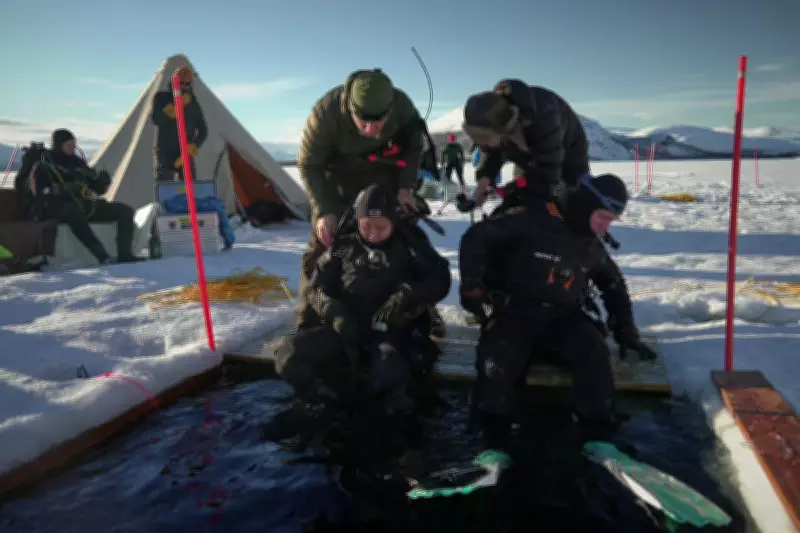
As bubbles ascended through the icy waters of a remote Finnish lake, diver Daan Jacobs surfaced through a man-made opening in the thick, frozen surface. His expedition had taken him eight meters beneath the Arctic ice, where filtered sunlight illuminated aquatic life around submerged rock formations. This hidden world, rarely witnessed during harsh winter months when land temperatures plummet to minus forty degrees Celsius, represents a critical frontier for climate science.
Addressing the Polar Climate Emergency
Jacobs, a biodiversity advisor from the Netherlands, participated in the Polar Scientific Diving program organized by the Finnish Scientific Diving Academy earlier this month. This initiative trains scientists and researchers to conduct underwater investigations beneath both Arctic and Antarctic ice sheets, studying flora and fauna in rapidly changing environments. "The view is beautiful," Jacobs remarked after his forty-five-minute dive, catching his breath in the freezing air.
The urgency of this work cannot be overstated. The Arctic region is warming at a rate four times faster than the global average, with devastating consequences ranging from disrupted weather patterns to threatened polar bear populations that depend on sea ice for hunting. Simultaneously, Antarctica faces accelerating ice sheet melt, contributing to sea level rise and disrupting delicate ocean ecosystems worldwide.

The Critical Need for Human Divers
Scientific understanding of these transformations requires direct examination of underwater habitats beneath remaining polar ice. Researchers must assess how climate change impacts organisms adapted to survive in near-darkness along seafloors. However, such investigations demand specialized scuba diving expertise combined with rigorous scientific training—qualifications currently held by only several hundred individuals globally.
Erik Wurz, a marine biologist and instructor with the program, emphasized the need for expanded research efforts: "Because it is melting so fast, we need more people deployed there—more science to be done—to understand better what happens. We must act quickly to preserve these unique Arctic and Antarctic ecosystems."
Despite technological advances, human divers remain indispensable for this work. Simon Morley, a marine biologist with the British Antarctic Survey, explained that robotic submersibles typically collect single specimens at a time, while trawling nets would destroy fragile habitats. "A diver can descend, gather twelve urchins in a bag, and minimize disturbance to the surrounding environment," Morley noted, though he is not directly involved with the Finnish training program.
Mastering Extreme Conditions
The academy's intensive ten-day sessions drill experienced divers in a frozen lake at the University of Helsinki's Kilpisjärvi Biological Station. Since its inception in 2024, demand has prompted organizers to add a second annual session. Participants include marine biologists, freshwater researchers, skilled recreational divers, and documentary filmmakers, all united by polar research ambitions.
Ruari Buijs, an oceanography student at England's University of Plymouth, aims to work in Antarctica studying marine megafauna. He enrolled in the polar diving class to enhance his employability after graduation. "This represents an excellent stepping stone toward that objective," Buijs stated.
Caroline Chen, a scientific diver and research assistant based in Germany, described polar diving as a lifelong aspiration. She believes the training will enable her to design future experiments under similarly challenging conditions.
Students must master diving beneath ice nearly one meter thick into water temperatures just above freezing. They contend with frigid air temperatures and fierce winds over Lake Kilpisjärvi, while support teams operate safety equipment and avoid frostbite. Trainees also learn emergency procedures, including how to assist divers who cannot locate the surface opening after prolonged submersion.

Unforgettable Underwater Experiences
Despite the hardships, divers describe transformative experiences beneath the ice. During recent sessions, the group explored waters under eighty-centimeter-thick ice. Chen observed fish along the seafloor and gazed upward as sunlight penetrated the ice, creating effects reminiscent of the Northern Lights. "It appears incredible from below," Chen said. "The scene constantly shifts, much like the auroras."
Buijs noted that while insulated diving suits protect most of the body, exposed areas around the mouth remain vulnerable to extreme cold. "The most uncomfortable sensation involves numb, protruding lips afterward," he chuckled. "It somewhat resembles having Botox injections."
As climate change accelerates polar warming, these trained divers will play an increasingly vital role in documenting and understanding transformations within Earth's most fragile ecosystems.