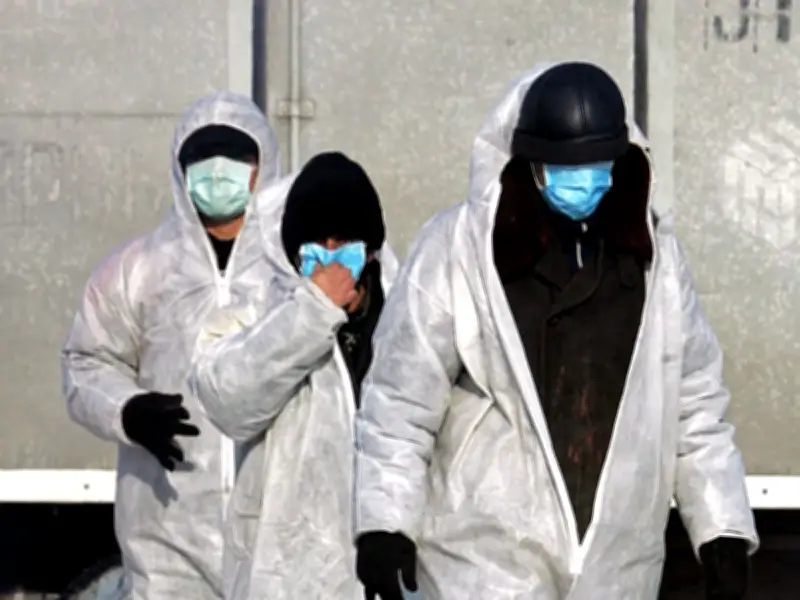
Russia has declared a "state of emergency" in Siberia as fears grow over a surging foot-and-mouth outbreak. The move comes after a medical alert earlier this week over two suspected cases of the deadly Black Death plague in the Irkutsk region, though health officials now insist no infectious diseases have been detected.
Emergency restrictions imposed
Alexander Osipov, the governor of the neighbouring Trans-Baikal region, has imposed emergency restrictions following the alleged spread of foot-and-mouth infections across borders from China and Mongolia. A draft decree from the governor warned of a "critical risk of the disease being introduced into and spreading throughout the region." Under the new rules, animals in border areas are set to be vaccinated while grazing is strictly curbed.
However, pro-Kremlin Telegram channel Babr Mash has claimed that infections have already crossed into Russia and accused authorities of staging a cover-up. The channel alleged that officials have actively refused to name the affected settlements. Osipov's administration insists the emergency measures are purely precautionary in response to a "serious and unfavourable animal disease" that threatens to spread further.
Previous outbreaks and cover-up allegations
Last month, cows were seized and burned in the Irkutsk region, with officials blaming an outbreak of nodular dermatitis, despite the symptoms reportedly matching foot-and-mouth disease. Earlier this year, as many as 4,500 cattle were slaughtered across Siberia's Novosibirsk region officially because of "pasteurellosis and rabies" - while farmers suspected the true reason was foot-and-mouth disease, and alleged a major official cover-up.
Foot-and-mouth is a highly contagious viral disease capable of sweeping through cattle and other livestock populations, triggering mass slaughter, crippling trade restrictions and devastating losses for farmers.
Backlash over scientist's death
Meanwhile, there is a backlash in the Irkutsk region over the authorities failing to say what killed young scientist Daria Shipilova, 28, amid widespread speculation the regime is seeking to hide a mystery plague outbreak as the cause. She worked at a major Irkutsk Anti-Plague Research Institute and there are fears she was infected with a killer disease at work.
The regional governor Igor Kobzev and health watchdog Rospotrebnadzor said a week-long quarantine had been lifted, with no infections found. But there was fury over officials failing to explain how Shipilova died, except to say it was an "unknown pneumonia". Locals flooded social media with questions for the governor who refused to mention her by name or express commiserations for her bereaved family.
He was asked by worried residents: "What is the final cause of Shipilova's death, and what evidence supports it? What methods were used to test her for Yersinia pestis [the plague bacterium], and when were the tests carried out? Where are the results?" Officials have been accused of not providing sufficient information to the World Health Organisation, with no details given of Shipilova's funeral arrangements more than a week after her death. One commenter said: "I don't believe she was vaccinated. I don't believe there were no accidents."
The plague is a potentially deadly bacterial infection caused by Yersinia pestis, usually spread by infected fleas or animals. Its pneumonic form can pass between humans through respiratory droplets and can prove fatal within days without prompt antibiotic treatment.