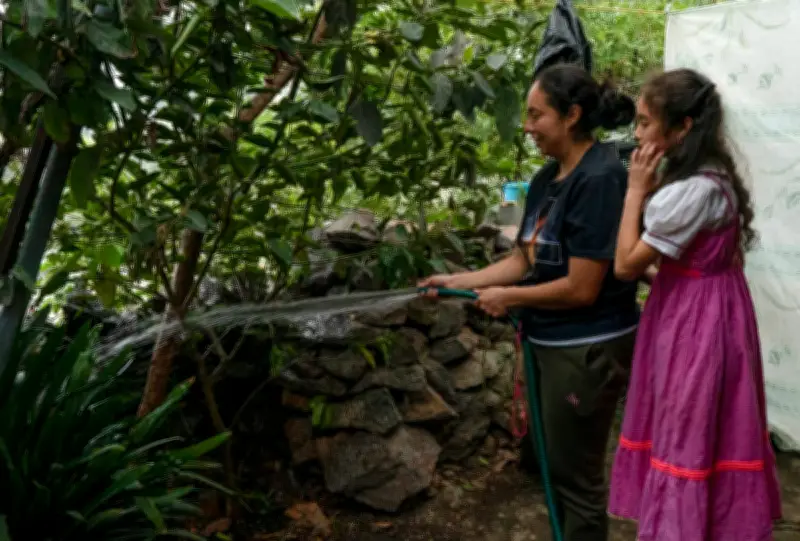
Ana Aparicio Bahena, a resident of the informal settlement Cristo Rey in Mexico City, now grows prickly pears, avocados, and lemons in her lush garden, thanks to a rainwater harvesting system installed four years ago. Her home, like many in the area, lacks connection to the water network, forcing her to previously collect water from a well 30 minutes away.
How the Rainwater Harvesting System Works
The system, provided by the non-profit Isla Urbana, captures rainwater from the roof and filters it for household use. Aparicio Bahena's system stores 2,500 liters of water, with a smaller 1,100-liter tank dedicated to watering plants. Founded in 2009, Isla Urbana aims to reach 1 million people by next year, focusing on low-income households and Indigenous communities across Mexico.
Impact on Daily Life
For Aparicio Bahena, the harvested water has enabled her to grow food, wash clothes, flush toilets, and bathe regularly—activities that were once limited due to scarcity. "We used to only be able to wash once a week," she said. The water is not drinkable, but she uses a small filter to convert it into safe drinking water. "The water harvesting system really changed our lives. Now we are able to dream and have more time," she added.
Broader Water Scarcity in Mexico
According to the National Health and Nutrition Survey, almost 17% of Mexican households struggle to meet basic water needs, and 74 million people (57% of the population) lack access to safe water. Droughts are frequent and worsening due to climate change. Isla Urbana co-founder Enrique Lomnitz explained that the system either replaces or complements water truck fleets for governments. In the past three years, the organization has installed systems at 2,000 public schools, educating children on water sustainability.
Another Success Story
In the Benito Juárez neighborhood, Dora Napolitano, a textile artist, installed a 5,000-liter rainwater harvesting system in 2018 for environmental reasons. Despite having tap water, she said the system, costing about 40,000 Mexican pesos (around £1,700), has been "a life-saver" during droughts, such as in 2018 and two years ago when mains water was unavailable for weeks. "It has got us out of trouble several times," she said.
Expert Insights
Judith Domínguez, a research professor at El Colegio de México, noted that rainwater harvesting is a good alternative in areas lacking formal services. "These systems can mitigate water scarcity, especially during rainy seasons, as well as address social and water vulnerability," she said. However, she emphasized the need for constant monitoring of water quality and filter maintenance, which households must bear the cost of once external support ends.