
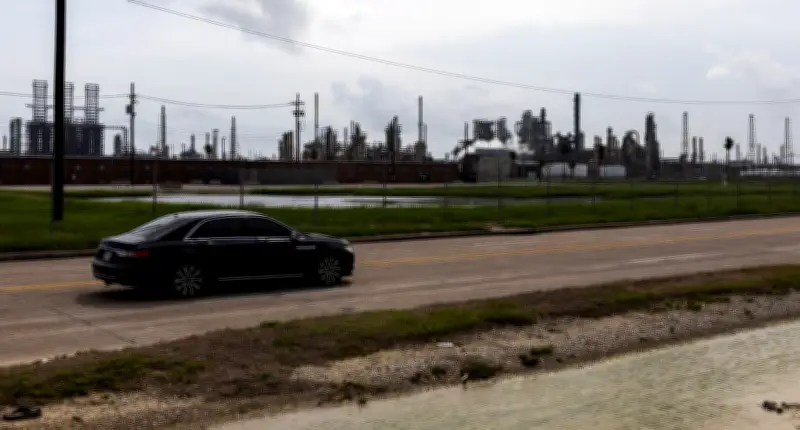
Residents of Port Arthur, Texas, say the Aramco-owned Motiva refinery exposes them to poisonous gases, causing cancer rates 40% higher than the state average, while Aramco sponsors the World Cup.
The refinery's impact on Port Arthur
Jamal Johnson walks home down the middle of a wide street in Port Arthur, a town of 55,000 people 100 miles east of Houston. Behind him looms the Motiva oil refinery, the largest in the US by some measures, covering 3,600 acres and producing up to 654,000 barrels of crude oil per day. Johnson lists a grandfather and aunt who died of cancer, and an uncle who died from ALS. "They've let off all these poisonous gases; it's like that all the time. It's fucked up," he says.
The refinery, solely owned by Saudi Aramco since 2017, is a major sponsor of FIFA, with pitchside ads and an "Aramco Arena" at the Houston fan festival. But in Port Arthur, there are no such bright lights. A 2021 study named it the poorest city in Texas, with a median household income of £27,700 and home value of £49,800. Almost 30% of the population lives below the poverty line. Cancer diagnoses consistently exceed the state average, with a cancer mortality rate 40% higher for the predominantly black community. Childhood asthma rates are almost double the national average, and heart disease is in the 90th percentile.
Emissions and violations
Emissions of benzene, a highly carcinogenic chemical, are among the highest in the US. Methane, carbon dioxide, hydrogen sulphide, and sulphur dioxide are also common pollutants. In 2024, Motiva was fined about £9,900 for an unauthorised sulphur dioxide release in 2023. In July 2023, they received a £43,000 penalty for a similar offence. In 2022, a £214,000 penalty was handed down for a major leak of contaminated water. In March 2024, an explosion at the adjacent Valero plant released more than 157,000 pounds of chemicals over 10 days.
Residents' experiences
Hilton Kelley, an environmentalist who grew up in Port Arthur, says he has attended funerals of many classmates who died of cancer before their time. He lists Jennifer Benson, who lived two blocks from Motiva and died at 25, and others. Residents on the west side, segregated until the mid-1960s under Jim Crow laws, have given up growing vegetables outdoors due to a film of black spots and dust on produce. Charles, a carpenter, says, "They've been killing us all our damn lives."
Economic and racial disparities
John Beard Jr, a former refinery worker and founder of the Port Arthur Community Action Network (Pacan), describes the situation as "environmental racism." Black families who bought properties on the west side during segregation have nowhere to go. Home values have dropped by $40,000 on a $100,000 home due to pollution. Some residents claim Motiva offers buyouts at desultory rates. "They want us away from here," says Johnson. "They want to make this refinery land."
FIFA and Aramco's responsibility
Beard questions why Aramco and FIFA have not invested in local soccer fields or community benefits. "Where are Aramco or FIFA on our soccer fields?" he asks. "It's basically blood money." FIFA's sustainable sourcing code requires sponsors to manage environmental impacts and improve greenhouse gas emissions, but FIFA did not respond to questions about Aramco's compliance. Kelley notes some improvements, like Motiva renovating downtown buildings, but says pollution is only 75% better than when Texaco owned the plant. Beard remains skeptical: "They're still putting that crap in the air. They should be looking at reducing pollution to zero."




