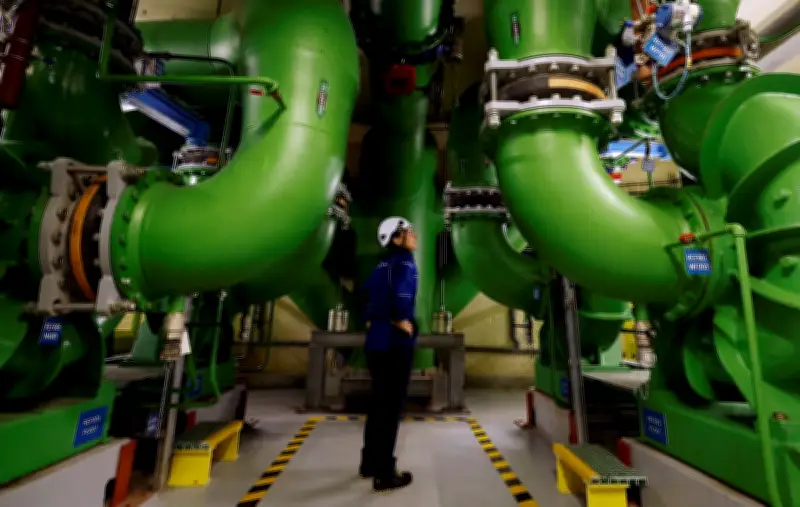
Paris is expanding its underground district cooling network, which uses cold water from the Seine River to cool buildings, aiming to triple its size by 2042. The system, one of the world's largest, currently spans 120 kilometers (75 miles) of pipes serving museums, offices, hospitals, and schools, including the Louvre and the Grand Palais.
How the Cooling System Works
The network circulates cold Seine water through pipes that run alongside pipes carrying warm water from buildings. A heat exchanger transfers heat from the building water to the river water without the fluids mixing. The cooled water then circulates back to buildings, while the river water returns to the Seine slightly warmer. This centralized approach replaces thousands of individual air conditioning units.
Expansion Plans and Goals
The city of Paris owns the network, operated by RATP and Engie under a 20-year concession renewed in 2022. Fraîcheur de Paris, the company managing the system, plans to extend it to all arrondissements and connect over 3,000 buildings, including critical infrastructure like hospitals and schools. Tim Guigon, a spokesperson for Fraîcheur de Paris, said: 'The ambition is to move from a historic network focused on large tertiary buildings to a city-wide infrastructure.'
Environmental and Energy Benefits
Experts highlight the system's efficiency. Charles Simpson, a senior researcher at University College London, said: 'The energy consumption should be much less than if the same cooling were provided by modular systems.' The network also helps combat the urban heat island effect by reducing heat released from individual AC units. Sophie Parison, a researcher on urban heat, noted: 'Everything that requires energy releases heat, and that heat has to go somewhere.'
Pauline Lavaud, director of climate transition in the Paris city government, stated that the network 'offers much higher energy and environmental performance than individual cooling systems.' While the system returns slightly warmer water to the Seine, studies show temperature changes remain within environmental limits.
Challenges and Replication Potential
Cost is a major barrier. The 20-year contract for Fraîcheur de Paris is valued at €2.4 billion (£2 billion). Replicating such a system in London would cost at least that, and the Thames lacks ideal water flow and temperature. Emmanuel Gendreau, an ecologist at the Sorbonne, said: 'Actions must always be adapted to the type of city and local issues. It is crucial not to simply apply adaptations that have already worked in one city directly to another.'
Other cities like Stockholm and Toronto use similar district cooling systems. For developing economies, high interest rates and infrastructure challenges may make city-wide retrofits unaffordable, but in areas with less existing underground infrastructure, implementation could be more feasible.