Florida's Abandoned Canal Project Sparks Renewed Environmental Restoration Battle
Decades after the ambitious Cross Florida Barge Canal project was halted, environmental advocates are intensifying efforts to permanently open a dam constructed for the abandoned waterway. This initiative aims to reunite two major rivers and restore a significant portion of Florida's natural landscape that has been submerged since the 1970s.
The Legacy of Florida's Unfinished Panama Canal
Originally envisioned as Florida's answer to the Panama Canal, the Cross Florida Barge Canal was designed to create a shortcut for vessels traveling from the Atlantic Ocean to the Gulf of Mexico, bypassing the need to navigate around the entire peninsula. However, construction was abruptly stopped in 1971 due to mounting environmental concerns, leaving behind a dam and reservoir that have since altered the region's ecology.
The Kirkpatrick Dam, spanning 7,200 feet (2,200 meters), and the adjacent Rodman Reservoir have submerged approximately 9,500 acres (3,844 hectares) of the Ocala National Forest. This flooding has drowned 20 natural springs and disrupted critical wildlife corridors, including migration paths used by manatees and other species.

Periodic Drawdowns Reveal Lost Ecosystems
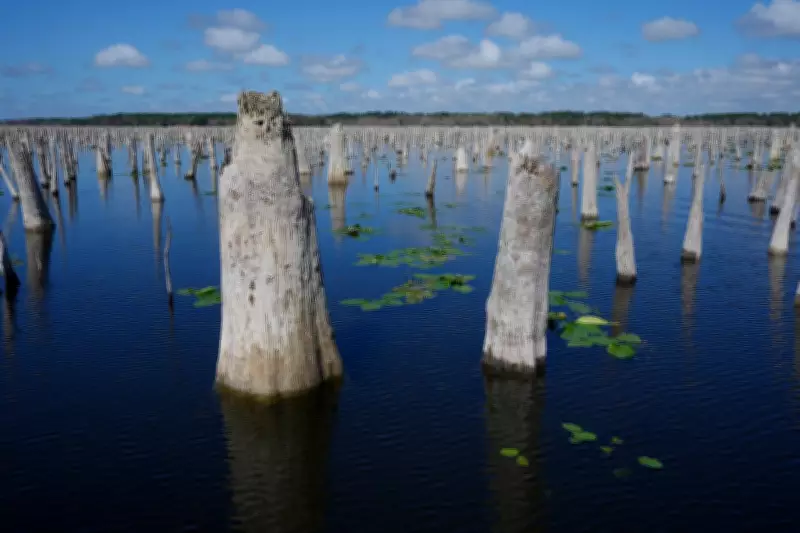
Every few years, state authorities drain the reservoir to remove accumulated sediment, temporarily revealing the submerged landscape. During these drawdowns, the area briefly returns to its natural state: springs reemerge, cypress saplings begin to grow, and wildlife such as bears, deer, wild turkeys, and sandhill cranes return to the dried land.
The most recent drawdown, the first in six years, commenced in October and concluded in early March. "It's haunting, like a graveyard," described Karen Chadwick, a local charter boat captain, as she navigated among decayed tree trunks protruding from the receding waters.
Legislative Setback and Continued Advocacy
A recent legislative effort to support a $70 million restoration project for the Ocklawaha River, which would involve opening the dam over four years, failed to pass before the Florida legislative session ended last week. The bill had gained bipartisan support in the House but awaited a Senate vote when the session concluded.
"While the bill did not receive a final vote in the Senate this session, the strong bipartisan support it earned reflects growing momentum for restoration," stated Nina Bhattacharyya, executive director of Florida Defenders of the Environment. Advocates remain optimistic and plan to regroup to identify new strategies for advancing the restoration initiative.
Environmental and Safety Concerns Drive Urgency
Proponents of dam removal emphasize both ecological and safety arguments. Reuniting the St. Johns and Ocklawaha rivers with Silver Springs—one of the largest spring systems in the United States—would restore natural water flows, revive submerged springs, and reconnect wildlife habitats. "By removing the dam, we would reunite the waters," Bhattacharyya explained. "Wildlife would be able to move back and forth—migratory fish, manatees, and so much more."
Additionally, concerns about the dam's structural integrity have intensified, as it has surpassed its intended lifespan. Advocates warn that a potential collapse could endanger hundreds of nearby homes. "Something is going to happen, maybe next year, maybe in a couple of years," cautioned Republican state Senator Jason Brodeur, the legislation's sponsor. "Something has to be done."
Economic and Recreational Opposition
Opposition to permanently emptying the reservoir comes primarily from fishing groups and local economic interests. They argue that Rodman Reservoir has evolved into a world-class fishing destination, particularly for largemouth bass, supporting camping, birdwatching, and related businesses in rural Putnam County—one of Florida's poorest regions.
"We have created chicken salad out of chicken," remarked Putnam County Commissioner Joshua Alexander, highlighting how locals have adapted to the dam's presence by building outdoor recreation businesses. Steve Miller, president of Save Rodman Reservoir, added that the reservoir helps reduce nutrient levels and could serve as an alternative water supply amid Florida's population growth.

Historical Context of Environmental Restoration in Florida
The push to restore the Ocklawaha River aligns with broader efforts in Florida to rectify past environmental mistakes. Similar projects include the multibillion-dollar restoration of the Everglades, which had shrunk to half its size due to earlier water management projects, and the recently completed restoration of the Kissimmee River, where dredging and canals installed in the 1960s disrupted floodplain ecosystems.
"Nature is very resilient," observed Chadwick, "if you just get out of the way and let it do its thing." As debates continue, the fate of the Kirkpatrick Dam remains a pivotal issue balancing ecological restoration, economic interests, and public safety in Florida's evolving landscape.