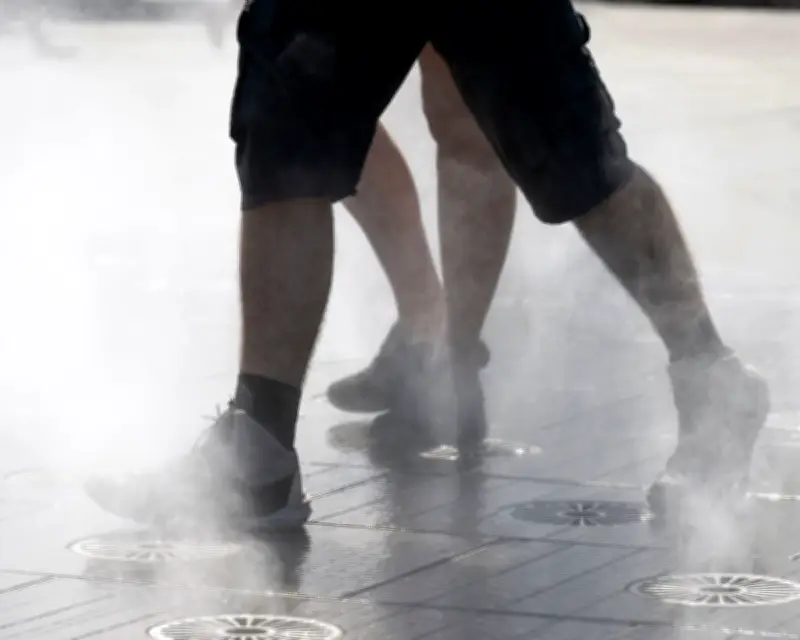
Budapest is forecast to exceed 40C on Tuesday as the record-breaking heatwave that scorched western Europe shifts east, bringing dangerous conditions to central and eastern Europe. The heat dome behind last week's extreme temperatures has moved, prompting red warnings for extreme heat across Hungary, Poland, Romania, Serbia, Croatia, Slovakia, and Bosnia and Herzegovina.
Authorities Urge People to Stay Indoors
Hungarian authorities published a list of more than 2,000 air-conditioned cooling centres across the country for people unable to find relief from the heat in their homes. Hungary’s prime minister, Péter Magyar, wrote on X on Monday: “The two hardest days of the heatwave are coming. Let’s show that we are capable of complete national unity. Let’s look out for each other.”
Belgrade and Bucharest reached 38C and 37C respectively on Monday. The European Centre for Medium-Range Weather Forecasts models show Budapest exceeding 40C on Tuesday.

Germany Records Highest Temperature
Germany recorded its highest temperature for a third consecutive day on Sunday, with preliminary data from the DWD weather service showing 41.7C in Coschen, Brandenburg. The extreme heat disrupted transport in several cities after tram tracks buckled, while Berlin police deployed water cannon to cool crowds gathering in public spaces.
Western Europe Sees Relief but Tragedies Mount
The worst of the heat has begun to ease in western Europe after temperature records were shattered. In France, officials said the heatwave had contributed to more than 1,000 excess deaths, while Spain’s institute of health recorded more than 800 additional deaths nationwide.
Fresh tragedies were also reported across Europe over the weekend. Two cyclists, aged 30 and 71, died, apparently due to the heat, while taking part in a Poland Bike Marathon event near Warsaw on Sunday. In Cyprus, police said two Bulgarian boys, aged eight and 10, were found dead inside a parked car on Sunday afternoon. At least 13 people died in swimming accidents in Germany over the weekend, police in the country said.
Violent Storms Hit Italy
Extreme weather brought violent storms to Italy’s Alto Adige region, where torrential rain triggered flash floods and landslides, with up to 50mm falling in just one hour in some areas. Several residents were evacuated from their homes, while firefighters rescued a person trapped in a garage after a river burst its banks near the town of Merano.
Climate Crisis Link
The heatwave scorching Europe, the most severe and widespread ever, is only possible due to the climate crisis driven by fossil fuel burning, scientists have said.
Vulnerabilities in Central and Eastern Europe
Experts say central and eastern Europe faces a uniquely compounding set of vulnerabilities to heat. The region’s cities are often dominated by socialist-era prefabricated concrete panel blocks designed entirely around heating, with heavy concrete walls that trap heat and have no ventilation for summer. Air conditioning usage across much of the region remains in the low single figures, against a European average of about 19%, according to the International Energy Agency.
Ukraine Energy Grid Bracing
In Ukraine, the battered energy grid was bracing for a sharp rise in electricity demand as temperatures climbed. Emergency power outages were reported in several regions amid the extreme heat, according to local authorities and electricity providers. The state hydrometeorological centre forecast temperatures of 35C to 38C on Monday, warning of “intense heat”. “The heat is also a serious test for equipment that has been operating under wartime conditions for more than four years and has withstood numerous attacks,” Serhii Kovalenko, chief executive of energy company Yasno, said over the weekend.