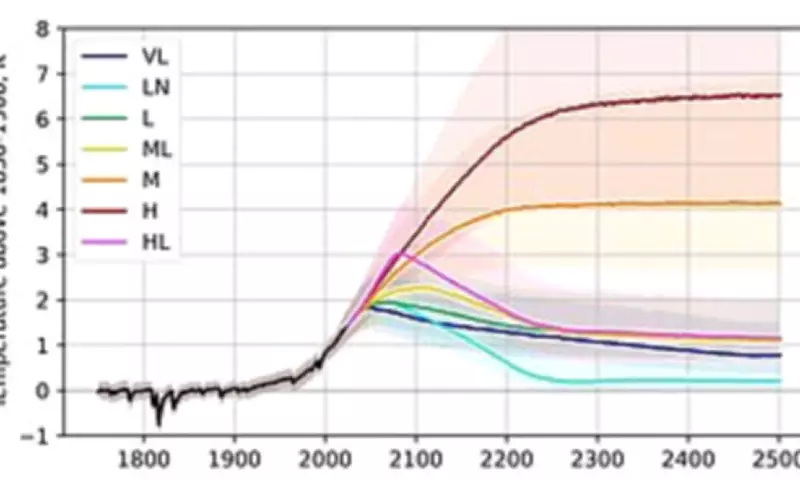
Scientists have laid bare Earth's worst-case climate scenario, warning that global temperatures could rise by a whopping 3.5°C (6.3°F) by 2100. In an ominous new study, the world's top climate modellers have reassessed the 'pathways' scientists use to predict the environment's future. Scientists say that the newly defined 'high emissions' scenario could lead to 'enormous climate impacts'.
Key Findings
Lead author Professor Detlef van Vuuren, from the University of Utrecht, says these include 'strong sea level rise, more extreme weather events, and impacts on crop yields'. Professor van Vuuren told the Daily Mail that this scenario would put the planet at risk of passing so-called 'tipping points', beyond which recovery is not possible. This warming could even trigger 'major impacts' on key ocean currents such as the Atlantic Meridional Overturning Circulation (AMOC).
However, even with these new models, the outcome of this worst-case scenario is not entirely certain. If the climate is more sensitive to greenhouse gases than scientists predict, Professor van Vuuren says the climate could be closer to 4°C (7.2°F) warmer.

ScenarioMIP and IPCC
This scenario is the work of the Scenario Model Intercomparison Project (ScenarioMIP), an international steering committee of 20 scientific experts. The researchers worked together to update the scientific scenarios which form the basis for how supercomputers will model the future climate. These models will also be the foundation of the next major assessment from the UN's Intergovernmental Panel on Climate Change (IPCC), which will set the tone for global environmental policy.
'Scenarios are used in climate science to explore possible futures in order to answer specific questions,' Professor van Vuuren explains. 'Key questions the set aims to answer are what happens under current policy, what is needed to meet our climate goals, and what could be a low-probability but high-risk outcome.'
High-Emissions Scenario
The 'high-emissions scenario' aims to tackle that last question and show what might happen if the world's climate policies fail. It is important to note that this would not be a 'business-as-usual' situation, and would actually require the world to weaken or even abandon climate action. That would involve a decline in the use of renewable energy and a significant expansion of the use of fossil fuels.
This could occur due to geopolitical factors or local issues, such as 'opposition to building new wind farms' or concerns about employment in fossil fuel industries. That doesn't mean that 3.5°C (6.3°F) of warming above the pre-industrial average is likely, just that it is the most warming that is plausible in the next 80 years.
Planning for the Worst
The point of having these models is not just to help scientists, but to ensure that societies can build robust defences for the worst possible outcome. For example, whether building flood defences in the UK or dikes in the Netherlands, governments will need to plan for the most extreme flooding that is plausible. Professor van Vuuren adds: 'In most things in life, we make sure that we build in safety.'
Comparison with Previous Predictions
The good news is that 3.5°C (6.3°F) of warming in the worst-case scenario is actually significantly cooler than scientists' previous predictions. The last time ScenarioMIP charted the planet's possible future, they predicted that 4.5°C (8.1°F) was plausible by 2100. In our current worst-case scenario, the world will still reach 4.5°C (8.1°F) of warming eventually, but this has now been pushed back to 2130.
However, this new prediction isn't lower because scientists overestimated the first time around, but because the world's climate action is working. 'In the last 15 years, we have been tracking a medium emission pathway,' says Professor van Vuuren. 'In addition, there is some impact of the low costs of renewables compared to fossil fuels and some emerging impacts of climate policy. So even if interest in fossil fuels would drive us back to a high emission pathway – we would come out lower in 2100.'

Current Trajectory
If the world follows its current 'middle of the road' pathway without making any more substantial changes, the researchers expect to see 3°C (5.4°F) of warming by 2100. Professor van Vuuren cautions that this will already lead to 'dangerous climate impacts'. He says: 'We know that climate impacts are expected to increase with every 0.1°C of warming – above 2°C we will get into the red zone for many possible impacts. However, it is very important to note that both 3.5°C and 3°C will lead to enormous climate impacts, and it would be wise to avoid such high levels of climate change.'