Doomsday Glacier Accelerates Towards Catastrophic Collapse, Study Warns
Antarctica's so-called Doomsday Glacier, officially known as the Thwaites Glacier, is on a perilous path towards collapse, with new research indicating its ice is melting at an alarming and accelerating rate. A study from the University of Edinburgh reveals that this massive ice formation, comparable in size to the United Kingdom, could shed a staggering 200 gigatonnes of ice every single year by 2067.
Unprecedented Ice Loss Projections
This projected ice loss surpasses the current annual depletion of the entire Antarctic Ice Sheet, which has been losing approximately 150 gigatonnes of ice per year over the past two decades. The consequences are dire: such a melt would contribute an additional 0.5 millimetres to global sea level rise annually, outpacing the combined impact of all mountain glaciers worldwide. The Thwaites Glacier holds enough freshwater to raise sea levels by a colossal 65 centimetres if it were to disintegrate completely.
Lead author Dr. Daniel Goldberg emphasised that while total collapse is not immediate, the glacier is rapidly accelerating towards disaster. He stated, 'That rate of 200 megatonnes per year could then increase quite quickly, and that instability could lead to collapse. That would be catastrophic for hundreds of millions, if not billions, of people in coastal cities around the world.'

Critical Role and Rapid Changes
The Thwaites Glacier serves as a vital drainage system for the West Antarctic Ice Sheet, funnelling ice and snow into the Amundsen Sea. Its stability is crucial for maintaining the integrity of the entire Antarctic Ice Sheet, making any potential collapse a global concern. Satellite data confirms that this glacier is among the fastest-changing in Antarctica, with current ice loss occurring five times faster than in the 1990s.
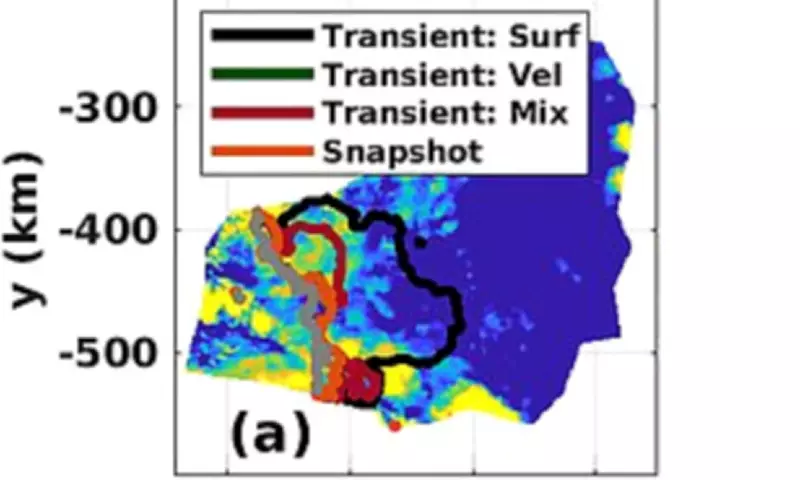
Published in the journal Geophysical Research Letters, the study utilised a sophisticated satellite-calibrated ice sheet model to simulate future melting. Unlike most research that relies on ice velocity measurements, this analysis incorporated satellite elevation data, yielding more accurate and alarming predictions of rapid ice loss.
Geological Factors Driving Acceleration
The simulations pinpointed deep troughs in the Antarctic bedrock, extending up to 60 miles inland, as hotspots for the most rapid ice loss. Dr. Goldberg explained that the glacier's acceleration is concentrated over a deep valley, suggesting that underlying geology, alongside human-induced climate change warming the Amundsen Sea, plays a significant role in its retreat. 'Where Thwaites is now going at its absolute fastest, it is sitting on top of this valley that goes directly inland,' he noted. 'The more it retreated into the valley, the faster it accelerated.'
Long-Term Implications and Human Response
At current emission rates, Dr. Goldberg estimates catastrophic collapse could occur within about 200 years. However, the glacier responds sluggishly to climate changes, currently reacting to alterations from the late 20th century. This lag means that efforts to curb emissions might delay collapse by centuries, but the benefits may not be visible for generations.
'It would be a bit disingenuous to say, "stop burning fossil fuels today and stop losing ice tomorrow,"' Dr. Goldberg remarked. 'It could take a century for any changes we make today to be evident in the loss of mass from Thwaites. It's a scary thought because humanity, if they care about sea level rises, will have to change their behaviour and not really see the outcomes while any of us are still alive.'
Historical Context and Global Impact
The Thwaites Glacier, up to 4,000 metres thick, has been retreating since the 1970s, with its grounding line moving nearly 14 kilometres inland from 1992 to 2011. Annual ice discharge has surged by 77 percent since 1973. As a gateway to the West Antarctic Ice Sheet, its collapse could trigger a sea level rise of one to two metres, with potential for even greater increases from the entire ice sheet, threatening coastal communities worldwide.