The Trump administration has opened a new front in its culture war against diversity and LGBTQ+ inclusion, this time targeting Major League Baseball. The Justice Department intervened after three San Francisco Giants pitchers added Bible verses to their rainbow-logoed caps during Pride Night, vowing to investigate whether the players' religious expression rights were violated.
The Giants players—Landen Roupp, Ryan Walker, and JT Brubaker—were not fined or disciplined by MLB. They were not required to wear the rainbow cap and could have opted out. However, the Justice Department's involvement signals a broader ideological battle, with Defense Secretary Pete Hegseth and President Donald Trump asserting that white, heterosexual, Christian men face the most discrimination in the United States, according to a New York Times report.
Justice Department Targets MLB Over Pride Caps
The Justice Department's investigation follows MLB's criticism of the players for protesting Pride Night. The department claims it is protecting religious expression, but critics argue it is part of a larger effort to weaponize the government against perceived enemies. This comes as Hegseth wages a 'war on diversity' within the military, blocking promotions of minority and non-male officers, as reported by the New York Times.

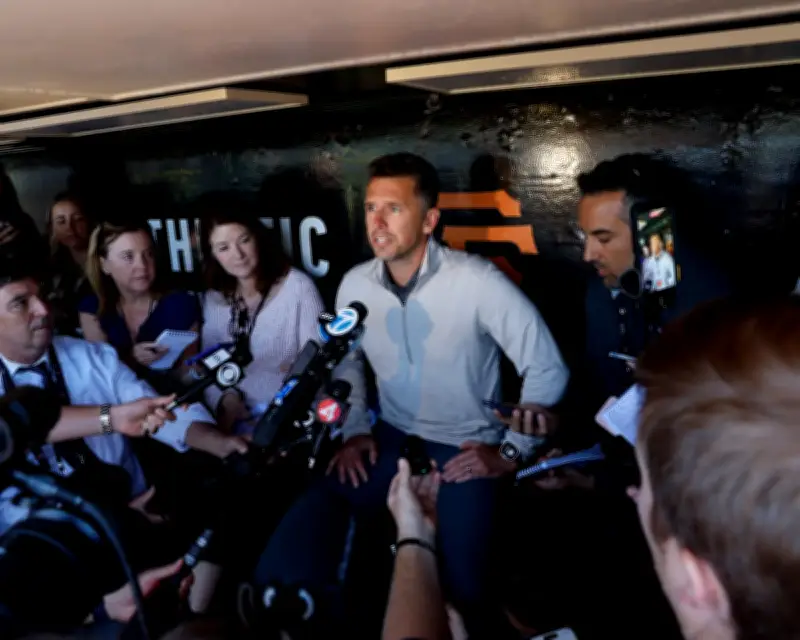
The Giants' response has drawn sharp criticism. President of baseball operations Buster Posey, a three-time World Series champion and former fan favorite, faced reporters in the dugout on Tuesday but refused to answer non-baseball questions, appearing annoyed and distant. He was eventually rescued by his public relations department, leaving many to question his leadership. 'Posey spoke loudest when not speaking at all,' wrote Howard Bryant, author of 11 books on sports and politics.
Giants' History of LGBTQ+ Inclusion Contrasts with Current Stance
The controversy marks a stark departure from the Giants' history of progressive activism. In 1994, they became the first professional sports team to hold an HIV/AIDS awareness game, partnering with the NAMES Project and raising funds for pediatric AIDS care. Reliever Rod Beck and his wife Stacey were major supporters of Camp Sunburst, a camp for children affected by AIDS. The team was then led by manager Dusty Baker and featured local hero Barry Bonds, embodying the city's values.
Today, the Giants are owned by Charles Johnson, a 93-year-old conservative donor. The players' protest reflects their owner's politics rather than the city's, according to Bryant. San Francisco has a rich LGBTQ+ history, and the Giants' failure to defend Pride Night has alienated many fans. 'The leader couldn't lead,' Bryant wrote. 'His smallness forced a reappraisal of him standing in his catcher's gear during all those Pride Nights and “Until There’s a Cure” ceremonies.'
Broader Culture War Context
The Justice Department's move is part of a pattern. In 2024, Hegseth's Pentagon attempted to erase Jackie Robinson's military service from its website before backing down after public outcry. The department claimed it was a 'mistake.' Trump's administration has also targeted California Governor Gavin Newsom, with the Justice Department investigating him and his wife for alleged financial irregularities—a move widely seen as political retribution.
Hegseth's book, The War on Warriors, outlines the ideology driving these actions: 'It’s Black over white. Female over male. Gay over straight,' he wrote. This worldview frames white, heterosexual, Christian men as the most discriminated group, a narrative that Trump and his allies have promoted aggressively.
The Giants' situation reflects the larger struggle over American values. The team once stood as a model for integrating sports and social progress. Now, its leadership appears unwilling to stand up for those principles. As Bryant concluded, 'The players in protest reflect their owner and not their city.'