
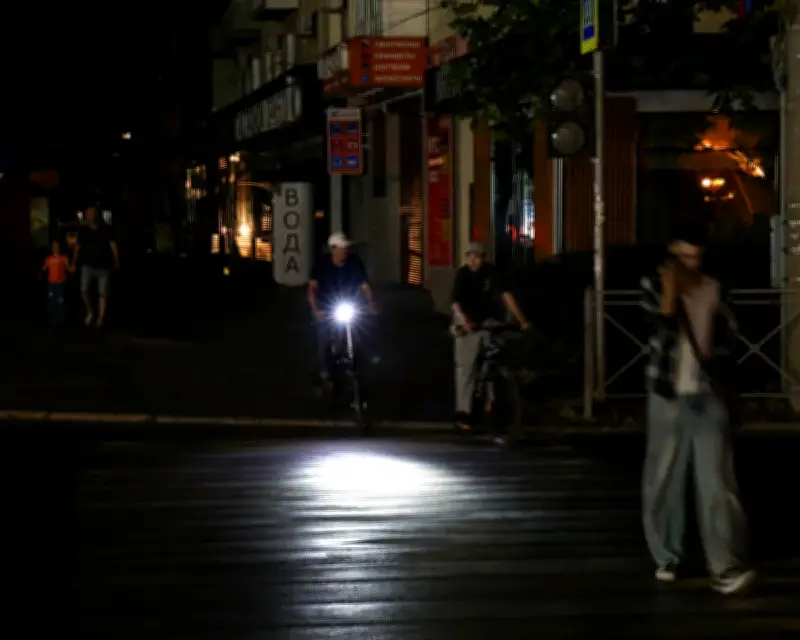
Residents of Russian-occupied Crimea are enduring severe disruptions to daily life, including prolonged power outages, fuel shortages, and water cuts, as Ukraine intensifies its military campaign to isolate the peninsula.
Marina, who runs a small guesthouse in the resort town of Yevpatoria, said Russian tourists stopped coming as Ukrainian drones and missiles struck Crimea through spring and summer. Petrol became scarce, and now electricity and running water are cut off for much of the day.
“For 12 years they told us Crimea was 100% protected,” Marina said, referring to Russian promises since the 2014 annexation. “And then, within a month, we’ve been thrown back into the Stone Age – no electricity, no water, no fuel.”
Widespread disruptions
Since early 2024, Ukraine has launched its largest sustained air campaign against Crimea, targeting the peninsula and its transport links to Russia. More than 70% of Crimea’s roughly 2.5 million residents have experienced power outages, with many going days without electricity or water, according to a Guardian analysis.
Fuel shortages, which first hit Crimea and later spread to Russia, prompted Kremlin-installed authorities to declare a state of emergency and ban sales to private motorists to preserve supplies for the military.
Festivals, summer camps, and beach events have been cancelled. Long queues for petrol and daily searches for showers and phone charging points have become the norm. “We’re surviving, not living,” one resident said.
Growing frustration
Interviews with over a dozen residents point to a sense of abandonment and frustration with both Russian-installed authorities and Moscow. Aleksei, a Crimean native who supported the 2014 annexation, said his restaurant has been empty this summer as tourists stayed away, and shortages make it hard to source fresh produce.
“The authorities kept insisting Crimea was ready for anything. Literally anything. It turns out the authorities failed to prepare for the worst,” he said. “People are hunting for fuel like it’s The Hunger Games.”
Comments on officials’ social media posts are flooded with pleas for help. “Belogorsk has been without electricity for more than 70 hours, and all we keep getting are promises,” one comment read, addressed to Crimea’s Russian-installed head, Sergei Aksyonov.
Strategic importance
Crimea, annexed by Russia in 2014, became a key staging ground for the 2022 invasion of southern Ukraine. Its military infrastructure supports air attacks and battlefield operations. Moscow has encouraged hundreds of thousands of Russians to settle there.
By targeting Crimea, Ukraine aims to strengthen its hand in future peace negotiations, said Rob Lee, a military analyst at the Foreign Policy Research Institute. “Ukraine has more leverage in future negotiations than it did before because it can now reliably strike almost any target in Crimea.”
Military campaign intensifies
Ukraine has focused strikes on supply routes, particularly the Novorossiya highway linking Crimea to Russia’s Rostov region. Ukrainian forces struck over 240 Russian military trucks in the first week of July alone, according to French analyst Clément Molin. Kyiv also said it had hit 90 vessels used to supply the peninsula in the past week.
An unnamed Russian general said Ukraine’s successes partly stem from Moscow diverting resources from Crimea to its offensive in the Donbas, leaving Crimea as “third or fourth” on Russia’s list of priorities.
Military analysts expect Ukraine to intensify attacks on the Kerch Bridge, which links Crimea to Russia, to deepen shortages.
Kremlin response
President Vladimir Putin instructed the government to provide subsidies to Crimea and Sevastopol for fuel purchases and lower petrol prices, calling the disruptions “temporary problems.” But residents remain skeptical. “They keep telling us these are only temporary problems,” said Dmitry, a university student. “We’ve been living like this for weeks. This isn’t normal life, and it can’t go on much longer.”




