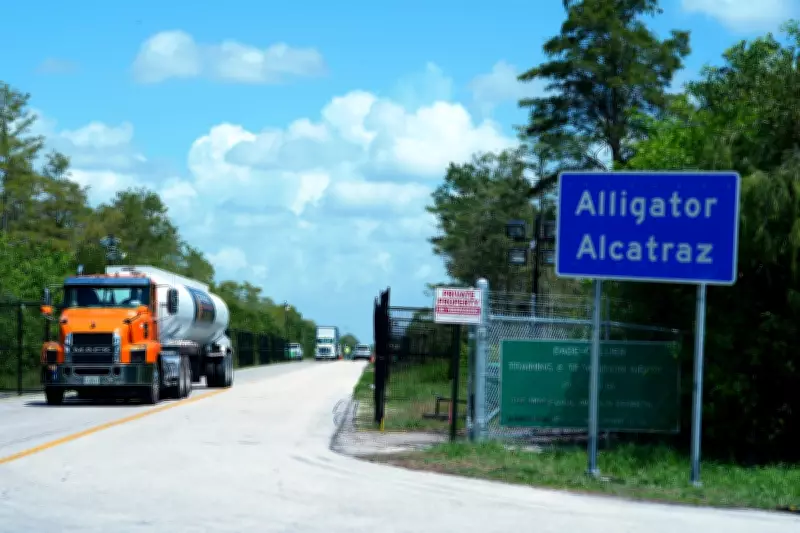
Environmental organisations have formally petitioned a federal appellate court panel to revoke its temporary suspension on the closure of an immigration detention facility located in the Florida Everglades, colloquially known as "Alligator Alcatraz." The groups argue that the centre, which remains operational and continues to detain individuals, should be shut down due to non-compliance with federal environmental regulations.
Legal Battle Over Federal Control and Funding
The appellate court initially imposed the halt in early September, based on arguments from Florida state officials and the Trump administration. They contended that since the state had not yet applied for federal reimbursement, it was not obligated to adhere to federal environmental laws. This detention centre was established last summer as part of President Donald Trump's stringent immigration policies, aiming to bolster enforcement efforts in the region.
During oral arguments held in a Miami courtroom, three appellate judges scrutinised the extent of federal oversight over the state-constructed facility. They explored the specific conditions under which an environmental review is mandated by federal law to ensure compliance. The judges have not provided a timeline for their ruling, leaving the outcome uncertain.

Arguments from Both Sides
Jesse Panuccio, representing the Florida Department of Emergency Management, asserted that federal environmental law only applies if two criteria are met: federal funding and federal control. He emphasised that while FEMA approved $608 million in funding for the centre's construction and operation in late September, the federal agencies lack direct control over the state-run detention centre. "You need both," Panuccio stated. "Even with funding, I don't think that would follow because they don't have federal control."
In contrast, Paul Schwiep, an attorney for the environmental groups including Friends of the Everglades and the Center for Biological Diversity, argued that the law requiring an environmental review is applicable. He highlighted that immigration is constitutionally a federal responsibility, not a state one, and the Department of Homeland Security authorised the funding. "What is different about this property is that immigration is constitutionally a federal function," Schwiep explained. "The state has no role."
Previous Court Orders and Ongoing Challenges
In mid-August, a federal district judge in Miami ordered the facility to cease operations over a two-month period, citing the failure of officials to conduct a mandatory environmental impact review under federal law. The judge concluded that a reimbursement decision had already been made, but the appellate court later stayed this order pending appeal.
This environmental lawsuit is one of three federal court challenges against the Everglades facility since its inception. In another case, a detainee claimed that Florida agencies and private contractors had no authority to operate the centre under federal law; this challenge was resolved after the detainee agreed to be removed from the United States. A third lawsuit resulted in a federal judge in Fort Myers, Florida, ruling that the facility must improve detainees' access to attorneys and provide confidential, unmonitored legal calls.
The ongoing legal disputes underscore the complex interplay between state actions and federal mandates in immigration enforcement and environmental protection.