Climate Change Fuels Nighttime Wildfires, Disrupting Natural Fire Cycles
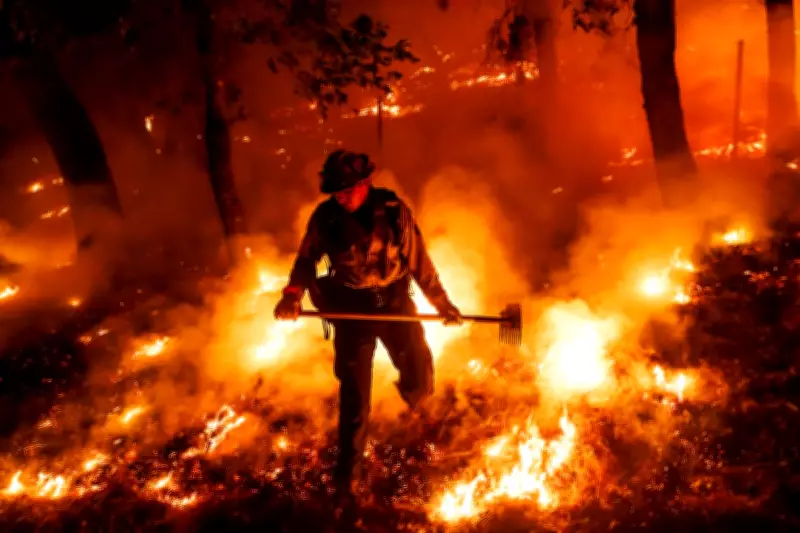
Wildfires traditionally subsided or ceased entirely during nighttime hours, as cooler temperatures and higher humidity provided a natural respite. However, human-induced climate change is now causing these fires to burn overtime, extending their duration and intensity well into the night, according to a groundbreaking study published in Science Advances.
Extended Burning Hours and Fire Seasons
The research indicates that the number of hours in North America with weather conditions favorable for wildfires has surged by 36% compared to five decades ago. This translates to regions like California experiencing an additional 550 potential burning hours since the mid-1970s. In parts of southwestern New Mexico and central Arizona, the increase is even more stark, with up to 2,000 extra hours annually prone to fire ignition, the highest recorded in the study covering Canada and the United States.
Moreover, the fire season itself has lengthened significantly. The number of days with fire-prone weather has risen by 44%, effectively adding 26 days over the past half century. This extension is primarily driven by warmer, drier nighttime conditions, compounded by slight increases in wind speed.

Increased Firefighting Challenges
Fires that persist through the night pose greater challenges for containment and suppression efforts. Notable examples include the Lahaina fire in Hawaii in 2023, the Jasper fire in Alberta in 2024, and the Los Angeles fires in 2025, all of which exhibited intense nighttime activity. The Maui fire, for instance, ignited at 12:22 a.m., highlighting the shift away from traditional nocturnal lulls.
John Abatzoglou, a fire scientist at the University of California Merced, emphasized that nights no longer offer reliable breaks for wildfire management. "Widespread warming and lack of humidity is keeping fires up at night," he noted, adding that fires that fail to diminish overnight gain momentum, making them tougher to control the following day.
Scientific Analysis and Environmental Impact
Canadian researchers analyzed nearly 9,000 major fires from 2017 to 2023 using satellite data and other tools to assess hour-by-hour atmospheric conditions, including humidity, temperature, wind, and fuel moisture. They developed a computer model linking weather patterns to fire behavior, applying it to historical data from 1975 to 2106.
The study underscores that nights are warming faster than days due to heat-trapping gases from fossil fuels, which increase cloud cover that acts like a blanket, retaining heat. Since 1975, summer nighttime lows in the contiguous U.S. have risen by 2.6 degrees Fahrenheit (1.4 degrees Celsius), compared to a 2.2-degree Fahrenheit (1.2-degree Celsius) increase in daytime highs, according to the National Oceanic and Atmospheric Administration.
Kaiwei Luo, lead author and a fire science researcher at the University of Alberta, explained that humidity at night no longer rebounds from daytime dryness as it once did. This creates a vicious cycle during droughts, where hotter, drier air extracts moisture from vegetation, making fuels more flammable and exacerbating fire risks.
Broader Implications and Future Outlook
From 2016 to 2025, wildfires in the United States burned an area equivalent to Massachusetts annually—over 11,000 square miles (28,500 square kilometers)—which is 2.6 times the average burn area of the 1980s. Similarly, Canada's average burned land over the past decade is 2.8 times higher than in the 1980s.
Jacob Bendix, a fire scientist at Syracuse University, described the study as a sobering reminder of climate change's role in elevating fire potential across nearly all fire-prone environments in North America. As warming trends continue, the disruption of natural fire cycles is expected to worsen, posing ongoing threats to ecosystems, communities, and firefighting resources.