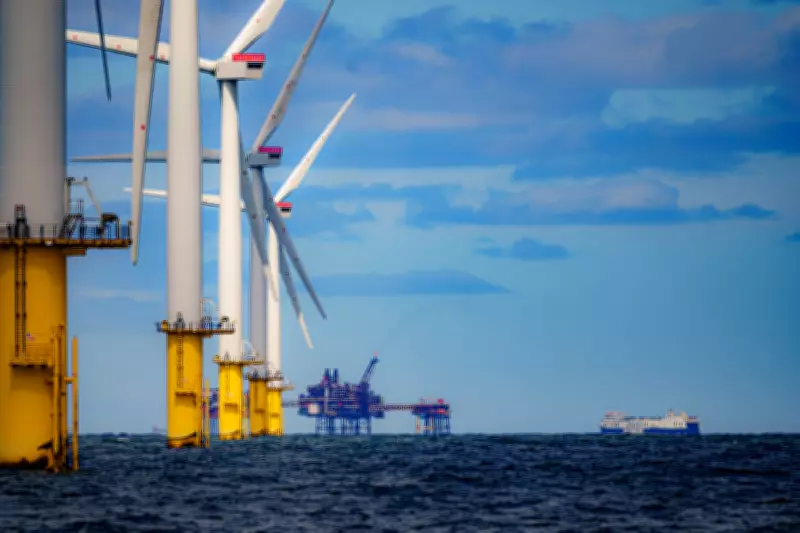
When ministers go out to bat for the government’s position banning new drilling in the North Sea, two arguments tend to dominate. First, that oil and gas are traded on global markets, fixing prices irrespective of UK production. Second, that the UK’s North Sea Basin is 90 per cent extracted, and no new government policy will change that. “It is a wrong argument to say that if we were to issue new licences today [it] would affect the energy prices we are facing because of the situation in the Middle East,” trade minister Chris Bryant said during a debate on loosening Russian oil sanctions, when asked if the UK should boost North Sea oil amid the Iran conflict. Recent months have seen Keir Starmer, Rachel Reeves, and even energy secretary Ed Miliband focus on similar lines.
It is certainly true that only by transitioning intensely towards renewables will energy bills no longer be dictated by fluctuating global hydrocarbon markets. Moreover, fourteen years of maximising drilling licenses under the previous government’s policy of “maximum economic recovery” only resulted in discoveries providing 36 more days of gas per year, given the North Sea Basin’s decline. But opponents can counter: “Well, that may be true, but it would not hurt to maximise extraction, even if the difference is negligible.” This is why a third argument becomes critical for the government.
The Climate Imperative
In 2021, the International Energy Agency (IEA) released a landmark report on how the world can reach net zero emissions by 2050 – the UK’s current legally-binding climate target. It noted that no new drilling licenses would be required for the world to have sufficient oil and gas to meet that target. While countries worldwide have continued to “Drill, Baby, Drill” as Donald Trump urged, the IEA warning still holds true to ensure a future without catastrophic climate impacts. It is particularly relevant for a wealthy country like the UK, which has grown rich off fossil fuel-powered industry for centuries.

“Adopting a policy of extracting every last drop might bring the UK a tiny short-term gain, but it would send a message to every other country that they could do the same. Then we could be looking at a world of 4-5°C of warming, which would mean civilisational collapse,” explains Ed Matthew, director of the UK programme at think tank E3G. A 1.5°C climate change limit is the aspirational goal of the landmark Paris Agreement of 2021 to prevent the most catastrophic consequences of global warming. “Sorry if that sounds dramatic but it’s not an exaggeration,” Matthew continues. “Climate change is a scientific fact that has been so deeply researched now. We know what will come if we don’t address it.”
A world with uncontrolled climate change would create a cost of living crisis that makes today’s seem minor. One study shows the global economy could take a $38 trillion hit per year by 2050 unless addressed, while another finds incomes could be up to 40 per cent lower by 2100 than in a world without climate change.
The Jackdaw and Rosebank Fields
Two North Sea fields have already been approved for extraction but were blocked last year by a Scottish Court. The judgement argued that consents were granted without a full assessment of their climate impacts. The first, Jackdaw, is a gas field 150 miles east of Aberdeen, owned by Shell. The second, Rosebank, is an oil and gas field north-west of Shetland, jointly owned by Shell and Norwegian state oil giant Equinor. Shell has recently called on the government to sign them off. Ed Miliband is due to decide whether to approve these fields for production, with party members including Rachel Reeves indicating support. Their approval would not contradict Labour’s election manifesto, which stated that while they would not issue new drilling licenses, they would honour existing ones.
Research shows the fields would make almost no difference to UK gas import reliance, with Jackdaw and Rosebank displacing only around two per cent and one per cent of annual imported UK gas demand respectively. Some will argue even this is worth it. But the bigger question for the government is whether that marginal production gain outweighs the broader principle of the UK signalling to the world that it has truly turned its back on fossil fuels to embrace the opportunities of the clean energy economy.