
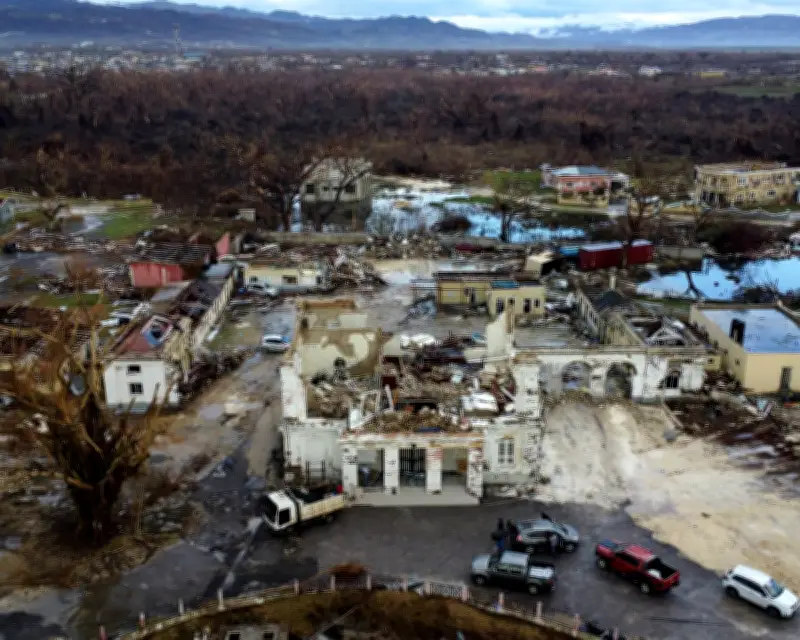
Caribbean nations suffered $53.2bn (£40bn) of damage from climate-fuelled disasters between 2000 and 2024, research into the cost of the climate crisis to developing small islands has found. The figure is more than 90% of the total $57bn in economic damage caused by floods, storms and drought across 39 developing island nations, according to a study by development thinktank ODI Global.
Human and Financial Toll
ODI Global estimates the climate crisis caused more than 190 deaths a year over the 25-year period studied. The research is important for conversations about global climate reparations, the report’s author, Emily Wilkinson, said.
The Caribbean has been pursuing climate justice after bearing the brunt of the crisis, which is primarily caused by high carbon emitters outside the region. Several Caribbean countries provided evidence to the International Court of Justice in a case that ended last year with a landmark advisory opinion that could mean states are ordered to pay compensation if they fail to tackle fossil fuels.
Hurricane Melissa Devastates Jamaica
Published on Wednesday, the report also highlights the devastating impact of Hurricane Melissa, which tore through Jamaica in October 2025 with winds of 185mph (298 km/h), the strongest ever recorded in the country. Experts say the storm was supercharged by global heating. The report attributes $9.7bn – about 80% of the $12.2bn of the government’s calculated damage and losses – directly to the climate crisis. This figure is almost half of the country’s total economy and far above commitments to the UN’s loss and damage fund.
For Jamaica, it was the second year in a row of brutal storms after 2024’s Hurricane Beryl. Thousands of people were left without homes, livelihoods, communication services and basic utilities such as water and power.
Adaptation and Solar Shift
In May, Jamaica’s government passed the National Reconstruction and Resilience Authority Act to speed up post-disaster rebuilding and improve resilience. The report says international financing for climate mitigation is moving in the wrong direction as some wealthy nations cut contributions.
Marcelo Cataldo, chief executive of Digicel Group, one of the Caribbean’s leading telecoms providers, said the worsening climate shocks mean the company needs to rethink how it powers its network. Digicel has responded by accelerating a major shift to solar energy, partnering with Caban Energy to roll out solar-powered telecom sites in Jamaica and Barbados, with plans to expand to 15 of its 25 markets.
Digicel says their solar systems can generate 15,000MWh of clean energy a year, enough to power 10,000 Caribbean homes. They also avoid approximately 200,000 litres of diesel use annually and cut emissions by 16,457 tonnes of CO₂e – equivalent to removing 3,600 cars from the road.
“We know that in a big hurricane … the infrastructure of the electricity company will affect us and all the other industries. Having solar is an outstanding alternative to return the service faster to our customers,” Cataldo said.
Wilkinson said switching to solar is one solution Caribbean nations could consider, but “they will need to overcome high upfront costs and address issues such as intermittency, storage and grid stability.” ODI Global’s findings suggest that under a 1.5C warming scenario, storms alone could cause a further $49bn in climate-attributable losses across small island nations by 2050. At 2C, that rises to $51bn.




