When her phone rang at around 5pm on 8 September 2016, Rosy Auffray was still at work. It was one of her daughters, distressed, calling to tell her that their father, Jean-René, had not come back from his daily run. Only the family dog had returned, alone and exhausted. Rosy rushed back home.
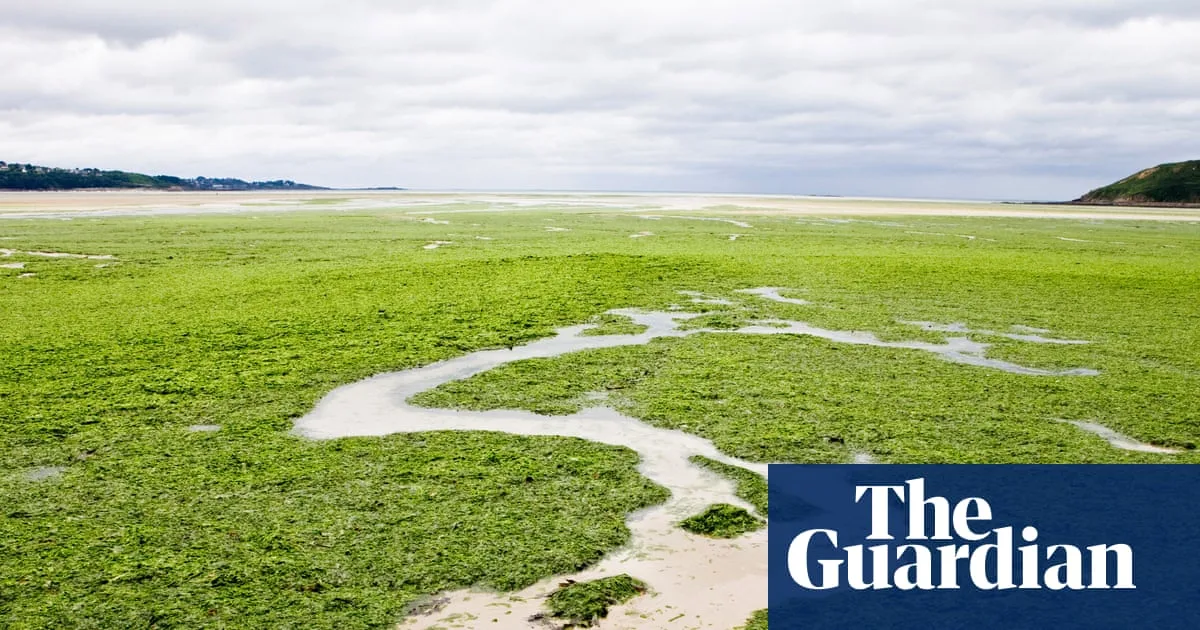
When she arrived, Rosy noticed that the dog was behaving bizarrely: she refused to walk, then collapsed under a bush. Her fur stank of rotten eggs, of overflowing sewers. Rosy knew where that smell came from: the mudflats roughly three miles from the family home in Brittany, where seaweed had been accumulating and putrefying. The soggy, decomposing seaweed stretched for miles along the shore, sometimes as much as five feet thick, killing other plants and suffocating fish and small birds.
Rosy and the couple’s two children set out on a desperate search along the route of Jean-René’s usual run. After about 90 minutes, they found him. His body lay on a crust of dried seaweed in one of the estuaries that empties into the bay of Saint-Brieuc in the Channel. A doctor attending the scene suspected a heart attack. In the shock of those first few days, Rosy didn’t think to question whether the stinking seaweed might have had something to do with her husband’s death.
The Brittany coastline is famed for its green hills, rugged cliffs and miles of sandy beaches. But over the past few decades, in places, the sand has begun to disappear beneath a carpet of green goo. At certain times of year, when Ulva armoricana, a type of seaweed, blooms, banks of green mass form on the beaches, releasing hydrogen sulphide, a foul-smelling, potentially harmful gas. In recent years, red and yellow warning signs have appeared on stretches of the coastline. Occasionally, beaches are closed to the public. Over the spring and summer months, tractors work their way along the coast, raking up thousands of tonnes of seaweed and carting it away: it’s an unending task that has to be done quickly, before the seaweed starts to rot.
Still it spreads: a stain on the landscape, killing biodiversity and breeding anger, frustration and shame. Alix Levain, a social anthropologist at the French National Centre for Scientific Research, calls the seaweed a “monster”. Since 1989, at least one man has died while clearing it from the beaches. In one incident in 2011, 36 wild boar were found dead in the sludge. The media began to talk about the “killer seaweed”.
What lies behind this explosion of seaweed are the high levels of nitrates in the water, which come from industrial farming’s intensive use of synthetic fertilisers and nitrogen-rich animal feed. Brittany is the agricultural heartland of France. On just 5% of the country’s surface, it crowds more than half of its pig population.
Since the mid-2000s, court cases against the French state over the “seaweed affair” have piled up, many of them initiated by environmental NGOs. The government has published successive action plans to tackle the problem, but each one has been criticised as overly complicated and ineffectual.
At the time of Jean-René’s death, Rosy recalls, she felt the authorities were uninterested in investigating the cause. Even though, as far as the family knew, he was very fit – he had been training for an ultra-marathon – he was buried without an autopsy. She and her children were grieving, they did not have the energy to pursue it. But in the months that followed, Rosy learned there was evidence to suggest that the seaweed was to blame. It was the start of a 10-year battle to establish the truth.
Pierre Philippe, a retired emergency physician, has been warning about the dangers of seaweed in this area for more than 30 years. At 66, he is still fit and wiry, with the weather-beaten look of the seasoned runner. The Saint-Michel-en-Grève beach, where we met, roughly 50 miles from the place where Jean-René’s body was found, is a sweeping expanse of sand framed with green hills. In October last year, there was seaweed stranded here and there, and a hint of rotten eggs in the air, the telltale scent of hydrogen sulphide. But it was still safe to stroll, Philippe assured me.
Philippe remembers some of the first algal blooms, in the early 1970s. Clumps would wash out on beaches, accumulate, then rot. It looked like chopped, defrosted spinach spread across the sand. The locals complained about the stench and avoided the shores. “No one ever imagined that it could be dangerous,” Philippe said.
On 30 June 1989, he was on call at Lannion hospital, about seven miles from Saint-Michel-en-Grève, when the body of a 26-year-old jogger, Jacques Thérin, was brought in. The young man had been found buried in deep layers of seaweed on the Saint-Michel-en-Grève beach. When Philippe opened the body bag, he was overpowered by the unusual stench of rotten eggs. “I couldn’t breathe. It was impossible to examine the body,” he said.
Philippe zipped up the bag and sent the body for an autopsy. The strange thing was that he never got the results. “I wrote about 10 letters, but no one replied,” he said. “I’m not paranoid. Maybe they really were lost. But I feel that at the very beginning, the authorities didn’t want me to see them,” he said. As far as he knows, the cause of Thérin’s death was never made public.
Ten years later, in July 1999, Philippe’s neighbour, Maurice Brifault, was brought to the Lannion hospital in a coma. Philippe was struck by how similar the case was to the jogger’s. Brifault, a middle-aged man in good health, had been cleaning the Saint-Michel-en-Grève beach with a tractor-excavator, loading a trailer with seaweed, when he went into convulsions and blacked out. Two nurses happened to be walking on the beach and called an ambulance. Brifault lay unconscious in hospital for five days, but when he came round, the doctors found nothing abnormal: no infection, no signs of stroke.
Philippe wrote to health authorities warning that Brittany’s seaweed might be dangerous. It took almost a year to get a response. The authorities replied by letter: yes, it was theoretically possible for seaweed to emit lethal levels of hydrogen sulphide, but serious harm would require a very high concentration of the gas, on the order of 750 to 1,000 parts per million (ppm), and there was no evidence, they wrote, that this could occur outdoors.
Ten years later, on 22 July 2009, another tractor operator, Thierry Morfoisse, aged 48, collapsed and died while cleaning seaweed in Binic, about 18 miles west of the Gouessant estuary. The family were convinced the seaweed was to blame, but they had no way of proving that hydrogen sulphide was the cause of death.
A few days after Morfoisse’s death, Vincent Petit, a young Parisian vet on holiday in Brittany, took his horse, Sir Glitter, on a ride along the beach in Saint-Michel-en-Grève. When we met late last year, Petit’s eyes softened when he showed me the photo of Sir Glitter, a chestnut thoroughbred with a white blaze. That day in 2009, Petit was leading the horse back from a gallop along the sands when suddenly, with one step, they both sank to their knees. “There was a kind of crust on the surface, so you couldn’t see what was underneath,” Petit told me. The man and his horse floundered in the mud, trying to free themselves. They both lost consciousness.
When Petit woke up, he was in an ambulance on the way to the Lannion hospital. Sir Glitter was dead, but weirdly, Petit felt fine, and his medical tests came back clear. The next morning, a wiry-looking doctor came on rounds. It was Pierre Philippe. “He told me he thought I’d been poisoned by seaweed,” Petit said. “I’m a trained veterinarian, so this made total sense to me. Of course I wanted to do the tests and understand what happened.”
As he recounted what happened next, Petit gesticulated with his hands as if to show a hawk descending on its prey: whoosh, he said, the authorities pounced on him. When he argued that the horse should have an autopsy, representatives of the town hall and local veterinary services tried to convince him otherwise, he said. The next day, when Petit got out of hospital, he learned that his horse had been sent for incineration by the town hall. He feared crucial evidence might be lost. Yet as it happened, the incineration service was on strike that day. Petit got the horse’s body back and arranged the autopsy privately.
The results changed everything, Philippe said. The horse’s lungs contained lethal amounts of hydrogen sulphide. This appeared to be proof that the seaweed on the beaches was dangerous. (It is unclear exactly how Petit was himself unharmed. It may have been that when he passed out, his head rolled backwards, towards the fresh air above, while his horse collapsed face forward into the putrid seaweed.)
Petit said he shared the autopsy samples with the veterinary and health authorities, hoping they would carry out follow-up tests and confirm that the seaweed was a danger to public health. Details of his accident were leaked to the press, and the ensuing media frenzy took Petit and Philippe by surprise. “Death of a horse: is seaweed to blame?” read one headline; another led with: “The mystery of the killer seaweed”. It became a national scandal. On 20 August 2009, François Fillon, the prime minister at the time, interrupted his holidays to visit the beach in Saint-Michel-en-Grève, announcing that “the state will assume all its responsibilities.” He promised money to fight the killer seaweed. An “action plan” the following year ordered regular beach cleanups and safe composting of seaweed.
When, in 2011, dozens of wild boar were found dead in the Gouessant estuary, the Ministry of Agriculture ordered an autopsy, which confirmed that they, too, had been poisoned by gas produced by the seaweed. But if some in government were finally, hesitantly, recognising the dangers of Ulva armoricana seaweed, it was still a long way from meaningful change. There were too many interests at play, chiefly tourism and agriculture. Nicolas Sarkozy, who visited Brittany at the time of the boar incident when he was French president, dismissed vociferous local groups campaigning for getting rid of seaweed as environmental “fundamentalists”.
When Jean-René Auffray collapsed in the same estuary in 2016, Rosy was vaguely aware that a series of animal deaths along the coast had been linked to gas released by rotting seaweed, but her son Yann told me they weren’t aware of any danger to humans. “We went to the beach on school trips, there was seaweed everywhere – but no one ever told us to stay away or that it might be dangerous for our health. It was never acknowledged that seaweed could kill.”
Rosy told me that she felt pressured not to stir things up. We were walking on the beach near the site of the accident, tiny shells cracking underneath our feet. As she recounted the aftermath of Jean-René’s death, her voice got slower, her breathing strained. Considering her husband’s unusual death, an autopsy should have been performed right away, but Rosy said that, after speaking with police and local officials, she felt discouraged from requesting one. Deep in grief, she agreed to bury Jean-René without an autopsy. About two weeks after his death, Jean-René’s body was exhumed at the request of the public prosecutor, and the autopsy performed anyway. By then, however, biological processes had wiped out most of the evidence.
For Philippe, who checked the autopsy report, although there was no hydrogen sulphide left in the blood, the patterns of hydrogen sulphide poisoning were still evident: Jean-René died of a massive pulmonary edema, and lesions in his lungs were similar to those found in Petit’s horse and in the dead boars. In October 2016, a few weeks after his death, a specialist military disaster response team went to investigate the spot where his body had been found. They pierced the crust over dead seaweed and measured the gas emitted with a hydrogen sulphide detector. The reading went off the scale.
In the bay of Saint-Brieuc, near the beach where Jean-René died, I went for a walk with Clément Daniel, an environmental engineer who works at the Algae Technology and Innovation Centre, a decades-old research centre based in Brittany. Daniel was far better prepared for the outing than I was: he had waterproof trousers, a hydrogen sulphide detector and a gas mask at the ready. He carries it with him in case of high levels of hydrogen sulphide – but, he assured me, he wasn’t expecting to use it that day.
There are more species of algae, a broad group of organisms ranging from microscopic microalgae to large seaweeds, than of all flowering plants, he explained. Those that bloom in Brittany are mostly Ulva armoricana, with pale, ribbon-like blades. He picked up a few strands. The blades broke apart between his fingers. That’s their secret power, he told me. Ulva reproduce by fragmentation: waves shred them into pieces that grow back into more seaweed and result in the rapid accumulation known as blooming. Unfortunately, Brittany’s bays – shallow, confined waters with no strong currents – also happen to be the kind of habitat that Ulva likes best.
All seaweed contain sulphur, and when it decomposes in low-oxygen environments, or where oxygen is absent altogether— such as dense, decomposing sediments on mudflats – it may release hydrogen sulphide. Ulva, however, is particularly problematic. “When they wash ashore and pile up on top of one another, they form a sort of airtight shell, and fermentation takes place inside,” Daniel said.
Even at low levels, year-round exposure to hydrogen sulphide may lead to fatigue and asthma. At levels of hydrogen sulphide in the air as low as 0.05 ppm, the rotten egg smell is offensive. By 1 ppm, the level at which beaches get closed in Brittany, the stench becomes unbearable. By 50 ppm, “it anaesthetises your sense of smell”, Philippe told me – and that’s when things get dangerous. You become unaware that you are inhaling something potentially harmful. By 100 ppm, you get headaches. By 250 ppm, your lungs get damaged. Reach 500 ppm, and it may kill you.
You won’t get 500 ppm in the open air of Brittany’s beaches, not even close. For that, you’d need to pierce the crust over long-dead seaweed – for example, with the weight of a tractor, or a horse – and release gas that had been trapped underneath. On beaches regularly raked clean by tractors, accumulations are unlikely. But in hard-to-reach spots, around rocks, close to river mouths, Ulva piles up undisturbed.
Brittany is not the only place that has seen the spread of green slime: in 2008 a seaweed bloom in the coastal region of Qingdao, China smothered a coastal area about 13,000 sq km in size. Seaweed blooms also strike Australia, Spain, Italy, Tunisia and, in the US, Rhode Island. While the story has been similar in all these places – where excessive pollution from agriculture, as well as industrial and domestic waste, has led to excessive seaweed – as far as we know, so far only Brittany’s blooms have proven deadly to humans.
Before the 1950s, farms in Brittany were small, crisscrossed with hedgerows and dotted with apple trees. With the French government’s postwar push for modernisation came change: the orchards and hedgerows were chopped down, the farms were consolidated and mechanised. Between the 1950s and the 1970s, pork production increased fourfold. For many locals, it all seemed to happen over their heads, said Levain, the social anthropologist. Farmers often claim they didn’t ask for the industrial model. But they also admit, she said, that it was the price worth paying for lifting the region out of poverty.
From the late 1980s, when research suggested links between farming methods in Brittany and the spread of seaweed, the meat industry pushed back. “We regularly faced attacks from the agri-food world,” said Alain Ménesguen, a marine ecologist who did some of this vital early research in Brittany. “We’ve been portrayed as fake scientists.” Even though scientific literature over the years clearly established that nitrates were driving algal blooms, some in the agriculture industry continued to point to the role of phosphates and water treatment plants, even though research showed that in Brittany at least 90% of nitrate pollution comes from agriculture. “It’s very tiring. The denial just keeps going,” Ménesguen said. When he wrote in a 2018 report that nitrates in rivers had to be seriously reduced, he said he was advised to remove the target figure of 10 mg per litre. “It was seen as too restrictive,” he said.
The government has launched a series of action plans to combat the seaweed problem. The first, in 2010, promised funding for beach cleanups, and asked farmers to voluntarily commit to changes in practices. There were no sanctions for farmers who failed to respect commitments. Unsurprisingly, not much changed.
In 2017, the regional authorities and central government came up with a second action plan, which tellingly didn’t include any mention of pork, or even livestock, but suggested farmers should adopt measures such as crop rotation that would reduce the need for chemical fertilisers. Again, funding for cleanups was increased, without doing enough to tackle the source.
Farmers have called the action plans “incomprehensible”, and complained of regulations that “are becoming ever more complicated and changed so often that we can no longer keep up with them”. At a public consultation in 2024, officials faced off against farmers who protested that the measures to limit nitrogen runoff, such as planting hedges and restoring wetlands, were going to cost too much. One farmer asked: “Who is going to pay for all this? You?”
Levain told me that farmers in Brittany feel that they’ve been unfairly blamed. In a press release in October last year, one of Brittany’s farming unions denounced “an unacceptable smear campaign” by the media, insisting that “agriculture is not the only one responsible” for the spread of Ulva seaweed blooms. “Stop the agricultural scapegoat” said a statement by La Coordination Rurale Bretagne, a farming union, in 2025, calling for more controls of wastewater treatment plants and better management of sewage overflows. (Local livestock farmers and union representatives did not respond to multiple interview requests for this article.)
The Auffrays believe the pressure to keep quiet about the cause of Jean-René’s death was not the result of government policy or the heavy hand of big agriculture, but local fear about the economy. The impact of publicity about the seaweed on Brittany’s beaches affects not just agriculture, but the tourist industry. Pierre Philippe recalled a confrontation in 2009, when he met with a journalist at a cafe in Saint-Michel-en-Grève to give an interview about the seaweed. The waitress came over, visibly upset, and said: “I live off tourism here, I’ll lose my job if you keep this up!”
“The entire Breton society is under this insidious pressure,” said Yves-Marie Le Lay, the chair of a local environmental association. “There is no need for orders from above: self-censorship operates in full force.”
Rosy Auffray doesn’t blame local farmers for what happened to her husband. “It’s not them who are at fault. It’s the system,” she told me. According to Levain, such sentiments are common in Brittany. “You still have a strong link between the farmers and their community. Most of the population says: ‘This kind of farming, no – but the farmers, yes.’”
It’s this system of intensive farming, and the apparent unwillingness of the authorities to address environmental concerns, that Rosy Auffray and her family wanted to shake. In 2019, the family took the local council, the regional government and the French state to court in a bid to prove that Jean-René’s death was caused by the seaweed and to win compensation. They didn’t expect to win, but their lawyer, François Lafforgue, believed they had a shot.
In 2022, however, the judgment went against them. The court based its decision on what Lafforgue considers a misinterpretation of the data from Jean-René’s sports watch, and concluded there was no evidence to rule out a simple heart attack. The family appealed. They needed answers.
On 24 June 2025, the appeal court in Nantes agreed with the Auffrays. In October that year, nine years after his death, the ruling became final: it was indeed hydrogen sulphide that killed Jean-René – the existence of lesions on his lungs proved it – and the French state was found guilty of failing to keep Brittany’s waters clean. The state was ordered to pay €277,343 to his wife, Rosy, €15,000 to each of his three children, and €9,000 to his brother. For all those who had fought to establish that the seaweed was dangerously toxic, it was a landmark judgment. “It felt like a huge weight off our shoulders,” Yann Auffray told me. “For nine years, we had no official confirmation of what my father died of. It was a relief to know we were right.”
There was a catch, though. The court deemed the state 60% liable, and the jogger 40%: apparently, he should have known better than to run in the estuary where the seaweed was rotting. “It makes us furious,” Rosy Auffray told me. As Lafforgue said in court, at the time of Jean-René’s death there was no official recognition of the dangers of the seaweed, and no signage to alert the public.
Even now, the warnings are sometimes hard to spot. Last autumn, I took a stroll with Rosy and Yann, on the beach where Jean-René went on his last run. We passed big boards warning of danger zones in bright yellow and red. But on a nearby beach that was officially closed to the public, the only warning notice was a small black-and-white printout of a municipal decree, in French alone. When I visited, a group of seniors were merrily hiking across the sand.
When I met Lafforgue in his Paris office last year, he was hoping that the ruling in favour of the Auffrays would help him in his next case: he is representing the family of Thierry Morfoisse, the beach cleaner who died in 2009, against the company that employed him to clean up the beach. While Morfoisse’s blood contained “enormous quantities” of hydrogen sulphide, the sample was kept in a regular hospital cupboard (which is standard procedure), rendering it inadmissible in court, Lafforgue told me. On 8 January 2026, Morfoisse’s case was sent back to the court of appeal, which will establish whether he was adequately informed and protected by his employer against the dangers of hydrogen sulphide. These days, the beach cleaners now carry hydrogen sulphide detectors and gas masks.
France is on its third “seaweed plan”, which will run until 2027, and includes funding to plant grasses or strips of woodland along vulnerable waterways to reduce nitrate runoff. Earlier this year, a court in Rennes declared these measures to be grossly insufficient. The only way to make a difference would be to shift to a less intensive system of livestock production. There is no sign that this shift will take place.
Meanwhile, the problem is getting worse. According to recent reports, there has been a worrying proliferation of seaweed on Brittany’s famous oyster beds, threatening their future along this coastline.
There is a prevailing fatigue among locals, exhaustion over the Ulva “still coming back, ever coming back”, said Levain. They mourn the loss of pristine nature, “seeing this familiar environment, very beautiful – damaged,” she said. The doctor, Pierre Philippe, has seen how deadly the seaweed can be to humans, but he, too, mourns the effect it has on the environment. “I love this region, it’s magnificent. When I walk along the cliffs, it’s still wild. But the degradation breaks my heart.”






