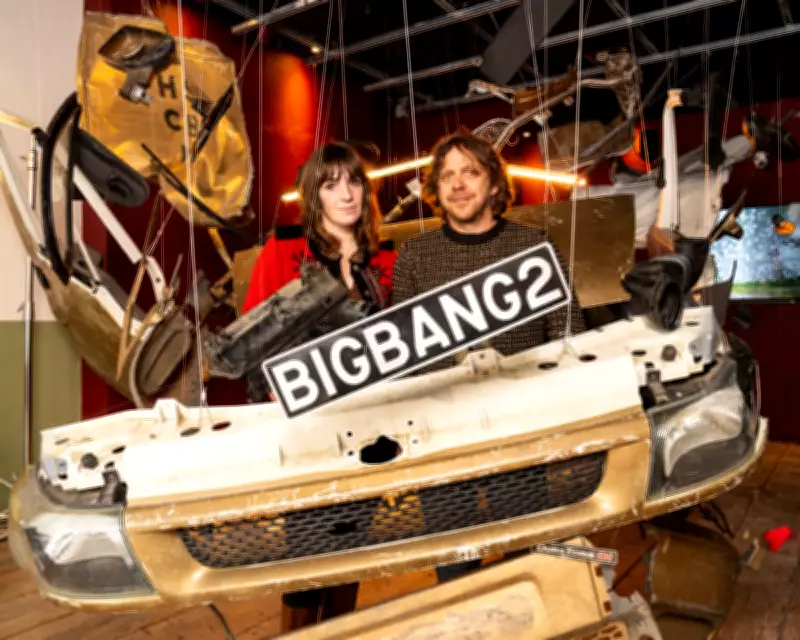
This Saturday, artists Hilary Powell and Dan Edelstyn are auctioning off their work from the past decade and a half. The reason? To help fund a community-led renewable power station in Nigel Farage’s Clacton constituency. Former YBA Gavin Turk will be wielding the gavel and the couple hope to raise at least £250,000 for the project.
The Big-Ticket Item: A Blown-Up Van
The centrepiece of the auction is the remnants of a gold Ford Transit van containing £1.2m in fake banknotes that the pair blew up in London’s Docklands in 2019. This was the climax of Bank Job, a film about their attempts to fight toxic debt culture with art, which involved printing cash to wipe out more than £1m in debt. The van wreckage and charred banknotes were reconstituted as an Alexander Calder-like mobile that once hung in Cambridge’s Fitzwilliam Museum. The sculpture could fetch around £100,000.
Powell hopes the exploded van will be bought by a public institution and has contacted the V&A and the Arts Council. “I’ve spent a week sending off many, many emails and then getting quite patronising replies,” she says.

Other Auction Items
Also up for grabs will be bottles of vodka from a 2009 project where Edelstyn traced his family’s Jewish ancestry to a Ukrainian village, revived his ancestors’ distillery, and sold high-end Zorokovich 1917 vodka to Selfridges.
Alongside the in-person auction, the pair are hosting an online iteration running until 31 May. “We have £750 at the moment,” says Edelstyn. “We need about 250 times that to fund the project.”
Why Build a Power Station in Clacton?
Edelstyn cites a report by climate campaigners DeSmog claiming that Reform UK has received over £2.3m from oil and gas interests since December 2019, amounting to 92% of the party’s donations. “Building a community-owned renewable power station in Reform’s first seat is the most direct response we can think of,” he says.
The pair call their approach Method Art, which they describe as “living ideas into existence rather than representing them. The work is the action: abolishing real debt, building a real power station, planning a real community-owned renewable in Clacton. Artists not as commentators but as people who get the thing built.”
From Existential Crisis to Action
The conviction that art should change the world came after Edelstyn made a film about his Ukrainian vodka enterprise and had an existential crisis, triggered by a Guardian review that called him a businessman rather than an artist. Writers George Orwell and Viktor Frankl helped him find answers. Orwell’s essay Why I Write outlined various motivations for creation, while Frankl’s Man’s Search for Meaning emphasised the desire for a meaningful life as a primary driver.
In the midst of his crisis, the pair learned about an American group buying and abolishing debts. “That was the inspiration for Bank Job,” says Powell. “We were going to really participate and consciously shape the world we live in, engage with political and economic arguments. And it was from there that Power Station came about.”
Previous Success with Community Solar
On their street in London’s Waltham Forest, the couple helped fund, build, and operate a community-owned solar power station. Shareholders provided capital for solar panels, and the host building buys energy at a cheaper rate than from the grid. More than 130 streets in Waltham Forest have signed up to follow suit, with another 50 across the UK.
Proceeds from Saturday’s auction will bankroll the setup in Clacton and a film about the project. If the blown-up van sells, proceeds will fund their not-for-profit production company. The power station itself will be funded through share issuance and other fundraising to create a community benefit society.
Challenges and Ambitions
Most solar co-ops prefer working with councils or long-term businesses due to security and stability. Domestic setups are complicated due to mixed tenureships. Yet, inspired by Frankl, the pair are determined to make the seemingly impossible exist. “That utopian sensibility, against all the odds, is definitely why we are the kind of artists we are,” says Edelstyn.

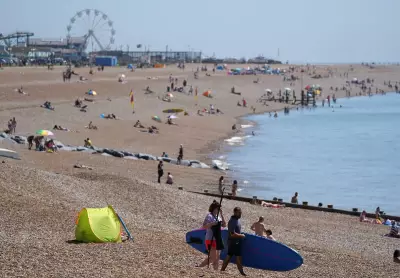
Their Power Station film has already influenced UK community energy policy; Ed Miliband visited them two weeks ago. Now they are taking their model to Reform UK’s stronghold, ideally on Clacton’s Electric Avenue, which includes Reform UK’s local office. Winning over locals is key, so they’ve arranged a screening of the film for councillors and other dignitaries from the Essex seaside resort.
When asked about approaching Clacton’s MP for funding, given the £5m Farage received from a Thai-based crypto billionaire, Edelstyn muses: “He would presumably want to get the bills down of everyone on the street where the power station would be. So why wouldn’t he put some of his money behind what we’re doing?”
The Everything Must Go auction takes place 23 May 2026.