
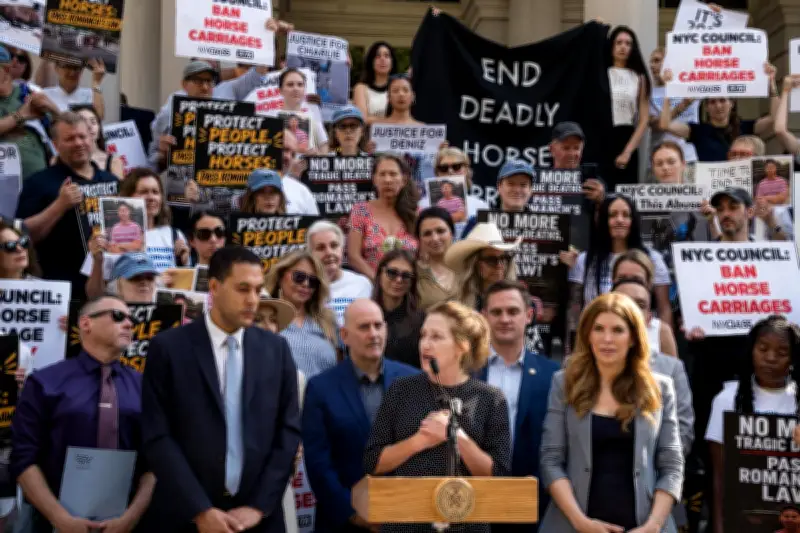
The New York City Council chamber was packed last week as a heated debate unfolded over a bill that would phase out Central Park's iconic horse-drawn carriages by June 2028. The issue, simmering for years, gained momentum after the death of 18-year-old tourist Romanch Mahajan, who fell from a carriage when the horse spooked.
Bill Renamed 'Romanch's Law' After Fatal Incident
Mahajan's father, Deepak, testified via Zoom from India, describing the terrifying ride: 'It was shaking. It was speeding. There was no one holding the reins, and we could do nothing but hold on to each other and scream.' The bill, now called Romanch's Law, is set for a vote in August. Council Speaker Julie Menin voiced support for the ban after the death.
Celebrity Involvement: Edie Falco vs. Liam Neeson
Animal rights activists have garnered support from actor Edie Falco, known for her role in The Sopranos. She told the assembly she was 'here for the horses' because 'the horse can't say it' and they 'have the right to a God-given life, just as we do.' In contrast, actor Liam Neeson previously supported the industry, writing in the New York Times that 'horses, much like humans, are at their happiest and healthiest when working.'
Industry Defenders: Jobs and Horse Welfare
John Chiarello, president of Transport Workers Union Local 100, which represents carriage workers, argued that most workers are immigrants. 'What about my members' American dream?' he asked. He pointed to accidents involving pedicabs and delivery services, noting 28 deaths from motorized two-wheelers in the first half of the year, up 20% from the same period in 2025. 'There's a 165-year history of transportation that I would put up against any other means of transportation,' Chiarello said. 'The horse and carriage business has been around since before the city was incorporated. It would be a shame to annihilate them.'
Concerns for Horses: Retirement and Living Conditions
Edita Birnkrant, executive director of New Yorkers for Clean, Livable, and Safe Streets (Nyclass), criticized the industry for lacking a retirement plan for horses. 'They should be retired and we have a network of sanctuaries and rescue farms,' she said. The stables on the West Side, she argued, were 'torture for a horse to be living in a cell with no grass.'
Drivers Speak Out: Fear of Job Loss
Angel, a driver originally from Mexico, said he invested all his savings in the business. 'I own horses and they say they want to help all the immigrant people. But this isn't going to help me at all.' Conner McHugh, a second-generation driver and stable manager for 40 years, noted a long battle against 'intimidation' from animal rights activists, including 'reporting us to ICE and the IRS, keyboard warriors trashing us on social media, animals rights volunteers who have come to Central Park to harass our drivers.'
Ethical Debate: Cruelty or Tradition?
Wayne Pacelle, president of Animal Wellness Action, called the carriage horse industry 'a vestigial practice with no practical value.' He said offers to replace carriages with electric versions were rebuffed. The industry has seen a surge in park visitors to 43 million annually, with unlicensed pedicabs competing aggressively. Drivers like Alanna claim the 'fix is in,' pointing to billionaire donors and real estate interests wanting the stables' land.
Horses' Future: Sanctuary or Slaughter?
Most carriage horses are Standardbred and draft horses from Amish settlements, accustomed to work. Without carriage pulling, many would face slaughter. Driver Hansen said her horse, Sherman, a former Amish workhorse, was heading for dog food when she bought him. 'Without work, he'd be bored out of his mind,' she said. Animal rights groups claim a network of sanctuaries exists, but drivers doubt their capacity.
The debate continues as the council prepares for a vote, with both sides firmly entrenched over the fate of 160 horses and 68 carriages in Central Park.




