
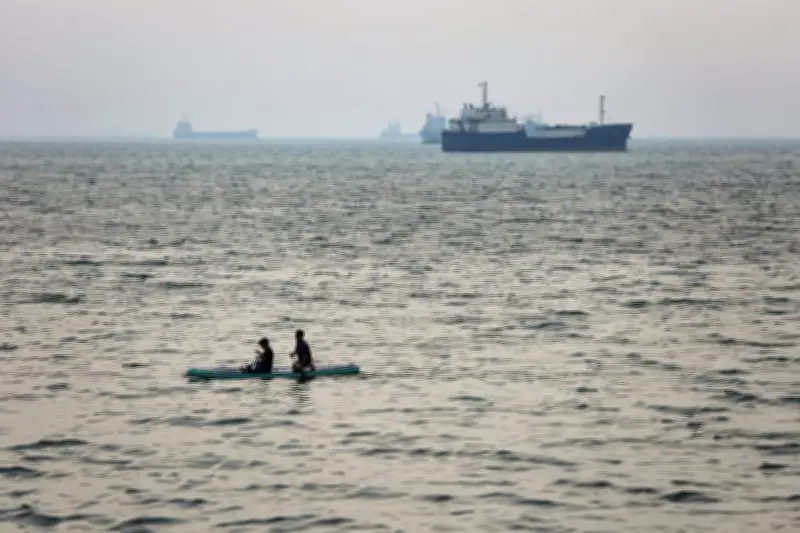
Yet again the Strait of Hormuz dominates headlines as the on-off peace talks grind on with no clear end in sight. President Trump still shouts about it in full caps on Truth Social. Television producers still show on repeat the same map: Iran on one side, Oman on the other. Oil tankers still play chicken when trying to squeeze through its chokepoint.
It is tempting to believe that the future of Middle East security will be decided solely by that narrow stretch of water between Iran and Oman. That is understandable. Hormuz is the great oil chokepoint of the Gulf. But it is also wrong. For while diplomats, traders and television cameras are fixed on Hormuz, another strait sits in dangerous shadow.
On the other side of Arabia, at the southern entrance to the Red Sea, lies the Bab al-Mandab. It is not as famous as Hormuz. It does not command the same instant recognition in Washington, London or the City. Yet it too is one of the pressure points on which the world economy depends. And it too is presently Iran’s to control.
The Bab al-Mandab, the ‘Gate of Tears’, is about 20-miles wide at its narrowest point. It sits between Yemen and Djibouti at the southern entrance to the Red Sea, guarding the way to Suez.
Normally, it is one of the key routes through which Asia trades with Europe and the Mediterranean. In good times, 8.7 million barrels a day of crude and refined products move through it.
But the lesson of Hormuz is that you do not have to close a chokepoint to weaponise it. You only have to make the world doubt whether it is safe.
That same lesson applies to Bab al-Mandab for, in dangerous times, ships go the long way round the Cape of Good Hope. That adds roughly 10 days to journeys, with extra fuel, insurance and freight costs. Those costs do not remain at sea. They work their way into factories, supermarket shelves, defence logistics and, eventually, household bills.
This is not remote cartography for London. It shows up in the City as insurance risk, in retailers’ supply chains, in the Royal Navy’s deployments and in the price of goods that arrive through long, vulnerable sea lanes. Britain is an island trading nation that has always depended on maritime passages it does not own and cannot afford to lose.
Yet Bab al-Mandab is presently the ignored strait, drowned up by the focus on its infamous neighbour.
Partly this is because Yemen’s catastrophe has lasted so long that it has become part of the background noise of international affairs. That is a dangerous mistake. Yemen is a collapsed state wrapped around a global artery.
The present crisis can be traced to 2014, when a radical movement from northern Yemen, the Houthis, seized the country’s capital Sana’a. A year later, Saudi Arabia led a military coalition to prevent Yemen’s internationally recognised government from being defeated.
There has been no winner in this conflict. Rather Yemen has splintered. The Houthis entrenched themselves in the north. A Saudi-backed Presidential Leadership Council holds parts of the south. Separatists, tribal forces, Islamist networks and al-Qaeda compete across the country. A 2022 truce froze much of the fighting – but it did not rebuild the state.
Rather it has settled into a new dangerous form of disorder – one in which Iran has turned the Houthis from a local insurgency into a missile and drone force capable of menacing the Red Sea.
In that disorder, Iran saw opportunity. The Houthis began as a Yemeni insurgency. With Iran’s backing, they have now been turned from a local insurgency into a missile and drone force capable of menacing the Red Sea.
The Houthis do not need to conquer Bab al-Mandab. They merely have to pose such a threat to it so as to make captains ask whether the next vessel to be attacked could be theirs and for insurers to ask how much that fear is worth.
As the world has witnessed in Hormuz, this is the new economics of coercion. A militia with drones, missiles and coastline can impose a surcharge on globalisation. That is the new economics of coercion.
In the case of Yemen, Tehran supplies doctrine, technology, encouragement and sometimes hardware. The Houthis supply geography. The rest of us pay the premium.
Bab al-Mandab gives Iran a second hand around the world economy’s neck. If pressure rises in Hormuz, Gulf exporters look west across Saudi Arabia to the Red Sea. But where does that oil then sail? Past Yemen. If container lines return to Suez, what guards the southern approach? Yemen. The bottom line is that if Europe wants cheaper trade with Asia, the Gate of Tears must be secure.
This reality needs to be taken seriously. One step towards that would be to start by naming the problem. The Red Sea is not suffering from “maritime insecurity” in the abstract. It is being used by an Iranian-backed armed movement to extract strategic value from Yemen’s collapse.
Escorts and air strikes may be necessary. But so is support for a Yemeni order that can deny the Houthis permanent veto power over the strait. That support must be conditional: no blank cheque, no indulgence of abuses, no pretence that potential allies in that process are spotless. But also no refusal to admit that order, even imperfect order, is preferable to a coastline policed by drones.
Iran’s skill is to make its opponents argue about the wrong question. While attention fixes on Hormuz, Bab al-Mandab becomes more dangerous. While we debate whether the Houthis are local rebels or Iranian proxies, they operate as both. While we wait for a tidy peace process, ships quietly take the long way round.
Bab al-Mandab comes from Arabic: bab means “gate” and mandab meaning “tears”. Legend tells that it comes from the cries of those drowned when, according to Arab tradition, an earthquake separated Arabia from the Horn of Africa.
The legend is ancient. The warning, however, is contemporary. If the West keeps treating Bab al-Mandab as the “other” strait, the risk is that Gate of Tears will earn its name once again.




