A groundbreaking international study has unveiled the stark future facing Antarctica under different climate change trajectories, with the frozen continent's delicate ecosystems and ice sheets undergoing alarming transformations. Researchers have mapped out best and worst-case scenarios for the Antarctic Peninsula, a region exceptionally vulnerable to human-induced global warming, revealing potentially catastrophic consequences for both polar wildlife and global climate systems.
Worst-Case Scenario: A 20% Sea Ice Collapse
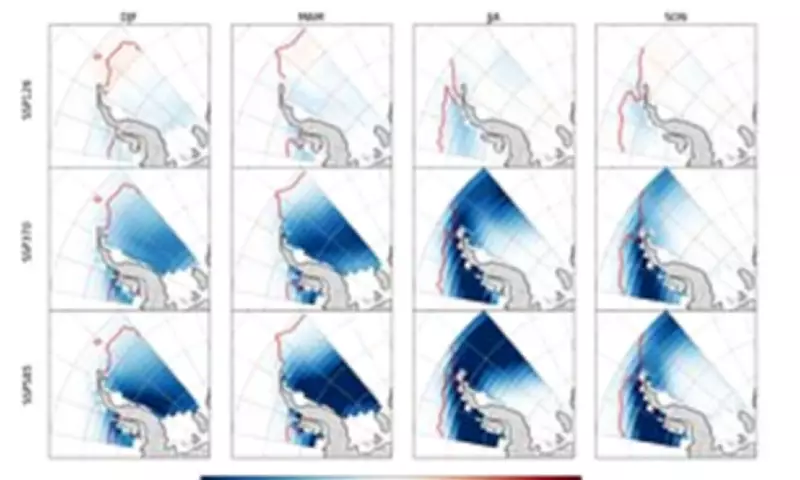
In the most severe emissions scenario, where global temperatures surge by 4.4°C (7.92°F) above pre-industrial levels by 2100, sea ice coverage around the Antarctic Peninsula could plummet by a staggering 20%. This dramatic reduction would be comparable to removing ice cubes from a cold drink, accelerating ocean warming and destabilizing glaciers and ice shelves that currently restrain catastrophic sea level rise.
Lead author Professor Bevan Davies of Newcastle University emphasizes the global implications: "Changes in the Antarctic do not stay in the Antarctic. Though Antarctica is far away, changes here will impact the rest of the world through changes in sea level, oceanic and atmospheric connections and circulation changes."

Three Emissions Pathways
The research team employed sophisticated computer modeling to project outcomes across three distinct emissions scenarios:
- Low emissions scenario: Global temperatures rise 1.8°C (3.24°F) by 2100
- Medium-high emissions scenario: Temperatures increase by 3.6°C (6.48°F) by 2100
- Very high emissions scenario: The world becomes 4.4°C (7.92°F) hotter by 2100
Co-author Professor Martin Siegert of Exeter University describes the highest emissions scenario as representing "a world very different to today, in ways our human civilisation development has not previously coped with."
Global Consequences of Antarctic Changes
The Antarctic Peninsula's transformation carries profound global implications. The region's vast white ice sheets currently reflect solar heat back into space and lock away freshwater that would otherwise elevate sea levels and disrupt crucial ocean currents.
Under the worst-case scenario, the Peninsula alone could contribute up to 22 millimetres of sea level rise by 2100, escalating to 172 millimetres by 2300. Professor Davies explains the amplifying effect: "This would darken the ocean, making it better at absorbing heat, amplifying global warming." Warmer oceans can store more energy, potentially intensifying extreme weather events worldwide.
Ecosystem Collapse and Species Extinction
The study reveals devastating impacts on Antarctic wildlife, particularly krill populations that form the foundation of the polar food chain. These small crustaceans depend entirely on sea ice for survival, meaning their numbers decline alongside ice coverage reductions.
Iconic species like penguins, seals, and whales that rely on krill face existential threats. Adelie penguins, which require sea ice and krill for survival, are already being displaced by more adaptable species in some regions. Professor Davies notes their particular vulnerability: "Adelie penguin chicks cannot tolerate rain as their downy feathers are not waterproof, so if they get wet, they get hypothermia." Increased rainfall in warming Antarctica could wipe out entire breeding colonies.
Irreversible Changes on Human Timescales
The research indicates that current global emissions trajectories place us somewhere between medium and medium-high scenarios. However, Professor Davies warns that "resurging nationalism and protectionism" could push the world toward the more damaging medium-high pathway.
In lower emissions scenarios, climate impacts would be more moderate, with sea ice reductions limited and sea level contributions measured in mere millimetres. But as temperatures climb, the effects become increasingly destructive and permanent. Professor Davies stresses the urgency: "These changes would be irreversible on any human timescale. It would be very hard to regrow the glaciers and bring back the wildlife that makes Antarctica special. If we don't make changes now, our great-grandchildren will have to live with the consequences."

The Carbon Capture Crisis
Beyond immediate ecosystem damage, krill population collapse threatens global climate regulation. These organisms play a crucial role in absorbing and trapping carbon dioxide in the Southern Ocean. Their disappearance could accelerate global warming processes already underway, creating a dangerous feedback loop.
Co-author Professor Peter Convey of the British Antarctic Survey observes the visible transformations: "For a casual visitor, the first impression is still inevitably that the region is ice-dominated. However, to those of us that have the privilege to go back multiple times, there are very clear changes over time." The Antarctic Peninsula has been extensively studied due to frequent research, tourism, and fishing activity over the past century, providing scientists with comprehensive data on climate impacts.
The study serves as a stark warning about the interconnectedness of polar and global systems, demonstrating how changes in remote Antarctica will reverberate across oceans, weather patterns, and coastlines worldwide.