Antarctica's Enormous Gravity Anomaly Finally Explained
Antarctica holds countless scientific mysteries beneath its vast ice sheets, but one of the most perplexing has been an enormous "gravity hole" where the planet's gravitational pull weakens dramatically. While gravity might seem constant across Earth's surface, its strength actually varies significantly depending on subsurface geology.
The Gravity Hole Phenomenon
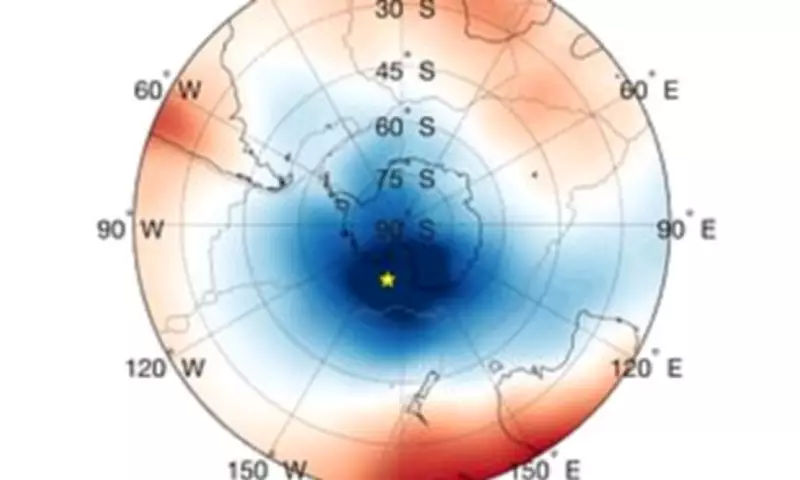
For decades, scientists have known about the Antarctic Geoid Low (AGL), a region in the Ross Sea where gravity is so weak that ocean surfaces dip approximately 420 feet (130 meters) below surrounding waters. This occurs because water naturally flows toward areas with stronger gravitational pull, creating dramatic depressions in sea level across large ocean areas.
"When viewed from space, Earth appears as a smooth blue marble, but in reality, our planet resembles a bumpy potato due to these gravitational variations," explains Dr. Alessandro Forte of the University of Florida, co-author of the groundbreaking study.

Millions of Years in the Making
Through innovative research combining global earthquake data with sophisticated computer modeling, scientists have traced the gravity hole's origins back 70 million years to when dinosaurs still roamed Earth. The researchers discovered that less-dense rock began accumulating beneath Antarctica during this period, gradually weakening gravitational forces in the region.
The gravity anomaly remained relatively small initially before experiencing rapid intensification between 50 and 30 million years ago. This strengthening phase coincided with the Eocene Epoch, a period of dramatic climate transformation that saw Antarctica's ice sheets advance rapidly across the continent.
Scientific Breakthrough Through Earthquake Analysis
To unravel this geological mystery, researchers employed an innovative approach using earthquake waves as their primary investigative tool. "Imagine conducting a CT scan of the entire Earth without traditional X-rays," Dr. Forte describes. "Earthquake waves provide the 'light' that illuminates our planet's interior, allowing us to map subsurface structures and density variations."
By analyzing how seismic waves traveled through different rock densities, the research team constructed detailed maps of Earth's inner workings. Their computer models successfully predicted gravitational variations that matched current satellite data with remarkable accuracy.
Connection to Climate History
Perhaps most intriguing is the potential link between the gravity hole's development and Antarctica's climatic evolution. The period of rapid gravitational weakening between 50 and 30 million years ago directly corresponds with significant glacial advancement across the continent.
While not yet definitively proven, researchers suspect a meaningful connection between these geological and climatic events. "Understanding how Earth's interior shapes gravity and sea levels provides crucial insights into factors affecting ice sheet growth and stability," Dr. Forte emphasizes.
Global Gravity Anomalies
The Antarctic Geoid Low represents just one of Earth's significant gravitational anomalies. Another prominent example, the Indian Ocean Geoid Low, creates a 340-foot (103-meter) sea level depression through similar geological processes. Recent studies suggest this feature formed from low-density magma plumes rising from Earth's mantle, generated by the remains of the ancient Tethys tectonic plate.
These discoveries highlight how tectonic activity continues to shape our planet's gravitational landscape millions of years after initial geological events. The fifteen major tectonic plates that comprise Earth's surface constantly interact through the asthenosphere—the warm, viscous rock layer beneath them—creating the geological features and gravitational variations we observe today.
Future Research Directions
Looking forward, scientists plan to develop new mathematical models to explore potential causal relationships between gravity anomalies and climatic changes more thoroughly. This research could answer fundamental questions about how planetary interior processes connect with surface climate systems.

The investigation into Antarctica's gravity hole not only solves a longstanding scientific mystery but opens new avenues for understanding Earth's complex geological-climatic interactions that continue to shape our world today.