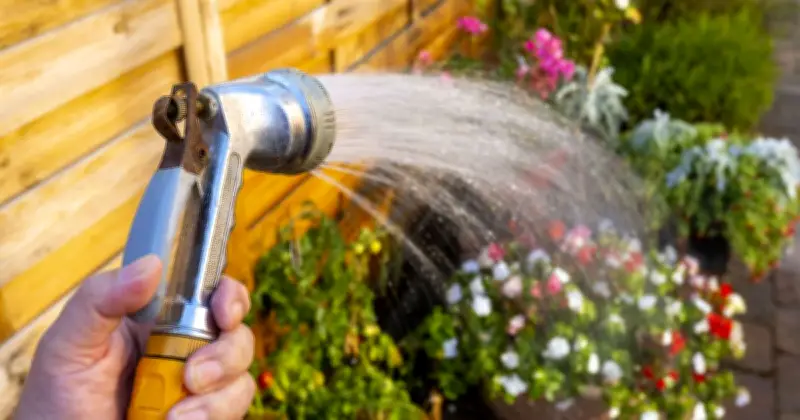
Thames Water has announced a hosepipe ban for just over 10 million customers, joining seven other water firms in imposing restrictions as the UK's record-breaking summer strains water supplies. The ban, effective from Thursday, prohibits using hosepipes for watering gardens or allotments, cleaning cars, filling paddling pools or swimming pools, and cleaning windows.
The company said its region had seen 40% of average rainfall and more days at or above 34C this year than ever recorded before. Nevil Muncaster, director of strategic water resources, said: "We would not be taking this step unless it was necessary to protect water supplies for everyone and the environment."
Water firms impose bans across Britain
Thames Water provides water to customers across parts of Gloucestershire, Wiltshire, Surrey, the Thames Valley, Greater London, and surrounding areas. The other firms with bans are Affinity Water, Anglian Water, Cambridge Water, Southern Water, South East Water, South West Water and Welsh Water.
Anglian Water introduced a ban for five million customers on July 11, and Affinity Water imposed a ban for one million customers on July 10. South East Water introduced a ban for 2.4 million customers from July 3, and Southern Water confirmed a ban for 400,000 customers in Hampshire and the Isle of Wight from July 10.
Cambridge Water announced a temporary hosepipe ban from July 17 for its 350,000 customers, marking the first time in three decades that it has introduced such a restriction. South West Water brought in its ban for a small number of homes in Mid Devon and parts of East Devon on July 14. On July 19, 33,000 homes in West Wales were subject to a ban by Welsh Water.
Drought fears and low reservoir levels
The Environment Agency has warned that large parts of southern, central and eastern England have moved closer to official drought status. Six reservoirs are currently classed as having "notably low" levels, including Wimbleball in Somerset, Grafham in Cambridgeshire and Hanningfield in Essex, while Blagdon reservoir in Somerset is classed as being "exceptionally low". Only 13% of rivers are at normal levels for this time of year, with several rivers seeing exceptionally low levels.
Thames Water said water use is currently 10% above normal in the Thames Valley and the Home Counties, and 7% above normal in London. Customers are using an extra 100 million litres every day – equivalent to adding all the homes in Manchester to the network. Mr Muncaster added: "While there is enough water for essential use, we need to reduce non-essential outdoor demand to keep taps flowing."
Other firms, including Severn Trent, Essex and Suffolk Water, Wessex Water and Portsmouth Water, have urged customers to use water wisely. Helen Wakeham, chair of the National Drought Group and director of water at the Environment Agency, said: "All sectors are taking action, and we are grateful to the public to make sure there is enough water for everyone this summer."
As of Monday, East Anglia, the West Midlands, Devon, Cornwall and the Isles of Scilly, Lincolnshire and Northamptonshire, Hertfordshire and London, Wessex, Thames, Solent and the South Downs are in "prolonged dry weather", the stage before drought. Rainfall totals for July to date ranged from 9% of the long-term average in north-west England to nothing in east and south-east England, the Met Office said.
Weather outlook
The Met Office warns that the rest of July will remain mostly dry with higher pressure likely to sit to the southwest of the UK. On Wednesday, temperatures will peak around 26C in the south and the Midlands. On Thursday, there could be spots of rain but mainly sunshine and highs of 27C in the south west of England. Into the weekend, northern and western areas may see cooler temperatures, clouds and more rain.