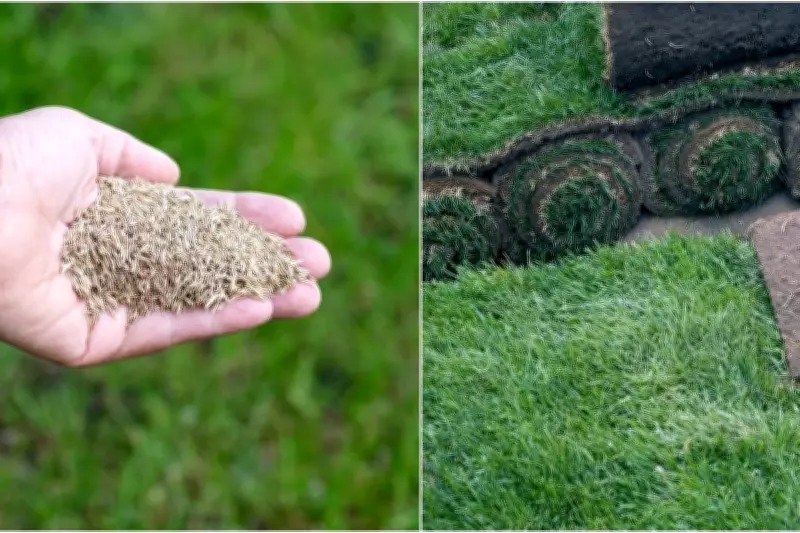
Turf vs Seed: Which Lawn Option Is Right for Your Garden?
As spring arrives, gardeners across the UK are eager to revitalise their lawns, facing a common dilemma: should they opt for turf or seed? Each method has distinct advantages and drawbacks, according to lawn expert Luke Taylor, co-author of Lawns: An Uncomplicated Guide and co-founder of the lawncare service So & Mo. Taylor emphasises that the choice largely depends on individual scenarios and budget considerations.
Budget and Speed: Key Factors in Your Decision
For those mindful of expenses, seeding emerges as the more cost-effective solution. Taylor notes, "If cost is a factor, there's no doubt that seeding is a lot more cost-effective." However, if speed is a priority, turf offers a rapid transformation, typically ready for use within a couple of weeks after laying. It's crucial to ensure the turf has developed a strong root system before mowing to avoid damage.
Turf requires prompt installation, ideally within 24 to 36 hours of delivery to prevent deterioration. In warm, dry conditions, this timeframe shortens, and gardeners must roll out the turf quickly to avoid sweating and rotting within the roll. In contrast, seeding demands patience, with a growth period of four to six weeks before the lawn is usable.

Grass Types and Quality Control
Your preference for specific grass species can influence your choice. Taylor explains that fescue-based lawns are ideal for coastal areas with sandy, free-draining soil, offering an ornamental, fine-textured appearance. Rye grasses, on the other hand, are broader-leafed and coarser, commonly used in turf mixtures to provide binding with fescues.
Seeding allows greater control over the grass mixture, enabling gardeners to tailor their lawn to exact specifications. Taylor points out, "With seeds you control that narrative, you have control over the mixture, whereas with turf you are a little bit susceptible to bare patches and weeds." He adds that while seeding requires a wait, the resulting quality is often superior, with better overall results.
Preparation and Maintenance Essentials
Proper soil preparation is vital for both methods. Taylor recommends rotavating to aerate the soil, creating air pockets for roots to penetrate. The process involves raking and compacting repeatedly to achieve a level surface. He warns, "It's very hard to get levels right once you've turfed or seeded it – and don't think that the turf is going to make up for little bumps and blemishes."
For patching existing lawns, Taylor advises caution with height levels. Turf requires accounting for its thickness, whereas seeding does not. He suggests seeding for small patch-up jobs, as cutting in turf can be challenging and lead to uneven surfaces.
Maintenance is critical, especially for turf. Taylor stresses the importance of diligent watering in the first few days to prevent shrinkage, which can create gaps resembling a jigsaw puzzle. For mowing, ensure both turf and seeded grass are well-rooted, starting with minimal cuts of one or two millimetres to encourage denser growth through tiller production.
In summary, turf offers speed and instant gratification but at a higher cost and with more immediate maintenance needs. Seeding is budget-friendly and allows for customisation but requires patience and careful nurturing. By weighing these factors, gardeners can make an informed decision to achieve a lush, healthy lawn tailored to their specific circumstances.