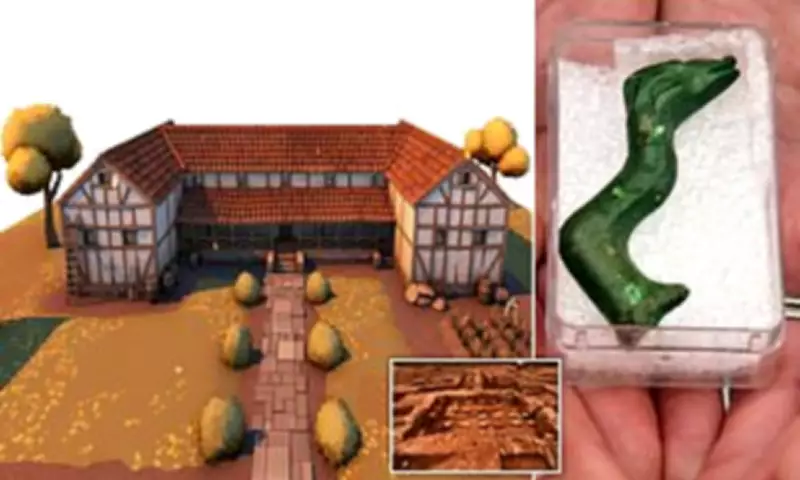
Archaeologists have made a stunning discovery in the Norfolk countryside, unearthing the remains of an extraordinary Roman villa complex that offers a remarkable glimpse into ancient farming life nearly two millennia ago. The find occurred during routine investigations for a power cable route intended to connect offshore wind farms to the National Grid.
A Monumental Roman Estate Revealed
At over 120 feet in length at its longest point, the villa is no ordinary farmhouse. It features an attractive covered porch and even a dedicated bathhouse, showcasing the sophistication of Roman agricultural estates in Britain. The massive structure was built in phases between the 1st and 3rd centuries AD, according to experts who excavated the stone walls.
Jessica Lowther of Headland Archaeology, who led the excavation, explained the discovery process. "We weren't expecting anything significant on this site near Dereham," she said. "But magnetometry surveys detected subtle variations in the Earth's magnetic field that suggested something important lay beneath the soil."

Advanced Detection Techniques
The team employed ground-penetrating radar after initial findings of numerous roof tiles indicated substantial structures below. "This revealed we had actually found a Roman villa estate," Lowther continued. "It's a large complex with many ancillary buildings, including remains of a Roman road and that bathhouse. The evidence for growing and processing food suggests this was a substantial farming operation."
Animal bones from cats and dogs found at the site indicate these creatures helped control pests on the estate, providing fascinating details about daily Roman life in rural Britain.
Remarkable Artefacts and the 'Norfolk Nessie'
The excavation yielded numerous personal items that bring the villa's inhabitants to life. Among the discoveries were a brooch, copper alloy hair pins, nail cleaners, and a military belt mount. Particularly intriguing was an inscribed silver ring featuring ancient graffiti.
Two bronze objects captured special attention: one shaped as a lion's head and foot that would have formed the base of a chair, and another ornate handle shaped like an unidentified creature. This latter artefact has been nicknamed the 'Norfolk Nessie' due to its resemblance to the legendary Loch Ness Monster.
Preservation and Documentation
Before the site was carefully reinterred, archaeologists conducted detailed photographic documentation, created precise drawings, and performed comprehensive digital surveys to preserve the villa's layout and features for future study.
Broader Archaeological Context
The villa discovery forms part of a much larger archaeological campaign along the 40-mile cable route between Happisburgh and Necton villages for RWE's Vanguard West, East, and Boreas wind farms. This corridor has revealed a continuous timeline of human occupation spanning thousands of years.
Other significant finds include an early Neolithic pit dating back to approximately 4000 BC and a Neolithic barrow mound containing human remains. Archaeologists have also uncovered ancient stone tools used for cleaning and preparing animal skins, along with Bronze and Iron Age pottery.
A particularly notable discovery was a coin from the time of the Iceni tribe, dating to around AD 60 or 61 when Queen Boudicea famously led her rebellion against Roman invaders. Additionally, researchers believe they have identified the remains of two medieval villages called Whimpwell and Stinton along the same route.
Understanding Landscape Evolution
Jon Darling, RWE project director for Vanguard West and East, emphasized the broader significance of these discoveries. "The archaeological campaign has revealed a remarkable story about how this landscape has changed over time," he stated. "From prehistoric activity through to a Roman villa estate and beyond, we're gaining unprecedented insights into centuries of human settlement in this region."

This Roman villa discovery not only illuminates the sophistication of agricultural practices in Roman Britain but also demonstrates how modern infrastructure projects can unexpectedly contribute to our understanding of ancient history. The careful archaeological work ensures that these important finds are properly documented and studied, even as renewable energy projects progress across the British landscape.