
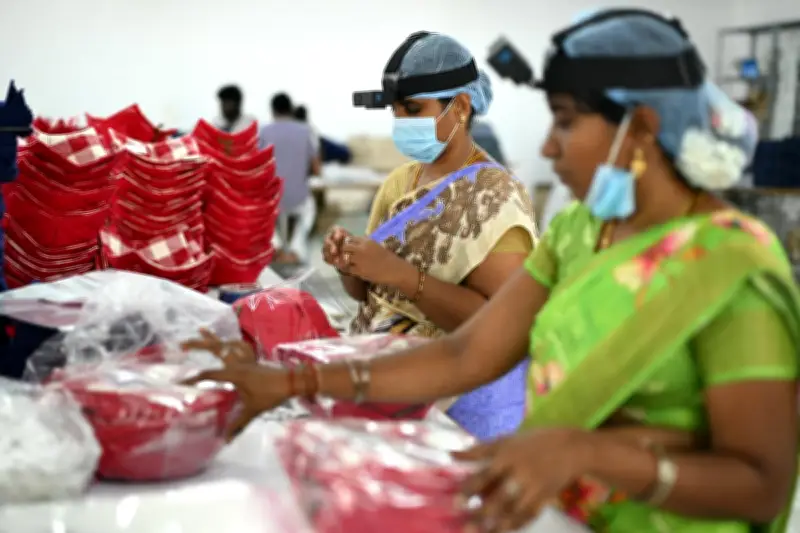
Garment workers in India are being fitted with head-mounted cameras to record their every movement on the factory floor, generating valuable data for training humanoid robots. Despite the footage being sold to technology companies, workers often receive no direct compensation for their contribution, raising ethical questions about consent, privacy, and exploitation.
The Rise of Egocentric Data Collection
Lalita, a 32-year-old garment worker at a factory on the outskirts of Delhi, was handed a head-mounted camera by supervisors without explanation. "The way people mount a CCTV camera on a wall, they mounted one on us," she said. Initially amused by the unusual headgear, workers soon became anxious as they realized their productivity was being monitored. Conversations grew quieter, and every mistake or pause felt scrutinized.
Lalita and her colleagues were unknowingly part of a growing industry collecting egocentric data—first-person recordings of human movements and interactions. This data is crucial for training humanoid robots, which industry experts say require hundreds of millions of hours of human activity filmed in real-world environments like factories, warehouses, and shops.
India's Role in the Global AI Data Pipeline
India has emerged as a key hub for egocentric data collection, driven by its vast labor force and low costs. Companies like EgoLab, Humyn AI, and Objectways build data pipelines for robotics firms, including Tesla, whose CEO Elon Musk predicts humanoid robots will account for 80% of the company's future value. According to Puneet Jindal, founder of Labellerr AI, "South Asia remains the workshop of the world... If you're trying to teach a robot how humans work, there are few places that offer the same combination of scale, diversity and density of human labour as India."
India dominates the global data annotation market, accounting for about 35% of it, with roughly 60% of revenues from US clients. Cost is a major factor: a company paying $30 an hour for data collection in the US can get similar work done in India for less than a sixth of that cost, according to an anonymous tech founder. Often, firms strike deals with factories to collect footage at scale without directly compensating individual workers.
Workers Left Without Compensation
The Guardian's examination of data-collection practices across six factories in five states found that workers wearing devices like Meta smart glasses or head-mounted cameras received no extra pay for generating footage sold to tech companies. "Sometimes they give us a soft drink," said Lalita, who earns about $200 a month. "I'm still not sure whether that's because we're collecting footage or because Delhi's heat is unbearable."
Companies argue that factories are compensated for facilitating recordings, but critics say this obscures who produces the data. "International clients are often willing to pay significantly more for this footage, but the pressure to undercut competitors keeps pushing costs downward. By the time that trickles through the supply chain, the workers generating the data are often left with nothing," said Jindal. Attempts to compensate workers directly are often resisted by factory owners, who cite rising labor costs and thin margins.
Surveillance and Privacy Concerns
Beyond compensation, the footage is sometimes used for productivity monitoring. Records reviewed by Scroll.in showed some companies generated reports ranking workers by active time, estimating losses from idle periods, and tracking social interactions. Geeta Thatra, a researcher at Work Fair and Free Foundation, raised privacy concerns: "I've heard accounts of women garment workers going to the washroom and forgetting they were wearing head-mounted cameras." She also questioned consent, noting that in insecure workplaces, workers may fear refusing to participate.
None of the seven technology companies interviewed by the Guardian said they sought consent directly from workers; some stated permissions were obtained through factory management.
Expansion Beyond Factories
Egocentric data collection is expanding to informal workers like construction laborers, delivery workers, and street vendors. Munazir, a mason in Bengaluru, earns $30 to $40 a week recording his work, supplementing his regular income of less than $8 a day. "The phone feels heavy and uncomfortable to wear," he said. "But I've only just started. Maybe I'll get used to it with time." Workers like Munazir are not told how the data will be used; companies acknowledge this.
Ownership and Future Value
Madhumita Dutta, an Ohio State University researcher, noted that workers are generating valuable digital assets without awareness or negotiation power. Sarayu Natarajan of the Aapti Institute argued that the data captures bodily knowledge—movements and skills accumulated over years—which, once extracted, can be circulated through global AI supply chains. This raises questions about ownership and compensation that current labor arrangements cannot address, potentially requiring new mechanisms like royalties.
Back at the factory, Lalita continues her work, unsure of her future. "We are not even getting our full worth for the work we do now," she said. "Who is going to pay us when we are replaced by robots?"




