
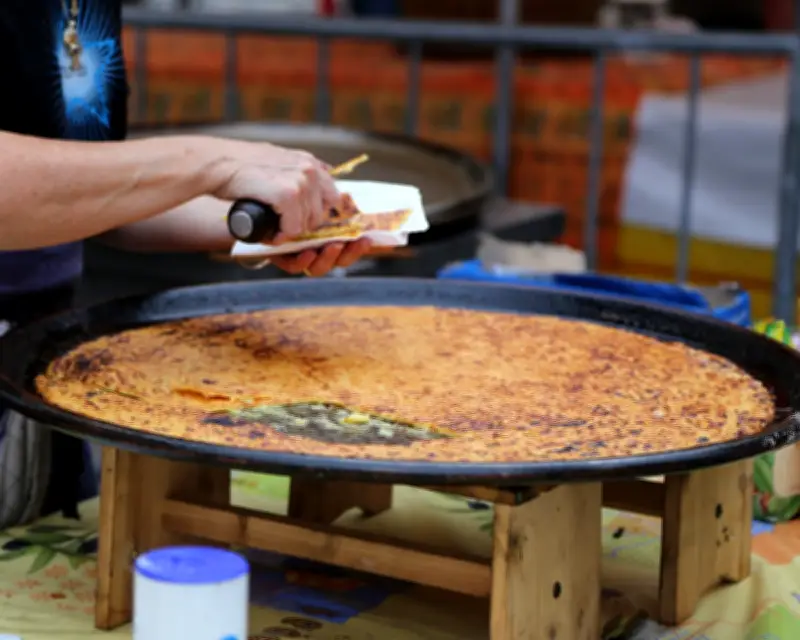
A simple street food made from chickpea flour, water, and olive oil appears across the Mediterranean under different names, serving as edible evidence of a shared regional identity that transcends modern borders. Tracing the Tyrrhenian coast from Italy to North Africa and up to the French Riviera, this humble batter unites diverse societies in a culinary tradition that predates contemporary geopolitical divisions.
From Pisa to Livorno: Cecina and the 5 e 5
In Tuscany, the dish is called cecina. At Pizzeria Il Montino in Pisa, crowds queue not for pizza but for this golden pancake, baked in a wood oven and served with black pepper. A few miles south in Livorno, the same dish is known as "5 e 5" (cinque e cinque), named for its historical price of five lire for bread and five for the pancake. There, it is served as a sandwich filling in a round loaf, sometimes with marinated aubergine, garlic, and chilli flakes. The two cities fiercely dispute which invented the recipe, reflecting a rivalry that extends beyond food.
Ligurian Farinata and Its Legend
In Liguria, the chickpea pancake becomes farinata. According to legend, it was accidentally invented during the Battle of Meloria in 1284. After Genoa defeated Pisa, a storm at sea caused barrels of oil and chickpea flour to spill and mix with salt water. The sailors let the mixture dry in the sun and found it delicious. This version is oven-baked and remains a staple of Genoese street food.
Island Variations: Sardinia and Sicily
In Sardinia, particularly around Sassari, the dish takes the Genoese dialectal name fainè. Sardinians often add dried sausage and onions. In Sicily, the recipe is deep-fried to create panelle, which are stuffed into soft sesame rolls to make pane e panelle. This crunchier version is best served with lemon juice to cut through the oil.
North African Adaptations: Karantika and Kalinti
Crossing to North Africa, in Oran, Algeria, karantika emerged under Spanish influence. Unlike the Italian versions, the batter includes eggs and milk, baked at high heat to produce a creamy interior and crusty exterior. In Tangier, Morocco, the dish is called kalinti, prepared similarly and served hot with salt and cumin. According to Federico De Blasi, an Italian food writer based in Barcelona, these variations demonstrate the deep cultural exchanges across the Mediterranean.
France: Panisse, Cade, and Socca
In Marseille, the batter is known as panisse, introduced by Italian immigrants in the 19th century. Chez Magali, a kiosk in the L'Estaque neighbourhood, still serves fried, thick panisses meant to be eaten by the sea. In Toulon, the same dish is called cade, baked in a wood-fired oven. Finally, in Nice, it becomes socca, poured thinner to create crispy edges and a roasted surface, heavily seasoned with pepper.
Historical Context and Modern Borders
De Blasi notes that migration has been the historical norm across the Mediterranean. By the 1950s, 40% of Marseille's population was Italian, explaining the strong influence of Italian cuisine. The Mucem Museum in Marseille argues that for most of human history, traveling by sea between Mediterranean ports was easier than going inland. The sea was a highway, not a barrier. The chickpea trail, he says, is "edible proof" of this ancient network. "Whether it’s a peppery socca in Nice, a kalinti in Tangier, or a slice of cecina in a Pisan alley, you are tasting the exact same impulse," he writes. "Long after modern frontiers were formed, this simple batter of chickpea and oil is a living reminder that these shores have a single, frontier soul."




