
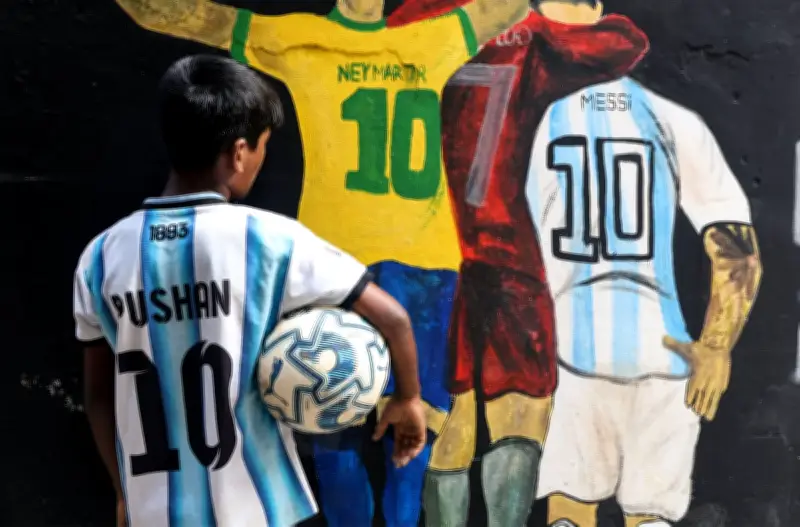
The 2026 World Cup final saw fans worldwide adopting temporary national identities, challenging traditional notions of nationalism. According to Jonathan Liew, a Guardian columnist, the tournament demonstrated the increasing fragility of nationhood as an idea, with allegiance becoming a disposable consumer brand.
Global Fanbase and Temporary Identities
At the MetLife Stadium in New Jersey, the crowd was overwhelmingly American, with figures like Mike Tyson in an Argentina shirt and Trevor Noah in a Spain shirt. Ticket sales data indicated that most attendees were locals, turning the final into a grand cosplay for the New Jersey leisure market.
Beyond the final, entire nations embraced foreign teams: Bangladesh went crazy for Argentina, central Asian friends in London cheered for Uzbekistan, and the Arab diaspora supported Morocco and Egypt. This upends the view of the World Cup as a playground for nationalism, instead showing the disposability of national identity.
The Fragility of Nationhood
Social psychologist Michael Billig's concept of banal nationalism—subliminal symbols of nationhood—has become so banal as to be disposable. Liew notes that if national identity can be slipped on and off like a football shirt, its value is questionable.
Forty of the 48 competing nations had a player born overseas. Only one member of the Curaçao squad was born on the island. Cape Verde's squad, which held Spain to a 0-0 draw, featured more players born in Rotterdam than in the country's capital.
Multiple Identities and Globalisation
The modern World Cup forces us to confront multiple identities cutting across national boundaries. Historian Eric Hobsbawm's quote about football gestating an 'imagined community of millions' takes on new meaning when that community has no defined borders.
This phenomenon is not exclusively left- or right-coded. Rightwing agitators may pledge allegiance to Donald Trump or wave an Israeli flag rather than champion their own country. The Trump administration showed greater solidarity with white South Africans than with Black Americans.
Football's Limited Role as Nation Builder
Football's role in nation-building is often overstated. France's 1998 World Cup win was hailed as a vindication of multiethnic identity, but four years later Jean-Marie Le Pen reached the presidential runoff. Argentina's 1978 victory boosted the dictatorship's popularity, but it collapsed by 1983. England's run to the Euro 2021 final did not arrest the descent into culture war.
Liew concludes that the World Cup reflects a messy hope: a world of hardening physical borders is doomed to disintegrate on contact with reality. Nationality is ultimately a brand, a consumer choice, a mask worn for six weeks and shed just as easily.




